- Removal of basic customs duty on scrap boosts its imports
- Capacity expansions by key cable makers drive scrap demand
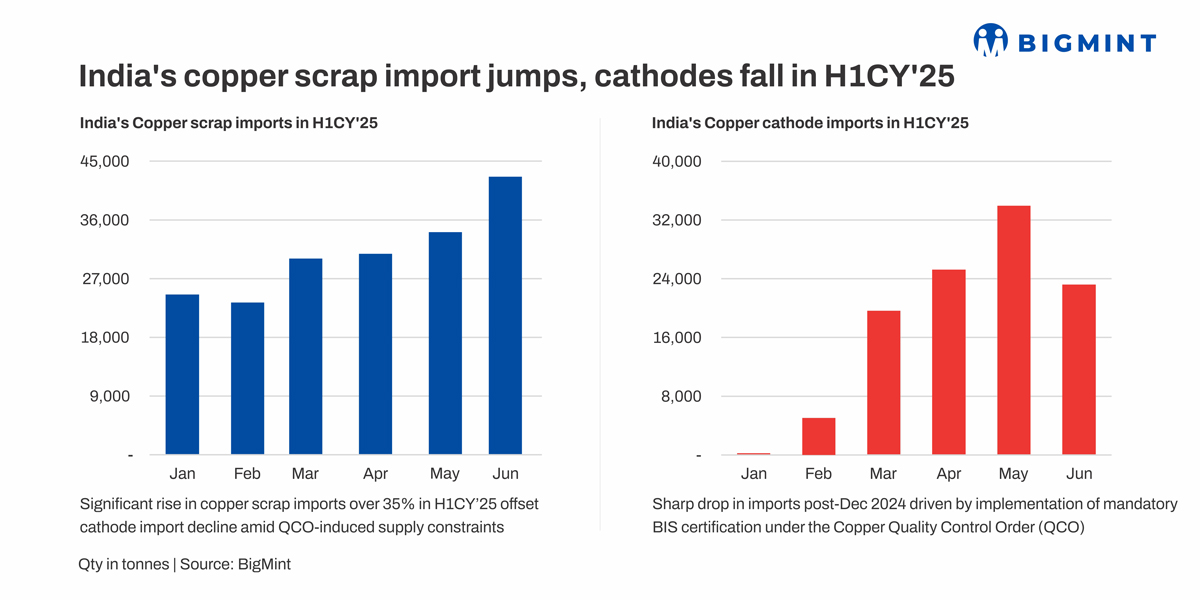
India’s copper scrap imports rose sharply by 37% y-o-y in H1CY’25, totalling 185,543 tonnes (t). Imports steadily climbed up m-o-m, with the highest volume seen in June, which received 42,621 t, marking a 25% jump from January levels.
At the same time, India’s copper cathode imports stood at 107,237 t in H1CY’25, marking a 26% y-o-y decline. Although imports rose steadily from February to May, they failed to match last year’s levels. May saw the highest inflow at 33,965 t, before volumes eased again in June.
India’s copper production rose by 11.4% y-o-y to 205,000 t in Jan-Apr’25 from 184,000 t a year earlier. Meanwhile, refined copper (cathode) imports fell 26% in H1CY’25.
How were LME prices in H1CY’25?
In January-June 2024, LME copper cash prices generally averaged around $9,200-9,600/t, with values fluctuating in the low $9,000 range for most of the period. In contrast, for the same period in 2025, copper prices showed a notable increase, with monthly averages predominantly in the range of $8,700/t to nearly $9,800/t, reflecting higher volatility but overall a modest uptrend due to supply constraints and rising demand in key markets.
Copper QCO curtails cathode imports
The key reason behind the decline in cathode imports is the implementation of the Copper (Quality Control) Order (QCO), effective from 1 December 2024. This order mandates both domestic and foreign suppliers to obtain certification from the Bureau of Indian Standards (BIS) to ensure quality and safety, with the aim of eliminating substandard copper cathode imports. Initially, this created compliance challenges and delays, particularly for major foreign suppliers such as Japanese smelters, which provide roughly two-thirds of India’s refined copper imports.
By mid-2025, several major suppliers have either initiated or completed BIS registration, but some uncertainty remains around approvals for newer grades and mills, limiting the full resumption of refined copper trade flows.
Limited cathode supply, duty removal boosts scrap imports
The sharp rise in copper scrap imports is closely linked to the cathode import disruption caused by the QCO. With restrictions and delays on cathode availability, Indian manufacturers increasingly turned to copper scrap as an alternative feedstock, which was more readily available and competitively priced.
Another key reason for the surge in scrap imports is the removal of basic customs duty on non-ferrous scrap in the Union Budget 2025-26, improving landed cost economics — especially for high-grade shipments from the US and Europe. Simultaneously, capacity expansions by major cable makers such as Polycab, RR Kabel, and KEI drove up demand for clean copper scrap.
However, the rapid growth in scrap inflows has also put pressure on domestic smelters and refiners, with some reporting challenges in processing mixed grades efficiently, especially under tighter quality monitoring post-QCO implementation.
How did India’s scrap import mix evolve?
India’s copper scrap import mix in H1CY’25 reveals a clear shift towards higher-yielding and versatile grades. Brass Honey remained the dominant grade by volume at 59,481 t, up 23% y-o-y, while Druid surged 51% y-o-y to 47,951 t, reflecting strong demand from refiners using ISI-grade wire applications. Birch and Berry imports also rose significantly, by 45% and 71%, respectively, indicating increased appetite for high-copper-content scrap despite pricing challenges. Barley showed only a modest rise of 8%.

Additionally, Millberry witnessed imports of around 17,500 t in H1CY’25, a rise of over 70% as against 10,200 t in H1’CY24. With a purity level close to that of pure copper cathodes (typically between 97% and 99.9%), Millberry can effectively substitute copper cathodes in many industrial applications. As a result, it serves as a cost-effective and sustainable alternative to imported copper cathodes, especially when regulatory or supply constraints limit cathode availability.
Who was India’s top scrap supplier?
The US supplied the highest share of India’s scrap imports in H1CY’25, with 30,600 t, a rise of 75% y-o-y. This can be directly related to the US’s position as the world’s largest exporter of copper scrap and the structural dynamics of its market. The US generates substantial volumes of copper scrap but has limited domestic refining capacity, which leads to it exporting a significant share of this volume worldwide. India, being the largest global importer of copper scrap, sources a major portion of its imports from the US.

Outlook
In the near term, copper scrap imports are expected to continue with strong momentum as Indian buyers prioritise flexibility and cost-efficiency. As more cathode suppliers obtain BIS certification and domestic production stabilises, the market may rebalance gradually in late 2025, though scrap will likely remain a core input for many refiners.
Leave a Reply