- Australia retains top slot; Russia, US shipments up
- SAIL, JSW Steel, Tata Steel boost quarterly intake
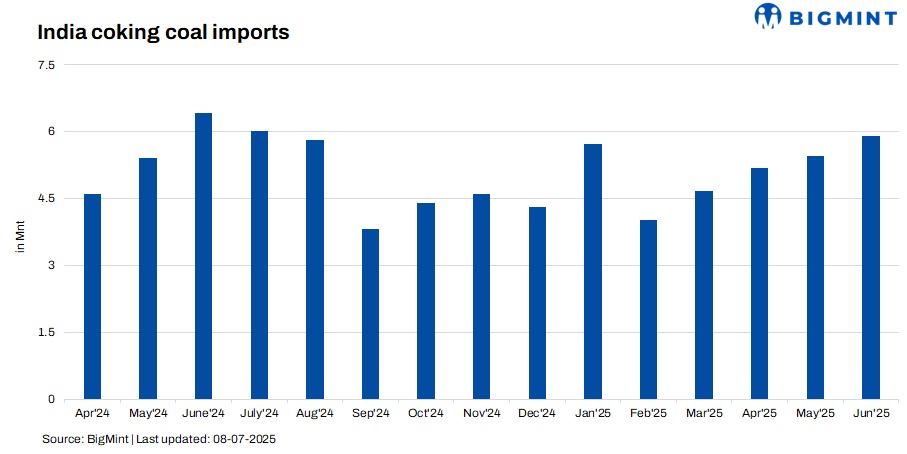
India’s coking coal imports totalled 16.5 million tonnes (mnt) in April-June, 2025 (Q1FY’26), up 6% from 15.5 mnt in Q1FY’25, as per BigMint data. The increase was driven by higher shipments from Australia and Russia. Imports rose by 11% m-o-m to 6 mnt in June 2025 from 5.4 mnt in May, mainly due to Australia’s higher shipments of 3.6 mnt, up 44% m-o-m. The rise in coking coal imports this quarter was largely driven by mills efforts to build buffer stocks ahead of the monsoon. Buyers also moved quickly to secure shipments amid concerns over potential supply tightness and firm prices in the global market.
Australia remains top exporter to India
Australia retained its top spot in Q1FY’26 with total exports of 8.6 mnt, stable compared to the same period last year. Russia’s shipments grew by 43% y-o-y to 3 mnt from 2.1 mnt in Q1FY’25, reflecting increased sourcing amid competitive prices. The US sent 2.3 mnt, up 9.5% from 2.1 mnt last year, while Mozambique contributed 1.2 mnt, slightly higher than 1.1 mnt earlier. Imports from Indonesia increased by 29% y-o-y to 0.9 mnt, and Canada’s volumes were stable at 0.5 mnt.
JSW import up 19%
JSW Steel was the top buyer with 3.7 mnt in Q1FY’26, up 19% y-o-y from 3.1 mnt. SAIL took 3.2 mnt, down 27% from 4.4 mnt. Tata Steel’s intake rose 14% to 2.5 mnt from 2.2 mnt. RINL imported 1.4 mnt, up 40% from 1 mnt. Jindal Steel stayed flat at 0.8 mnt, while NMDC’s rose to 0.7 mnt, up 75% from 0.4 mnt.
Latest price trends
Metallurgical coke prices stayed firm this week, with BigMint’s assessment of the 25-90-mm BF grade at INR 28,000/t ex-Jajpur and INR 29,000/t exw-Gandhidham. Market sentiment was cautiously positive as the government extended import quotas on LAM coke until December 2025, aiming to support local producers. Meanwhile, Australian PHCC prices edged up $9/t w-o-w to $183/t FOB, though Chinese coke prices held flat amid weak steel margins and limited plant utilisation.

Leave a Reply