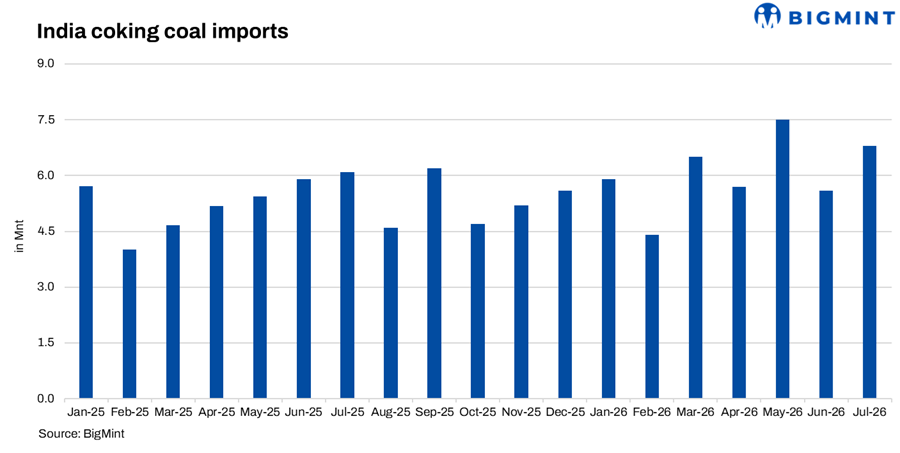
- Imports rise 21% m-o-m on higher arrivals
- Russia shipments surge, while Australia remains largest supplier
India’s coking coal imports increased 21% m-o-m to 6.8 mnt in July 2026 from 5.6 mnt in June, as higher arrivals from Australia and Russia lifted overall volumes. Imports were also 11% higher y-o-y than 6.1 mnt in July 2025. The increase followed a sharp decline in June, when imports had fallen 25% m-o-m, and largely reflected higher cargo arrivals rather than a broad recovery in fresh buying. Indian steel mills remained cautious amid weak steel prices, while lower coking coal prices during July improved import economics.
Australia remains largest supplier
Australia remained India’s largest source of coking coal in July, with shipments rising 16.7% m-o-m to 3.5 mnt from 3.0 mnt in June. However, July imports from Australia were 7.9% lower y-o-y than 3.8 mnt in July 2025.
Russia recorded the strongest monthly increase among major suppliers, with imports rising 50% m-o-m to 1.8 mnt from 1.2 mnt. The July volume was also three times higher than the 0.6 mnt imported in July 2025.
US-origin imports remained stable at 0.7 mnt m-o-m, but were higher than 0.5 mnt a year earlier. Mozambique shipments increased to 0.6 mnt from 0.5 mnt in June and remained unchanged y-o-y. Indonesian volumes stayed at around 0.1 mnt.
The changing supplier mix indicated continued diversification away from Australia, particularly towards Russian material, although Australia still accounted for more than half of total July imports.
JSW Steel leads July arrivals
Among major receivers, JSW Steel recorded the largest increase, with coking coal imports rising to 2.3 mnt in July from 1.3 mnt in June. SAIL also increased imports to 1.7 mnt from 1.1 mnt, while Tata Steel’s receipts declined to 1.1 mnt from 1.4 mnt.
Jindal Steel & Power increased imports to 0.5 mnt from 0.3 mnt, while NMDC’s receipts declined to 0.2 mnt from 0.3 mnt. RINL’s imports also eased to 0.1 mnt from 0.2 mnt.
Compared with July 2025, JSW Steel’s imports increased from 1.4 mnt to 2.3 mnt, while SAIL rose from 1.2 mnt to 1.7 mnt. Tata Steel also recorded higher imports than the 1.0 mnt received in July 2025.
The higher receipts by major steelmakers suggest that July imports were supported partly by cargoes booked earlier, rather than indicating a uniform improvement in spot procurement appetite.
Lower prices improve import economics
Import activity in July coincided with a significant correction in coking coal prices. BigMint’s PHCC CNF Paradip index averaged $250/t in July 2026, down from $268/t in June and closer to the $243/t assessed on 24 July.
The decline followed lower demand from China, cautious Indian mill buying and lower Australian FOB indications. By late July, market participants reported unsold cargoes at ports and reduced buying interest from Indian mills.
Australia-India Panamax freight also remained relatively manageable through much of July, although rates firmed during parts of the month on active Australian fixtures and tighter prompt tonnage. This provided some support to delivered costs but did not offset the broader decline in coking coal prices.
Imports rise despite cautious steel market
The July increase in imports therefore appeared to reflect a combination of higher cargo arrivals, supplier diversification and improved import economics, rather than a strong recovery in Indian steel demand.
The contrast between higher July arrivals and weaker market sentiment was particularly evident in June, when imports had dropped to 5.6 mnt despite Australia remaining the largest supplier. The subsequent rebound suggests that previously booked cargoes continued arriving in July as mills maintained their procurement programmes.
At the same time, weaker steel prices continued to limit aggressive fresh bookings. Market participants expected coking coal prices to remain under pressure as Indian mills stayed selective and Chinese buying remained less aggressive.
Outlook
Coking coal imports could remain volatile in the coming months, with shipment volumes influenced by previously booked cargoes, steel mill inventory positions and relative pricing between Australian and alternative origins. A sustained recovery in steel demand would be required for higher imports to translate into stronger fresh procurement.
Leave a Reply