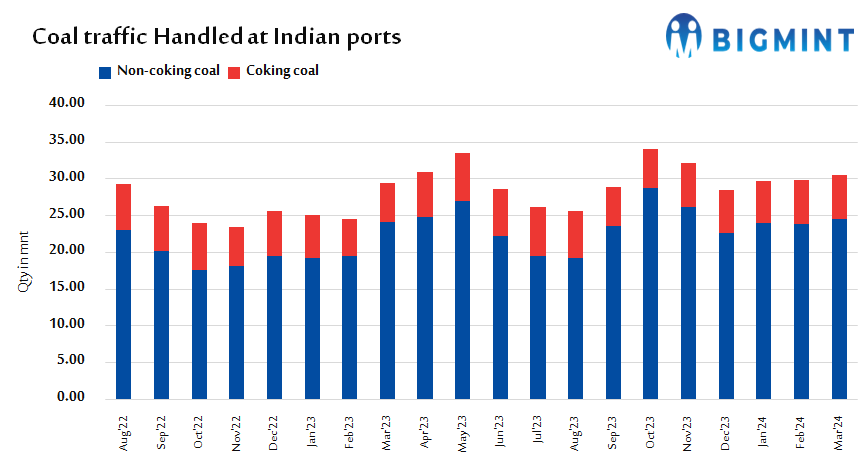
*Dhamra port records the highest number of coking coal vessels in March 2024
Total coal traffic (including coking and non-coking) handled at Indian ports stood at 30.52 million tonnes (mnt) in March 2024, up by 2% m-o-m from 29.79 mnt in February 2024, as per BigMint data.

Note: Port traffic refers to shipments via imports, exports, and coastal movement between different ports in India.
Why coal traffic increased in March?
Increase in import volumes
India’s coking coal imports in March 2024 increased by 14% to 5.22 mnt as against 4.56 mnt in February 2024. Australia emerged as the top country in exporting coking coal to India at 3.23 mnt in March 2024 as against 2.44 mnt in February 2024 followed by the US, down by 23% to 0.61 mnt as against 0.79 mnt. The rise in coking coal import volumes can be attributed to the decline in coking coal prices. Additionally, non-coking coal import volumes also increased due to a surge in power demand resulting from the onset of summer.
Key ports handling thermal coal

As per BigMint data, thermal coal traffic at Paradip port was recorded at 4.20 mnt in March 2024, increased by 9% m-o-m against 3.84 mnt in February 2024. Mundra port handled 2.74 mnt and Krishnapatnam 3.19 mnt. Port traffic at Tuticorin (up by 4%) and Gangavaram (down by 19%) were recorded at 1.73 mnt and 0.93 mnt respectively in March 2024.
Key Ports handling coking coal

Dhamra port recorded the highest number of coking coal vessels in March 2024, carrying 1.09 mnt, followed by Paradip (down by 32%) at 1.04 mnt. Traffic at Haldia port increased by 7% to 0.89 mnt in March 2024 as against 0.83 mnt in February 2024. Vizag and Jaigad ports surged by 38% and 53% in March 2024 to 0.60 mnt and 0.53 mnt, respectively.
Outlook
As summer approaches, India’s demand for non-coking coal is anticipated to increase, potentially resulting in a rise in imports and subsequent coal traffic at ports. However, the prevailing subdued demand and the upcoming general elections in India could impact the coal traffic for coking coal in the coming months. Additionally, supply constraints from major coal-exporting countries to India, such as Australia and Indonesia, are expected to ease due to the end of the rainy season, further supporting an increase in India’s imports.