- Pithead stocks shrink from 152 mnt in end-Mar’26 to 85 mnt by end-Aug
- CIL’s production recovery in Sep could ease pressure on mine-end inventories
India’s coal supply chain leaned heavily on accumulated pithead inventories during August 2026 as monsoon-affected production failed to keep pace with dispatches.
Domestic production stood at 66.87 million tonnes (mnt), down 3.8% y-o-y from 69.48 mnt and 4.1% below July’s 69.75 mnt. Dispatches, however, reached 81.87 mnt, 5.5% above August 2025, although lower than July.
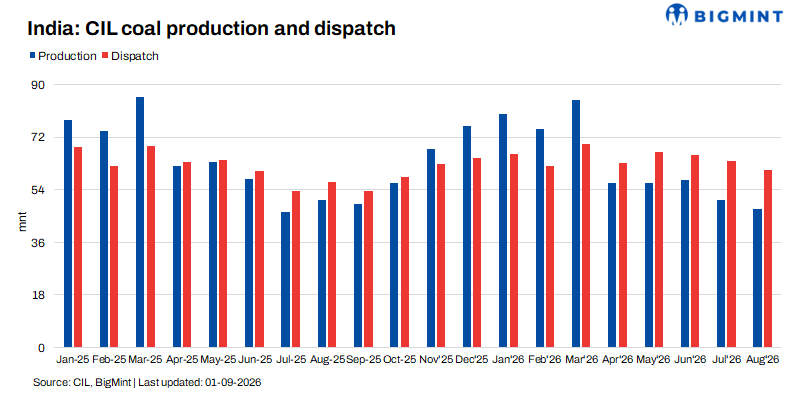
The roughly 15 mnt gap between August production and dispatches was effectively met by drawing down coal accumulated at mine pitheads — continuing a trend visible since the beginning of FY’27.
CIL drives Aug’26 production decline

CIL bore the brunt of the decline. Its production fell to 47.52 mnt, achieving only 90.4% of its August target. NCL output dropped 24.8% y-o-y, while MCL and SECL fell around 10% each. In contrast, ECL, WCL and CCL recorded strong y-o-y increases.
The Ministry of Coal attributed the weakness to prolonged July-August rainfall, particularly across east-central mining regions, which affected mine conditions and coal handling.
Dispatches outperform production
Despite lower production, coal movement remained relatively resilient.
CIL dispatched 60.58 mnt, up 5.5% y-o-y, despite producing only 47.52 mnt. Total Indian dispatches reached 81.87 mnt, against production of 66.87 mnt.
Power remained the dominant destination, receiving 65.63 mnt, around 80% of total dispatches and 3.7% higher y-o-y. Non-regulated-sector supplies rose 13.2% to 16.23 mnt. CIL alone supplied 48.46 mnt to the power sector in August, up 4.5% y-o-y.
Pithead stocks provide buffer
India entered FY’27 with 151.96 mnt of pithead stocks — 129.97 Mnt with CIL, 5.06 mnt with SCCL, and 16.93 mnt with captive/commercial producers.
Since then, stocks have fallen steadily as dispatches repeatedly exceeded fresh production.

March is officially reported. Subsequent figures are BigMint reconstructed/implied stocks based on production and dispatch, except CIL’s end-August figure of around 76 mnt, which was reported by the Ministry. Reconstructed inventories can differ from physical stocks because of adjustments, transfers, and reporting timing.
The implication is significant: India’s mine-end coal buffer has fallen by roughly 67 mnt, or 44%, in five months.
CIL accounts for most of the drawdown, with stocks falling from nearly 130 mnt to around 76 mnt. But SCCL and captive/commercial inventories have also declined substantially.
This explains how coal dispatches could remain strong despite weaker monsoon production: India has been converting its pre-monsoon pithead stockpile into consumer supplies.
Railways keep coal moving
Rail evacuation also remained relatively resilient.
CIL subsidiaries averaged around 304.8 rakes/day across all sectors in August, against 314.3 in July and 283.7 in August 2025 — down 3% m-o-m but up around 7% y-o-y.
For the power sector, loading averaged 280.2 rakes/day, against 287.4 in July. MCL led with 95.1 power-sector rakes/day, followed by SECL at 42.4 and CCL at 39.7.
The combination of relatively strong rail evacuation and available pithead inventories therefore cushioned consumers from the full impact of weaker August mine output.
CIL’s production begins to recover in Sep
The early September trend is encouraging.
As rainfall receded, CIL’s daily production increased from an average 1.36 mnt/day during 1-3 September to 1.83 mnt on 6 September, while power-sector dispatches increased from 1.37 mnt/day to around 1.70 mnt.
By 1-16 September, CIL’s production had reached around 27.94 mnt, up 8% y-o-y and slightly above its month-to-date target, with daily production approaching 2 mnt by mid-month.
The recovery is important because the supply equation has changed materially since March.
During the monsoon, India’s coal producers successfully maintained dispatches by drawing on exceptionally large pithead inventories. That strategy helped protect consumers but reduced the mine-end buffer from around 152 mnt to approximately 85 mnt.
As the monsoon withdraws, the critical relationship therefore becomes production versus dispatch.
If CIL’s September production recovery strengthens and mine output begins catching up with evacuation, the five-month pithead inventory drawdown should slow and eventually reverse.
August’s message is therefore not simply that coal production fell. It is that India’s coal supply chain successfully used its pre-monsoon stockpile to sustain dispatches through the rains — but consumed roughly 44% of that buffer in the process.
Leave a Reply