- Average daily maximum demand rises 17% y-o-y during 1-20 September, reaching a peak of 269.1 GW
- Coal supplies 76% of incremental generation as hydro output declines 15.4%
- Demand moderation later in the month sharply reduces power shortages despite lower coal inventories
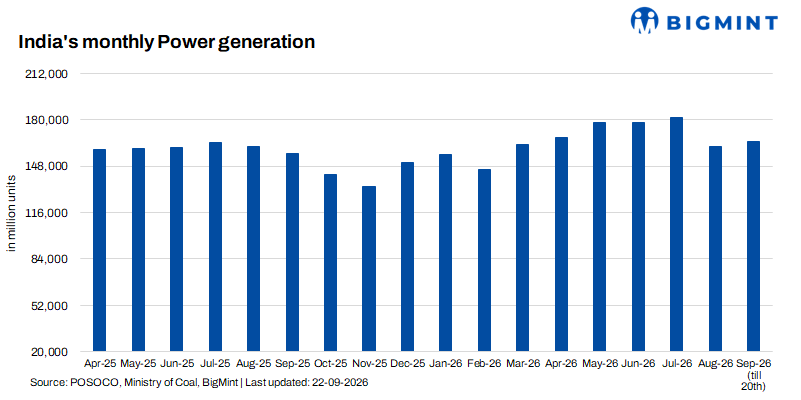
India’s electricity system came under significant pressure during the first half of September as average daily maximum demand during 1-20 September increased around 17% year on year to 251.8 GW, while total electricity generation rose 14.4%. Coal-fired power plants supplied the bulk of the additional electricity as weaker hydropower generation increased reliance on dispatchable sources. Grid conditions, however, improved sharply during the second half of the month after demand retreated from an early-September peak of 269.1 GW, allowing reported energy shortages to fall to almost negligible levels.
The sequence illustrates how India’s power system responded to one of its strongest demand periods of the year. Higher renewable generation contributed significantly to meeting incremental demand, but lower hydro output required coal to absorb most of the additional load. The resulting increase in thermal generation tightened coal inventories and coincided with regional power shortages before moderating demand eased pressure on the grid.
Demand surged while coal carried most of the additional load
Average daily maximum demand during 1-20 September stood at approximately 251.8 GW, compared with 215.3 GW during the corresponding period of 2025, an increase of around 36.5 GW. National demand reached 269.1 GW on 10 September, before gradually declining towards 230 GW by 20 September.
Overall electricity generation increased 14.4%, but the composition of incremental supply was heavily skewed towards coal. Coal-fired generation rose by 11.25 TWh, accounting for approximately 76% of the total year-on-year increase in electricity generation. Coal’s share of the generation mix consequently increased from 63% to 64.6%.
Renewable energy generation also expanded strongly. Output increased from 15.36 TWh to 19.47 TWh, up 26.7% year on year, lifting its contribution to the generation mix from 14.9% to 16.5%. Rather than replacing coal, renewable generation expanded alongside thermal generation as the system responded to substantially higher electricity demand.
The timing of demand also shifted. During September 2025, daily peak demand generally occurred during evening hours. Between 16 and 19 September, maximum demand occurred at around 3 pm, allowing solar generation to contribute directly during periods of highest system load.
Hydro decline increased dependence on dispatchable generation
Hydropower provided the principal counterweight to higher coal and renewable output. Hydro generation declined from 16.71 TWh during 1-20 September 2025 to 14.14 TWh this year, a reduction of 15.4%, lowering its share of the generation mix from 16.2% to 12%. The decline created a 2.57 TWh generation gap relative to the previous year at a time when electricity demand had increased sharply.

Gas, naphtha and diesel-fired generation increased around 60%, while nuclear generation rose nearly 36%, indicating that the system relied on virtually every available dispatchable source to meet demand.
Grid shortages emerged as demand approached 270 GW
The increase in generation did not entirely eliminate supply stress as the power system experienced its most severe shortages between 9 and 12 September, when national demand consistently exceeded 260 GW. On 9 September, demand reached 267.9 GW, while reported maximum-demand shortage stood at 6,777 MW and energy shortage reached 51.40 MU. On 10 September, demand increased further to 269.1 GW, with maximum-demand shortage remaining elevated at 5,281 MW and energy shortage at 46.72 MU.
The shortages were concentrated in specific regions rather than being evenly distributed nationwide. Northern India accounted for the largest share of unmet energy demand. On 10 September, the region recorded approximately 28.25 MU of the national 46.72 MU energy shortage. Haryana reported 12.29 MU, Punjab 8.28 MU and Rajasthan 4.99 MU, while Uttar Pradesh also experienced maximum-demand shortages.
Southern India also experienced significant supply pressure. On 9 September, the region recorded approximately 21.89 MU of energy shortage together with a maximum-demand shortage of 3,827 MW. The regional pattern broadly coincided with declining coal inventories at several thermal utilities. By 20 September, Haryana’s HPGCL held only 13% of normative coal stocks, Rajasthan’s RRVUNL 12%, Andhra Pradesh’s APGENCO 12%, and Karnataka’s KPCL around 22%. Coal availability alone should not be interpreted as the direct cause of reported shortages, as generation outages, transmission constraints and procurement decisions also influence supply adequacy.
Demand moderation restored system balance
Grid conditions improved rapidly as demand retreated from the early-September peak. Maximum demand declined to 244.4 GW on 14 September, 245.9 GW on 17 September, 242.3 GW on 18 September, and 229.9 GW on 20 September. Reported energy shortages fell accordingly.
By 18 September, the all-India energy shortage had declined to just 0.69 MU, while maximum-demand shortage was only 30 MW, entirely within the North Eastern region. The data indicate that the grid was capable of meeting virtually all reported demand once the exceptional pressure experienced earlier in the month subsided.
Outlook
The moderation in electricity demand shifts attention from generation adequacy towards replenishing coal inventories depleted during the first half of September.
If maximum demand remains within the 230-250 GW range, lower thermal generation requirements should allow coal receipts to exceed consumption, gradually rebuilding stocks at power plants. A renewed increase towards 260-270 GW, particularly if hydro generation remains weak, would again increase reliance on coal-fired generation and narrow operational buffers across parts of the grid.
September demonstrated that India’s power system was able to meet a sharp increase in electricity demand by expanding generation across coal, renewable energy, gas and nuclear sources. It also highlighted that coal remains the principal balancing fuel during periods of elevated demand, with changes in thermal generation continuing to determine both inventory levels and the resilience of the power system during demand spikes.
Leave a Reply