Coal imports up on cement, steel sector demand
Imports from Indonesia up by 32% m-o-m
Coal vessel arrivals at Indian ports rose by 9% m-o-m in the first half of February 2024 (1-16 January) to 10.77 million tonnes (mnt) as against 9.92 mnt in the first half of January, BigMint’s vessel line-up data show.
State-run miner Coal India Ltd (CIL) continued its robust performance in terms of production in January. CIL’s production rose by 9.1% y-o-y to 78.4 mnt in January as against 71.9 mnt in January 2023. Notably, the company’s total production in FY’24 (April- January) recorded at 610.3 mnt, an increase of 10.8% as against 550.9 mnt in FY’23 (April-January).
Indonesian coal imports

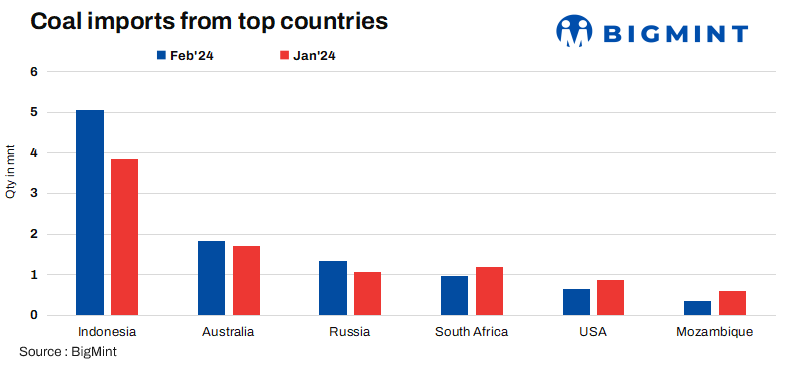
Out of the total imports in the first half of February 2024, volumes of Indonesian coal were the highest at 5.05 mnt. Some major trading companies that bought Indonesian coal were Adani Enterprises (0.89 mnt) and Adani Power (0.87 mnt). About 3.16 mnt are expected to be imported in the second half of this month.
Shipments from Indonesia were recorded at 5.05 mnt in the period under review, an increase of 32% m-o-m as against 3.84 mnt in the same period in January 2024. Imports from Indonesia rose as the Lunar New Year holidays in China halted purchases, diverting material to India. The disruption in Chinese buying prompted a shift in trade patterns, benefiting Indian markets. Furthermore, increased imports were facilitated by miners obtaining RKAB approval, contributing to a rise in supply.
Australian coal imports

India’s imports of Australian coal were recorded at 1.84 mnt. Tata Steel was the top buyer at 0.72 mnt followed by SAIL at 0.43 mnt respectively. About 1.04 mnt of Australian coal are expected to arrive at Indian ports in the second half of February.
Imports rose amid improved demand from the steel sector buoyed by falling prices. Prices of PHCC dropped 4% m-o-m to $333.44/t in February as against $348.01/t. Moreover, all ports are presently operating without disruptions, easing previous supply constraints exacerbated by maintenance shutdowns at Abbot Point, Hay Point, and Port Kembla in January.
South African coal shipments drop

During the period under review, South Africa’s shipments totalled 0.96 mnt, showing a 20% m-o-m drop compared to 1.19 mnt in January. JSW Steel emerged as the leading importer, accounting for 0.21 mnt. Although there has been a slight uptick in buyers’ interest in South African-origin coal lately, driven by attractive prices and increased enquiries from industries like cement and steel, the overall demand for India’s thermal coal on the spot market has remained sluggish. This is primarily due to the presence of sufficient level of domestic stocks.
Thermal coal stocks across 21 Indian ports rise by 5% w-o-w on 21 February, 2024, according to BigMint data. During week 7 of 2024, thermal coal stocks at Indian ports stood at 14.16 million tonnes (mnt) compared to 13.50 mnt in week 6, reflecting an increase of 5% w-o-w.
Despite slow demand, transactions are still occurring. However, buyers who typically relied on seaborne supplies are now showing a preference for domestic coal. According to an India-based trader, this shift in preference towards domestic supplies is notable, indicating that while there is an improvement in demand, buyers are increasingly favouring domestic coal over imported options. About 1.26 mnt of thermal coal are expected to be shipped in the second half of this month from South Africa.
Other exporters
Shipments from the US dropped 26% to 0.64 mnt in the period under review compared to 0.87 mnt in the first half of January. Shipments from Russia recorded a rise of 25% to 1.34 mnt compared with 1.07 mnt in the same period in January 2024.
Outlook
Imports of South African coal are expected to increase in the near future due to improved demand, spurred by competitive prices and heightened enquiries from cement and steel sectors. Additionally, Australian ports are currently functioning normally without disruptions, alleviating prior supply constraints exacerbated by maintenance shutdowns at key ports. These factors may exert upward pressure on coal imports.