- Coal production drops 5.7% y-o-y in August
- Dispatch growth may hasten inventory drawdowns
Coal India Ltd (CIL) recorded coal production of 47.5 million tonnes (mnt) in August 2026, declining 6% month-on-month (m-o-m) from 50.4 mnt in July and 5.7% year-on-year (y-o-y) from 50.4 mnt in August 2025.
The decline indicates a moderation in mining activity during the monsoon period, when persistent rainfall and adverse ground conditions typically affect mining, overburden removal, coal extraction and transportation operations.
NCL and SECL lead production decline
Among CIL’s major subsidiaries, NCL’s production fell 22% m-o-m to 8.5 mnt, while SECL declined 14% to 9.9 mnt. CCL production also decreased 5% to 5.6 mnt and BCCL declined 12% to 2.2 mnt.
MCL, however, delivered a stronger performance, with production rising 8.4% m-o-m to 14.2 mnt, while WCL increased 17.2% to 3.4 mnt and ECL rose 2.8% to 3.7 mnt. Despite these pockets of growth, the decline at some of CIL’s larger producing subsidiaries was sufficient to pull total August production lower.
Dispatches remain resilient
CIL’s dispatch performance was comparatively stronger, with total dispatch at 60.6 mnt in August 2026, down 5% m-o-m from 63.7 mnt but up 5.5% y-o-y from 57.4 mnt. The stronger annual performance suggests that CIL continued to prioritise supplies to consumers despite the seasonal reduction in production. Dispatch was supported by higher movement from ECL, CCL, WCL, SECL and MCL, which helped offset weaker volumes from NCL and BCCL.
The divergence between production and dispatch also indicates that CIL continued to utilise available inventories and maintain consumer supplies even as fresh production was affected by monsoon-related operational constraints. This remains particularly relevant for the power sector, where coal availability and timely deliveries remain critical during periods of elevated generation requirements.
Production drops 5% in Apr-Aug’26; dispatches up 7% y-o-y
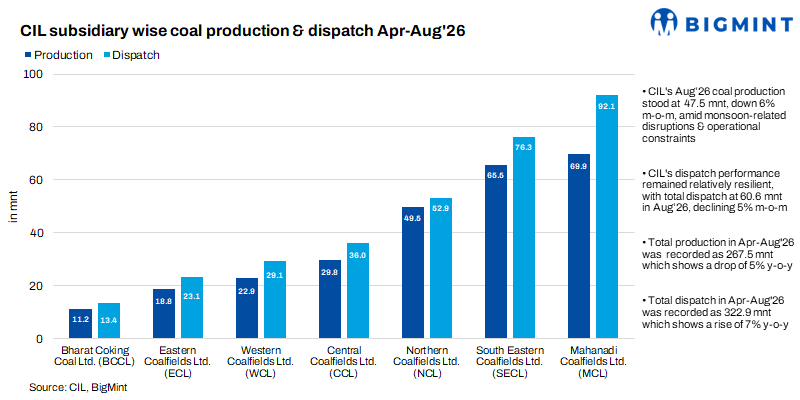
On a cumulative basis for April-August 2026, CIL produced 267.5 mnt, down 5% y-o-y from 280.2 mnt during the corresponding period of FY2025-26. The production shortfall reflects the weaker performance during the opening months of the fiscal year as well as the impact of seasonal disruptions during the monsoon.
In contrast, cumulative dispatches during April-August 2026 stood at 322.9 mnt, representing a 7% y-o-y increase from 302.6 mnt. The stronger dispatch growth despite lower cumulative production highlights CIL’s continued focus on meeting consumer requirements through higher offtake and inventory utilisation.
MCL and SECL provide support, NCL remains a drag
At the subsidiary level, cumulative production trends remain mixed. SECL’s April-August production increased 6% y-o-y to 65.5 mnt, while ECL and CCL recorded growth of 11% and 19%, respectively. WCL was broadly stable, increasing 1.3%.
On the other hand, MCL’s cumulative production declined 15% to 69.9 mnt, while NCL registered a 15% decline to 49.5 mnt and BCCL fell 18% to 11.2 mnt. Thus, the overall production deficit is being driven primarily by weaker output from some of CIL’s major producing subsidiaries, despite robust gains from ECL and CCL.
The dispatch picture is healthier, with cumulative dispatch from MCL at 92.1 mnt, SECL at 76.3 mnt and CCL at 36 mnt, all above year-ago levels. MCL’s cumulative dispatch increased 7% y-o-y, while SECL and CCL rose 6% and 26%, respectively. However, NCL and BCCL dispatch remained below last year’s levels, declining 6.8% and 6.6%, respectively.
Monsoon key near-term constraint
August production was impacted by monsoon-related mining disruptions, including water accumulation, restricted mine access, slower overburden removal and transportation constraints. While dispatch remained supported by existing inventories, continued high offtake amid weak production could constrain stock replenishment and tighten domestic coal availability, particularly for the power sector.
Outlook
CIL’s near-term outlook remains cautiously constructive on dispatch but watchful on production. Easing monsoon conditions should support a production recovery, although stronger output from MCL, NCL and BCCL will be crucial to narrow the cumulative deficit. If production catches up with dispatch, inventories can stabilise; otherwise, continued stock drawdowns could tighten domestic availability, supporting coal imports, domestic prices and auction premiums.
Overall, CIL’s August performance reflects a seasonal production setback rather than a broad-based deterioration in dispatch capability. The immediate focus should therefore remain on post-monsoon production recovery, subsidiary-level performance and the pace of inventory replenishment.
Leave a Reply