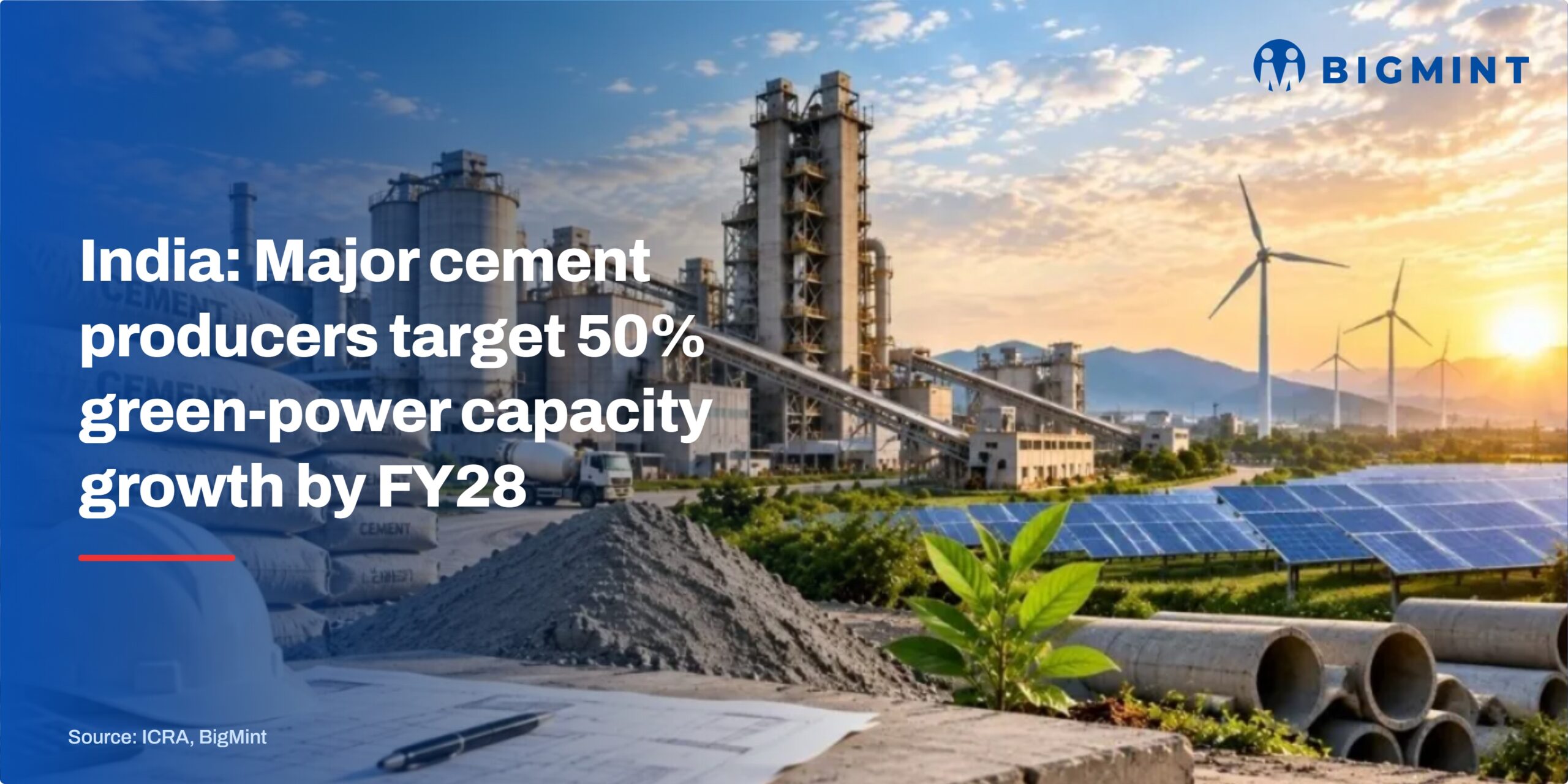
- Green power capacity seen rising 50% by FY’28
- Lower energy costs could strengthen cement margins
India’s leading cement producers are accelerating investments in renewable power as they seek to lower energy costs, reduce exposure to fossil-fuel price volatility and advance decarbonisation. It is estimated that green power capacity among major cement producers may rise to 5.8-6 GW by March 2028 from around 4 GW in March 2026, supported by investments of INR 12,000-13,000 crore.
Green power becomes cost strategy
The investment case is increasingly being driven by both cost savings and decarbonisation. It is estimated that the additional green power capacity could generate annual savings of INR 6,200-6,700 crore, implying a payback period of 1.8-2.2 years.
Every 5% increase in green-power replacement can reduce power and fuel costs by INR 15-16/t. At 25% replacement, the potential saving rises to INR 75-80/t and could expand operating margins by 140-160 basis points.
This could improve cost competitiveness by reducing producers’ exposure to fluctuations in conventional fuel and power costs.
Several major producers are already expanding their green-power base. UltraTech Cement had 1,806 MW of installed green-power capacity at the end of FY26, comprising 1,392 MW of renewable power and 414 MW of WHRS. Around 41% of its power requirement was sourced from green energy during FY26.
Ambuja Cements plans to increase the share of green power to 60% by FY28, supported by 1 GW of solar and wind capacity and 376 MW of WHRS.
Impact on cement cost structure
Higher renewable-power penetration could increasingly differentiate producers on energy costs. Companies with greater access to captive renewable generation and WHRS may gain greater protection from fossil-fuel price volatility, potentially supporting margins during periods of weak cement realizations.
The decarbonisation push is also extending beyond electricity. The need for higher thermal substitution through biomass, municipal waste and industrial waste as cement producers work to reduce conventional fuel consumption.
Outlook
Green power is likely to become an increasingly important component of cement producers’ cost and decarbonisation strategies through FY28. The combination of renewable power and WHRS could lower energy costs while reducing exposure to conventional fuel-price volatility.
However, the pace of capacity addition will depend on project execution, renewable-power availability, grid connectivity and capital allocation. Manufacturers with faster renewable deployment could gain a cost advantage as the industry moves towards higher green-power utilization.
Note: This article has been written based on ICRA’s FY28 forecast and industry analysis.
Leave a Reply