- Geopolitical tension in SA raises concern of vessel movement
- Prior to monsoon, restocking activity surges
Coal import costs are on the rise in India as freight rates have risen this week. To meet the anticipated surge in electricity demand during summer, the Indian government extended the full capacity operation allowance for imported coal-based power plants until mid-October. This move, along with India’s need to restock coal before the monsoon, is expected to significantly increase demand for coal imports.
Route-wise details:

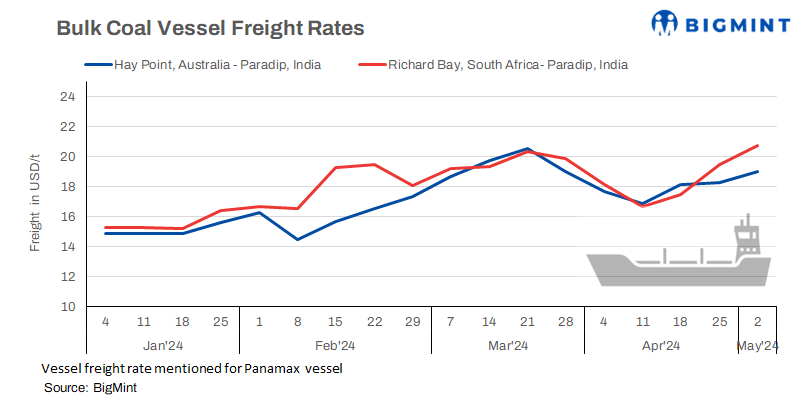
- South Africa to India freight rates increase w-o-w: Freight rates for coal shipments from the Richards Bay Coal Terminal (RBCT) to Paradip, India, are currently at around $20.75/tonne (t), an increase of $1.25/t w-o-w on 2 May, as per BigMint’s assessment. Thermal coal prices gained support due to recent geopolitical tensions, including Iran’s retaliatory actions against Israel, spurring European buyers to take new positions. Concerns over vessel movement through the Strait of Hormuz further contributed. Additional geopolitical tensions could elevate thermal coal prices as increased LNG and crude oil prices are passed on to suppliers in Colombia, South Africa, Russia, and Indonesia. These nations stand to benefit from higher LNG prices and heightened coal demand.
- Australia-India freight rates rise w-o-w: Freight rates from Australian ports increased w-o-w for Indian ports. As per BigMint’s assessment, coal freight rates from Port Hay Point, Australia, to Paradip, India, were recorded at $19/t, up by $0.7/t w-o-w. BigMint noted that one of the major miners has signed a Contract of Affreightment (COA) for three years, which is supporting movement of ships on a regular basis.
- Indonesia to India freight increases w-o-w: Freight rates for coal shipments from East Kalimantan to Paradip stood at $15/t, up by $1.2/t w-o-w today. While last week’s available cargoes were limited due to miners having sold most of their material under long-term contracts, demand from the seaborne market was subdued. So, Indonesian miners were mostly focusing on fulfilling domestic demand.