- Lower buying interest from India amid sufficient stocks
- Oversupply of cargoes weigh on coal freight rates
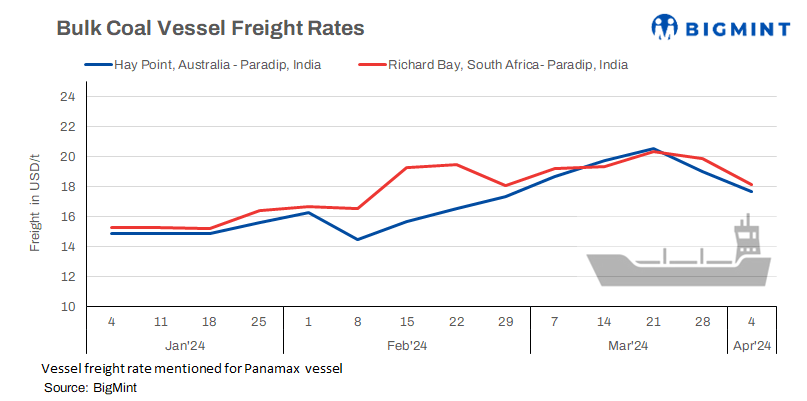
Coal freight rates fell this week amid weak demand. Indian buyers are inactive due to availability of sufficient stocks in the domestic market. Meanwhile, oversupply of cargoes on the portside and limited enquiries in the global market have pushed down freight rates. In addition, demand from the steel and cement sectors remain sluggish due to decrease in infrastructure projects.

Route-wise details:
- South Africa-to-India freights fall w-o-w: Freight rates for coal shipments from the Richards Bay Coal Terminal to Paradip, India, are currently at around $18.15/tonne (t), a drop of $1.75/t w-o-w on 4 April 2024, as per BigMint’s assessment. There is limited cargo availability for the mid-April period on sluggish demand from India. Weak market sentiment due to increased domestic production is leading to sluggish enquiries this week.
- Australia-to-India freight rates fall w-o-w: Freight rates from Australian ports declined w-o-w for Indian as well as for Chinese ports. As per BigMint’s assessment, coal freight rates from Port HayPoint, Australia to Paradip, India record at $17.65/t, fall by $1.35/t w-o-w today. The subdued demand for coking coal has led to an oversupply of cargoes in the market. Demand from the steel sector has also declined, which is impacting movement of ships on the key routes. However, an enquiry has been recorded as fixed this week, SAIL has booked a Panamax vessel for 75,000 t of metallurgical coal from Hay Point Port, Australia to Vizag and Haldia at a rate of around $19.05/t. The shipment is scheduled for 21-30 April, sources informed.
- Indonesia-to-India freights inch down w-o-w: Freight rates for coal shipments from East Kalimantan to Paradip stood at $12.2/t, inching down by $0.5/t w-o-w today. Demand from India largely remained low, with only a few power plants occasionally purchasing Indonesian mid-CV coal. Seaborne coal demand is also weak, as most buyers have adopted a wait-and-watch approach amid market volatility.