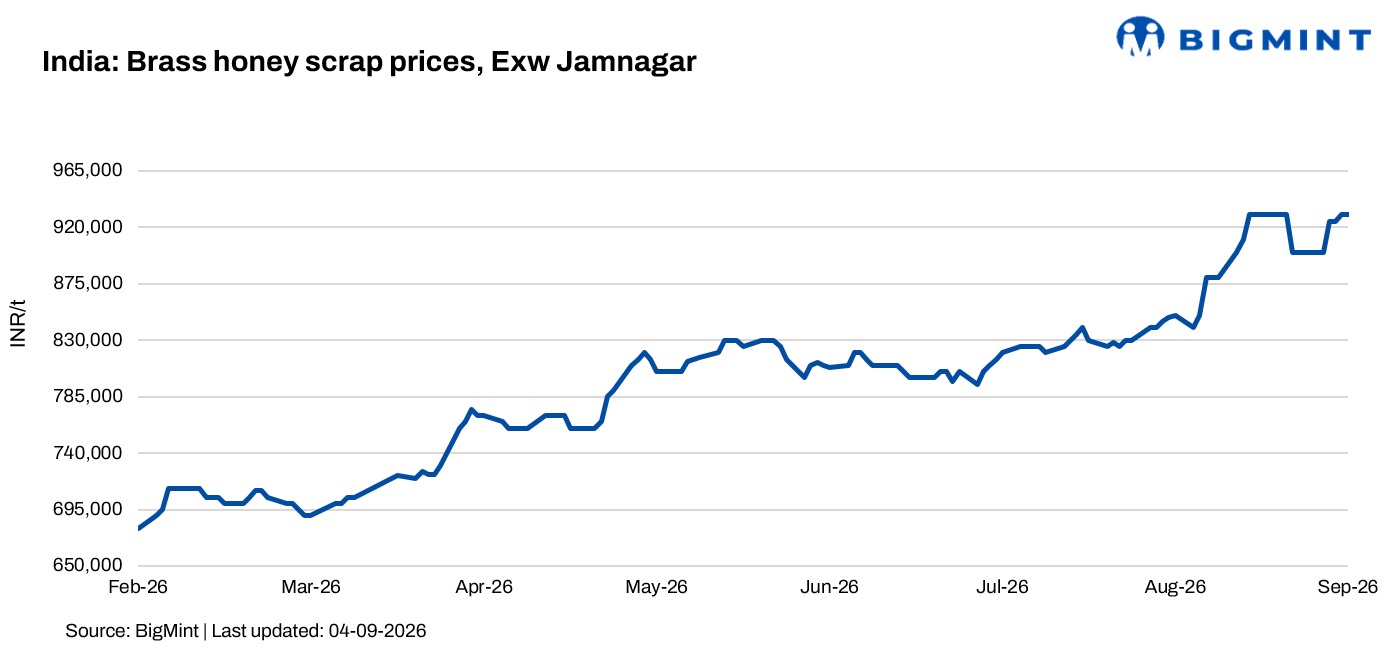
- Brass honey prices remain rise amid tight availability.
- Holiday slowdown limits trading activity and fresh bookings.
India’s brass honey scrap prices rise 3% in the week ended 4 sept 2026, supported by robust demand and also on shortage of material across key recycling and manufacturing centres.
BigMint’s assessment assessed brass honey scrap prices at around INR 930,000/t exw-Jamnagar, rise week-on-week, as recyclers, ingot makers and component manufacturers intensified procurement amid limited spot availability.
Market Insight
India’s brass honey scrap market remained largely steady during the week ended 4 September 2026, with prices holding firm despite a noticeable slowdown in trading activity across key consumption centres. BigMint assessed brass honey scrap prices at around INR 930,000/t exw-Jamnagar, unchanged week-on-week, supported by tight material availability and healthy underlying demand from recyclers, ingot manufacturers, casting units and brass component producers.
However, market activity was subdued as the Gujarat market entered a holiday phase due to Janmashtami celebrations. Several yards, processing units and trading houses operated at reduced capacity, while many buyers postponed fresh bookings until after the festive period. As a result, spot transactions declined significantly during the week, with participants reporting limited new order placements from both domestic and export-oriented manufacturers.
On the export front, sentiment softened compared with recent weeks. Market participants indicated that export deals, which were earlier concluded at around 64% of the prevailing LME copper price, have recently eased to nearly 61-62% CIF China. The decline reflects weaker buying interest from overseas consumers and increased caution among Chinese buyers amid volatile non-ferrous markets. Despite lower export bids, Indian suppliers remained reluctant to reduce offers aggressively due to the continued shortage of quality brass scrap in the domestic market.
International trading activity was also relatively quiet. Market participants reported that western markets, including Europe and the US, remained largely inactive for the past two to three days because of limited participation and slower inquiry levels. This reduced international liquidity further contributed to the muted trading environment witnessed in India.
In Jamnagar, one of India’s largest brass recycling and manufacturing hubs, local deals were concluded mostly in the range of INR 925,000-930,000/t. Market sources noted that European-origin honey scrap was available at around INR 950,000-955,000/t, while sellers continued to quote offers as high as INR 970,000/t, reflecting replacement cost concerns and restricted availability of imported material. The gap between bid and offer levels limited transaction volumes during the week.
Overall, market participants expect trading activity to improve from next week as businesses resume normal operations after the holiday period. Buyers are likely to return to the market to replenish inventories, while exporters will closely monitor Chinese buying interest and international scrap price movements for fresh direction. Despite the temporary slowdown, the market’s underlying tone remains firm due to constrained scrap availability and stable demand from downstream brass manufacturers.
Leave a Reply