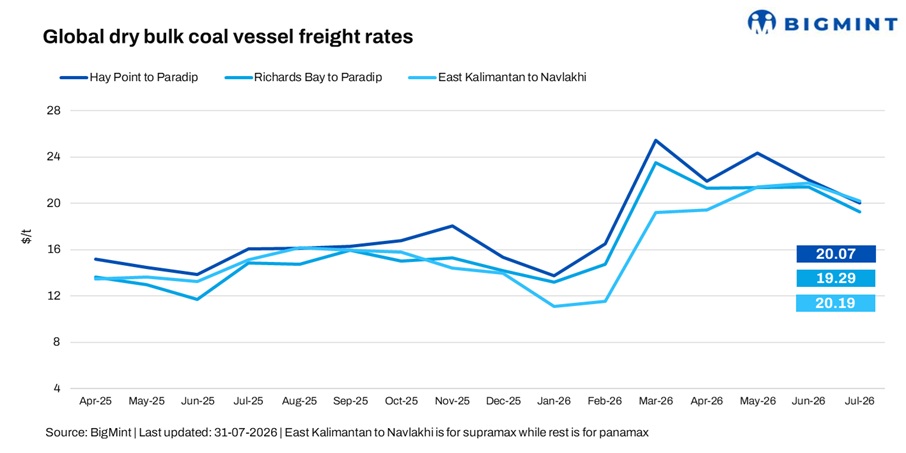
- Muted Australian and South African cargoes weigh on Panamax routes
- Limited Kalimantan coal stems keep Supramax sentiment cautious
India-bound coal freight softened in the week ended 31 July 2026, led by weaker Panamax rates as limited fresh cargo and comfortable vessel availability across both Atlantic and Pacific basins kept chartering activity subdued. Indonesian Supramax routes were relatively steadier, with selective cargo coverage and firm bunker prices helping to cushion the downside.
The Panamax segment remained under pressure, with thin cargo programmes and fewer fixtures limiting owners’ negotiating power. Softer Pacific fundamentals, combined with subdued Atlantic enquiry, further restricted opportunities for rate gains.
A shipbroker told BigMint, “Limited fresh cargo orders and a high concentration of open vessels in the Pacific are weighing on freight sentiment, prompting owners to gradually lower their rate expectations.”
Lower cargo activity from Australia and South Africa, alongside ample tonnage, added to the pressure on Panamax freight.
Route-wise update

The Supramax market remained largely subdued, as limited coal stems from East and South Kalimantan kept chartering activity muted. However, firm bunker costs continued to provide a floor to freight levels.
A shipbroker said, “The Pacific market remains under pressure as vessel supply continues to outpace cargo availability. Unless more East Kalimantan cargoes enter the market, rates are likely to soften further since only a handful of major players are currently active.”
Selective Indonesian cargoes offered some support, while firm bunker prices limited the extent of any downward correction.
Another shipbroker observed, “Limited coal stems from East and South Kalimantan continue to cap freight momentum, although firm bunker prices are preventing a sharper correction.”
Overall, weaker Baltic sentiment and cautious chartering kept the broader market subdued, although selective Indonesian demand and firm owner resistance to lower offers helped contain the downside.
Market highlights
- Baltic Dry Index (BDI) declines further w-o-w: The BDI fell 5.9% (167 points) w-o-w to 2,673 as of 30 Jul’26, from 2,840 a week earlier, as weakness across the dry bulk segments continued to weigh on market sentiment. The Panamax Index edged down 1.2% (24 points) to 2,040, reflecting subdued cargo demand and ample vessel availability. Meanwhile, the Supramax Index declined 5.4% (92 points) to 1,610, pressured by limited fresh cargo enquiries and softer chartering activity across key loading regions.
- Brent crude futures decline w-o-w: Brent crude oil (September 2026 contract) fell to $90.25/bbl as of 31 Jul’26, down $7.44/bbl (7.6%) from $97.69/bbl a week earlier. The decline reflected easing geopolitical tensions, reduced concerns over supply disruptions, and profit-taking following the previous week’s sharp rally.
- Bunker prices decline w-o-w: Singapore’s Very Low Sulphur Fuel Oil (VLSFO) bunker prices fell by $74/t (8.4%) w-o-w to $808/t as of 31 Jul’26, from $882/t a week earlier. The decline followed a pullback in crude oil prices and easing geopolitical risk premiums, reducing voyage operating costs for shipowners.
- DCE coke futures decline further w-o-w: Coke futures on the Dalian Commodity Exchange for the September 2026 contract fell to RMB 1,767/t ($261.57/t) as of 31 Jul’26, down from RMB 1,840.50/t ($271.85/t) a week earlier. The decline reflected weak steel demand, ample coke supply, and cautious market sentiment amid continued uncertainty over China’s steel production outlook.
Outlook
BigMint expects India-bound coal freight to remain range-bound with a softer bias in the near term. Ample vessel availability, muted fixture activity and limited fresh cargo orders are likely to keep pressure on Panamax routes.
However, selective coal stems from Indonesia and owners’ reluctance to discount sharply are expected to provide support to Supramax freight. Market direction will largely depend on fresh cargo stems from East and South Kalimantan, Pacific vessel availability, and the pace of chartering activity in the coming weeks.

Leave a Reply