- BDI rises 5.8% w-o-w to 2,693 despite 8.7% decline in Panamax index
- Rising bunker costs support freights despite caution among charterers
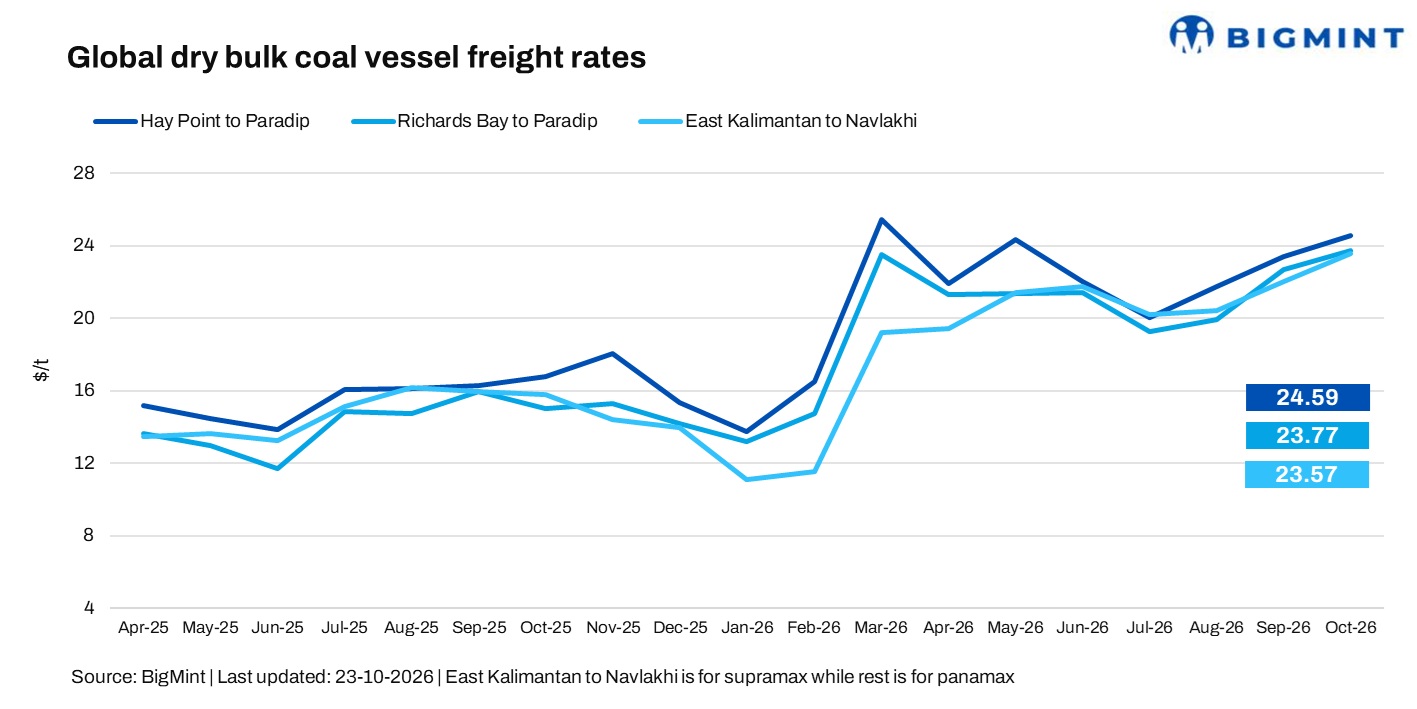
India-bound coal freight markets moved in different directions in the week ended 23 October. Better cargo demand in the South Atlantic supported freight sentiment, while the Panamax market faced pressure from weaker forward expectations. Supramax rates held up relatively better, although limited fresh bookings and cautious charterers kept activity in check.

Panamax: Atlantic gains contrast with Pacific pressure
Fresh enquiries in the Atlantic offered some support, but weak US Gulf grain demand and more vessels heading from the East Coast of South America continued to weigh on freight rates. As a result, charterers remained in no hurry to book ships.
In the Pacific, Australian coal cargoes and fewer vessels available for prompt loading helped support freight levels, despite quieter grain demand. Owners continued to hold firm on period rates, but weaker forward freight agreements (FFAs) kept charterers cautious and made it harder to close deals.
Supramax: Firmer sentiment, but limited fresh bookings
The Supramax market held up better, supported by tighter vessel availability and stronger cargo demand in the South Atlantic. However, activity in the US Gulf remained slow, while the Continent and Mediterranean markets were largely stable, with better rates limited to select routes.
A shipbroker said, “Supramax coal market activity remained quiet today, although a few cargoes from East Kalimantan to India’s west coast were fixed until yesterday.”
These bookings provided some support to the Pacific market, but overall activity remained limited. With charterers still cautious and fresh enquiries few, the market needs more cargo bookings to sustain the current firmness.
Market highlights
- Baltic Dry Index (BDI) rises w-o-w: The BDI increased 5.8% (148 points) to 2,693 as of 22 October, from 2,545 on 15 October, despite a decline in the Panamax segment amid weaker cargo demand. The Panamax index fell 8.7% (205 points) to 2,151, while the Supramax index rose 1.8% (34 points) to 1,890, supported by relative resilience in the smaller vessel segment.
- Bunker prices rise further w-o-w: Singapore Very Low Sulfur Fuel Oil (VLSFO) increased by $42.5/tonne (t), or 4.7% w-o-w, to $952.5/t as of 23 October, from $910/t on 16 October. The sharp rise reflects higher crude oil prices and persistent Middle East supply concerns, increasing vessel operating costs and potentially adding upward pressure to dry bulk freight rates.
- Brent crude futures rise w-o-w: December Brent crude futures climbed 7.7% ($8.23/barrel (bbl)) to $114.71/bbl as of 23 October, from $106.48/bbl on 16 October, amid persistent geopolitical tensions and concerns over potential supply disruptions. Rising crude prices could push marine fuel costs higher, adding to vessel operating expenses and keeping dry bulk freight rates exposed to further volatility.
- DCE coke futures decline w-o-w: January 2027 Dalian Commodity Exchange (DCE) coke futures fell 1.8% (RMB 35.50/t; $4.74/t) to RMB 1,937/t ($290.05/t) as of 23 October, from RMB 1,972.50/t ($294.79/t) on 16 October, amid cautious market sentiment and concerns over steel demand.
A shipbroker said, “Bunker prices are rising again, with Brent crude climbing to $114/bbl. we are closely watching geopolitical developments, as the US elections and the situation in Israel could bring further changes to the market.”
Rising fuel costs are adding to vessel operating expenses and may prompt owners to seek firmer offers, although charterers’ acceptance will depend on cargo demand and vessel availability.
Outlook
BigMint expects coal freight markets to remain mixed in the near term. Pacific Panamax rates may find support from steady Australian coal flows, while weaker Atlantic demand could limit gains. Supramax rates may remain relatively resilient, but quiet fixing activity could restrict further momentum. Rising bunker costs and geopolitical uncertainty will continue to influence freight offers, with fresh cargo enquiries and vessel availability key to the market’s direction.
Leave a Reply