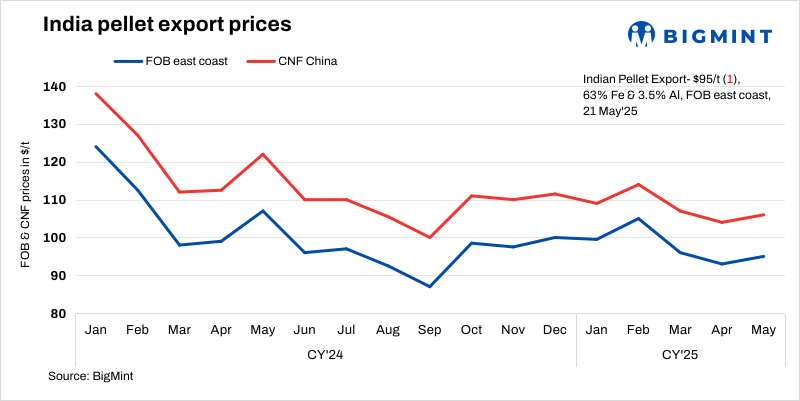
- East coast sees nil pellet export deals
- Low-alumina pellets popular in China
The Indian pellet export market remained largely range-bound this week, despite the conclusion of a few tenders. No significant deals were recorded from the eastern coast, as buying interest from overseas, particularly Chinese mills, remained subdued.
BigMint’s India pellet (Fe 63%, 3-3.5% Al) export index (FOB east coast) decreased by $1/tonne (t) w-o-w to $95/t on 21 May 2025 against the previous assessment on 14 May. Weaker demand for pellets from the eastern coast further led to muted trades in this publishing window.
An India-based pellet maker concluded an export deal for 50,000 t of material (Fe63%, 2.5% alumina) through a tender yesterday. The deal was heard closed at around $101-102/t FOB India, as per sources. Last week, an export deal for 50,000 t of pellets (Fe61%, 2.5% alumina) was concluded at around $93-94/t FOB India.
A pellet producer commented, “Chinese buyers are more focused on sourcing low-alumina pellets, below 1%, which are currently not available from Indian exporters. This is pushing them towards alternatives from other regions such as Brazil and the CIS region.”
The lack of suitable high-grade material continues to weigh heavily on Indian exporters. Market participants noted that a few Indian cargoes remain unsold at Chinese ports, further dampening sentiment.
Meanwhile, in the domestic market, pellet prices also trended downward following the latest Odisha Mining Corporation (OMC) iron ore auction. A market participant informed, “Many pellet producers are hesitant to procure raw materials at current price levels, waiting for more clarity in the market.”
Domestic prices exceeded export offers by INR 1,450/t ($13/t), remaining stable compared to last week, as domestic tags witnessed a drop w-o-w. Pellet (Fe63%) prices in Odisha’s Barbil were recorded at INR 7,700/t ($90/t) exw, down INR 150/t ($2/t) w-o-w. Meanwhile, ex-plant realisation in exports from Barbil stood at INR 6,250/t ($73/t) exw.
Exporters are adopting a cautious, wait-and-watch approach, hoping for a rebound in seaborne demand. However, with current market fundamentals remaining weak, most traders do not expect a significant turnaround in the near term.
An exporter added: “Until there is a visible recovery in Chinese steel margins or restocking activity, Indian pellet prices are likely to stay volatile. We do not expect strong demand to emerge in the short term.”
As per Chinese reports, steel mills are cautious in their purchasing, mainly replenishing inventory due to steady demand. The number of inquiries remains limited, resulting in low market activity and limited transactions.
Rationale
- No confirmed deals from India’s east coast were recorded in this publishing window for T1 trade. Thus, this category was not taken into consideration for today’s price calculations and accorded 0% weightage in the index calculation. Click here for the detailed methodology.
- Eleven (11) indicative prices were received, and seven (9) were considered for the calculation of the index and given 100% weightage.
Factors impacting pellet exports
Chinese iron ore fines prices down w-o-w: The benchmark iron ore fines index remained largely stable w-o-w at $101/t CFR China on 20 May. Lower-grade fines remained more favourable, with narrowing discounts, but this trend seemed unsustainable amid declining trade. Additionally, yesterday’s interest rate cuts by the central bank boosted liquidity, while falling coke prices eased costs for steel mills.
DCE iron ore futures drop w-o-w: Iron ore futures on the Dalian Commodity Exchange (DCE) for the May 2025 contract fell by RMB 8.5/t ($1/t) w-o-w to RMB 728.5/t ($101/t) on 21 May. On a d-o-d basis, prices were under pressure.
Pellet inventory at Chinese ports remained almost unchanged w-o-w at 5.25 mnt on 15 May, as per data published by Steelhome.
Outlook
As per BigMint’s analysis, the pellet export market is expected to remain volatile along with fluctuations in global iron ore prices. However, demand for pellets is unlikely to improve in the Indian seas.
Leave a Reply