- Domestic realisations better than exports
- Iron ore spot prices, futures drop post-holidays
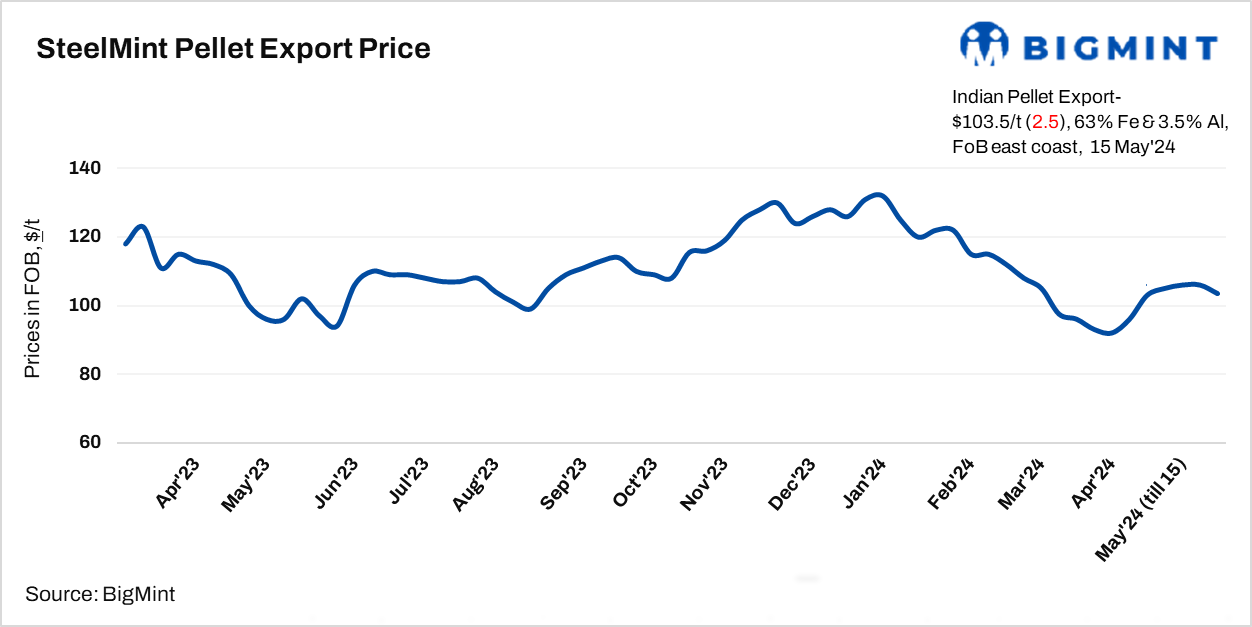
BigMint’s India pellet (Fe 63%, 3% Al) export index (FOB east coast) inched down w-o-w by around $2.5/tonne (t) to $103.5/t on 15 May, 2024. The export market remained sluggish in the last one week following sluggish buying interest post-Labour day holidays. Meanwhile, no deal was concluded from India amid offer and bid disparity. Pellet manufacturers are getting better realisation in the domestic market against exports.
Indian pellet sentiments in the seaborne market continued to remain bearish this week too considering lack of trades. Notably, pellet export market had not shown any promising return post-holidays as limited bids received as Chinese steelmakers struggling for margins. Therefore, they are more emphasising on blending iron ore fines than taking pellet from overseas market. At the same time pellet inventory at the ports are also very high.
A South India-based pellet producer tried to sale in the export market but not received a decent response. They floated an export tender for exports of 50,000 t of iron ore pellets (Fe 63%, 8% Al2O3+SiO2). According to sources, the tender failed to receive bids as per the seller’s expectations.
“I don’t see any one making pellet offers for exports these days. All are focusing on the local market, it seems, due to better price realisation. In fact, recent pellet export tenders did not fetch any response,” a market source told BigMint.
Notably, an eastern Indian pellet producer has diverted one pellet cargo recently towards western India amid active demand against export offers. To add details, the particular vessel comprised of 55,000 t pellets at INR 10,200-10,500/t DAP Kandla.
In the meantime, domestic realisations exceeded exports by INR 1,200/t ($14/t). In the local markets, pellet (Fe 63%) prices increased w-o-w by INR 100/t ($1/t) to INR 8,350/t exw ($100/t) in Barbil, eastern India. However, pellet export ex-plant price realisation for Barbil was at the level of INR 7,000-7,050/t exw ($84/t) this week.
In the meantime, Chinese sources said that Qingdao portside offers of Indian pellets (Fe 63.5%) increased by around RMB 5/t ($1/t) w-o-w on 15 May, 2024. Offers were recorded at around RMB 995/t ($137/t), inclusive of all import taxes and port charges. However, on d-o-d basis, portside offers rose by around RMB 10/t ($1/t).
Rationale:
- No pellet export deal was recorded in this publishing window and hence accorded with 0% weightage in the index calculation, Click here for detailed methodology.
- Nine (9) indicative prices were received, out of which seven (7) were considered for calculation of the index and given a 100% weightage.
Market dynamics
- Iron ore spot prices drop post-holidays: The benchmark iron ore fines index decreased w-o-w by around $4/t to $115/t CFR China on 15 May, 2024. As per report, the market witnessed a downtrend, shattering earlier expectations of post-holiday price recovery. Meanwhile, due to small decrease in production margins, mills are focusing towards purchase of lower quality fines that come with bigger discounts in the market.
- DCE futures edge down w-o-w: Iron ore futures on the Dalian Commodity Exchange (DCE) for the September 2024 contract decreased by RMB 8/t ($1/t) w-o-w to RMB 858 ($119/t) on 15 May, 2024.
- Pellet inventories largely stable: Pellet inventories at China’s major ports remained largely stable at 7.55 mnt on 9 May, 2024 compared to the last week, according to SteelHome data.

Weekly pellet export vessel line up from India recover
India’s pellet exports recovered this week after witnessing zero shipments since mid-April, 2024. Around 168,130 t of pellets were exported from India in the second week of May compared to zero shipments in the first week, as per vessel line-up data maintained with BigMint.

Outlook
Pellet export offers in the seaborne market may face uncertainty in the short term due to Chinese mills’ lack of interest in purchasing material amidst low margins. Meanwhile, Indian manufacturers are finding better returns in the domestic market, leading them to potentially focus on domestic sales.