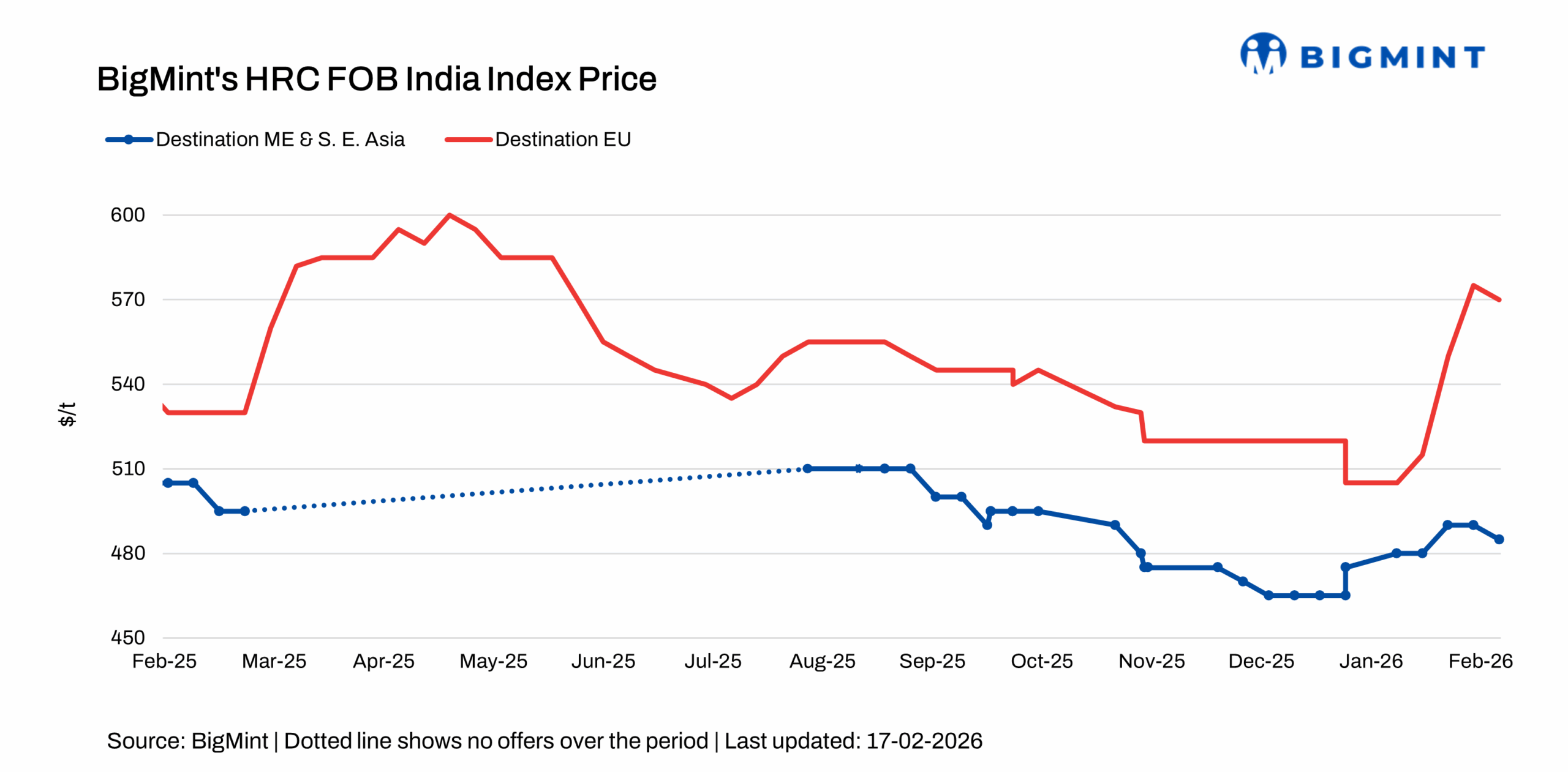
- HRC offers to the EU, Middle East decline w-o-w
- EU optimism persists despite subdued consumption
BigMint’s Indian HRC (S275) export index for the European Union (EU) dropped by $5/t w-o-w to around $570/t FOB main port from $575/t in the previous week. Moreover, Indian HRC (SAE 1006) export index for the Middle East and South East Asia declined by $5/t w-o-w to $485/t FOB main port compared with $490/t a week earlier following a recently concluded deal.
1. HRC offers to the EU: Indian HRC export offers to the EU fell by $5/t w-o-w to around $620/t CFR Antwerp, compared with $625/t in the previous week, amid ongoing uncertainty regarding the quota allocations and weak demand due to adequate domestic inventory levels. With sufficient stock coverage and subdued end-user consumption, buyers largely refrained from restocking, keeping market activity limited. Nevertheless, domestic market sentiment remained cautiously firm, supported by expectations of cost pressures from CBAM implementation and the upcoming safeguard revisions in the second half of 2026.
2. HRC offers to the Middle East: Indian HRC export offers to the Middle East declined by $5/t w-o-w to around $510/t CFR UAE, compared with $515/t in the previous week as market sentiment in the region is gradually slowing down ahead of Ramadan. Moreover, a deal of around 33,000 tonnes (t) has been heard concluded at similar levels for March shipments.
Meanwhile, Chinese HRC export offers to the Middle East remained stable w-o-w at around $500/t CFR UAE, amid slow trading activities due to the Lunar New Year holidays in the region. May 2026 HRC contracts on the Shanghai Futures Exchange (SHFE) declined by RMB 34/t ($5/t) w-ow to RMB 3,223/t ($466/t) on 13 February from RMB 3,257/t ($471/t) on 6 February 2026.

Outlook
Indian HRC export prices are expected to remain range-bound (within a range of around $10/t) in the coming week, as persistent uncertainty regarding quota allocations continues to weigh on market sentiment, keeping trading activity subdued and may further restrain shipments. Meanwhile, trading activity in the Middle East might remain slow with the beginning of Ramadan.
Leave a Reply