- Maintenance downtime continues at some plants, other mills halt bookings
- Uptrend may continue amid firm raw material costs, reduced supply
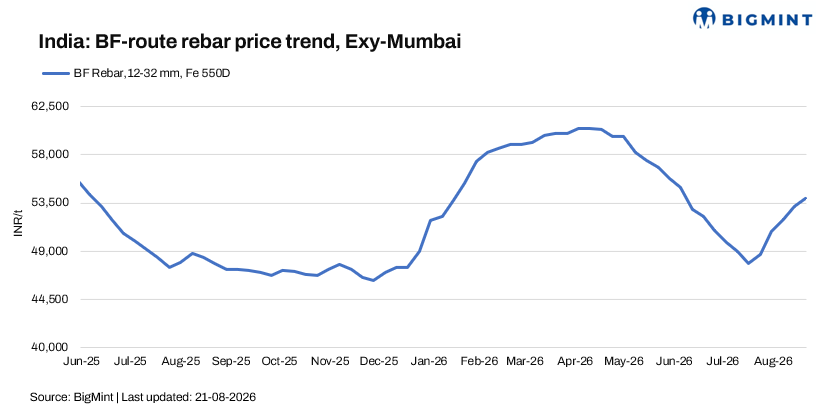
Trade-level blast furnace (BF) rebar prices increased by INR 700/t w-o-w to INR 53,900/t ($564/t) ex-Mumbai on 21 August 2026, according to BigMint’s assessment. The increase came amid improving overall demand, with buying activity largely driven by retail requirements, while project demand also remained supportive.
In the project segment, demand remained positive, supported by ongoing infrastructure and construction activity. However, some producers have reportedly stopped accepting new bookings amid limited availability. While some mills have completed planned maintenance shutdowns and restarted production, a few mills are still under maintenance, indicating tightening supply conditions towards end-August.
According to market participants, major integrated steelmakers increased rebar prices by up to INR 1,000/t ($10/t) for mid-August deliveries, supporting buying activity and market sentiment.
Market sentiment improved as several mills undertook routine maintenance shutdowns during August. There is currently no significant inventory pressure at the mills, while most available material is being absorbed by the retail segment. In addition, some producers are expected to divert production towards other steel products, further limiting rebar availability and providing continued support to prices.
Factors influencing market dynamics
1.IF-route rebar prices rise amid active buying
IF-route rebar prices increased by INR 800-2,500/t across major markets during the week, with the steepest hikes recorded in Jaipur and Jalna, where prices rose by INR 2,500/t and INR 2,000/t, respectively. Buying activity remained good throughout the week, with traders actively stocking material in anticipation of further price increases in the coming days.
The upward price movement was primarily driven by limited mill margins and rising raw material costs, particularly iron ore and coal, which increased production costs and supported higher rebar offers. Improved buying interest, coupled with higher input costs, enabled mills to sustain the upward price trend.
Mill inventories declined to around 8 days, while order booking visibility remained limited to 3-5 days, indicating continued near-term supply tightness.
 The blast furnace (BF) to IF rebar price spread in Mumbai widened w-o-w to around INR 6,100/t ($64/t) this week. IF rebar continues to dominate the Indian market, accounting for an estimated 65-70% share.
2.Raw material prices remain supportive
BF-route raw materials showed mixed movement during the week. BigMint’s Odisha iron ore fines (Fe 62%) index remained stable w-o-w at INR 5,000/t ($52/t) ex-mines as of 14 August 2026, supported by steady trading activity and stable steelmaker demand.
Meanwhile, BigMint’s premium hard coking coal (PHCC) assessment increased by $19/t w-o-w to $267/t CNF Paradip, reflecting firmer sentiment in the seaborne coking coal market.
Higher coking coal costs, together with limited mill margins, are likely to keep pressure on steelmakers’ production costs and provide continued support to rebar offers.
Infrastructure activity remains robust
Infrastructure project activity remained strong, with major orders awarded a cross roads, power, water, urban infrastructure and renewable energy. Key awards included Ceigall India JV (INR 2,149.6 crore), Afcons (INR 1,918 crore), H.G. Infra (INR 716 crore), J Kumar (INR 522 crore), B.L. Kashyap (INR 616 crore), NBCC (INR 234.8 crore) and Oriana Power (INR 214.8 crore).
The continued flow of project awards highlights sustained infrastructure spending and provides a positive demand backdrop for long steel products.
Outlook
BF-rebar prices are expected to remain firm in the near term, supported by strong retail buying, limited mill availability, ongoing infrastructure demand and elevated raw material costs. However, the sustainability of further price increases will depend on the continuation of retail buying and the ability of mills to maintain supply discipline.
Leave a Reply