- Sharp w-o-w gains reflect bullish miller sentiment, tight supply conditions
- Freight volatility and geopolitical risks continue to cloud export visibility
India’s basmati rice market witnessed a sharp rally this week, with prices rising by $50-70/tonne (t) over the past two days, driven by renewed bullish sentiment among millers and expectations of demand recovery. The increase comes despite a prolonged period of geopolitical tension, during which prices showed remarkable resilience and did not witness any significant correction.
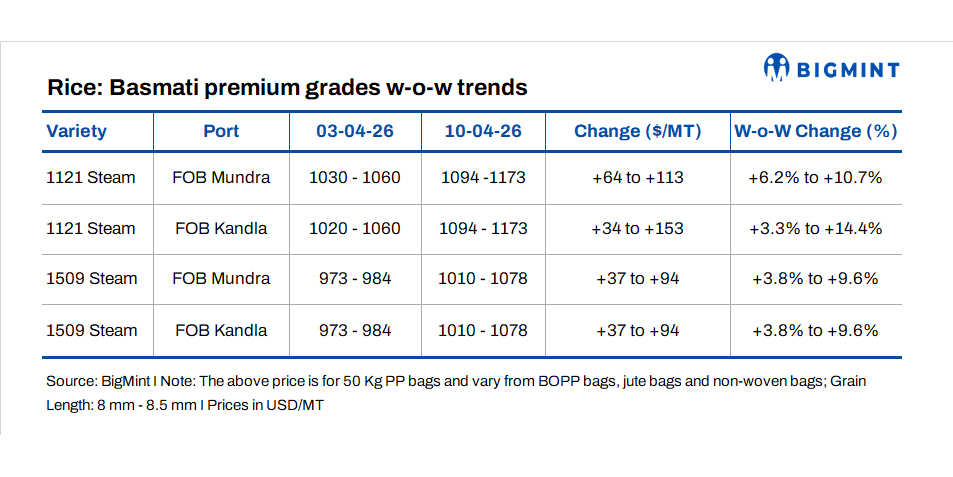
For 1121 steam, Mundra quotes moved from $1,030-1060/t on 3 April to $1,094-1,173/t on 10 April, an increase of around 6-10% w-o-w. Similarly, 1509 steam prices rose from $973-984/t to $1,010-1,078/t, reflecting gains of approximately 4-9% over the same period. Kandla prices mirrored a similar trend, indicating a broad-based market movement across key export hubs.
Demand outlook and trade disruption
The recent price spike is largely sentiment-driven, as exporters anticipate a gradual recovery in demand following the announcement of a ceasefire in the Middle East. However, the situation remains fragile, and market participants are cautious about committing to fresh orders amid heightened uncertainty. Exporters note that it has become increasingly difficult to finalize contracts at current price levels due to rapid fluctuations.
Trade flows to West Africa remained largely uninterrupted during the conflict, as shipments were rerouted via the Cape of Good Hope. In contrast, basmati exports to Gulf countries were significantly disrupted, with demand yet to fully recover due to infrastructural and logistical damages.
Freight dynamics and market uncertainty
Freight remains a critical variable. Although crude oil prices have eased below $100 per barrel, shipping lines and vessel owners have not yet reduced freight rates, preferring to wait for clearer market signals. Both containeried and bulk freight are expected to soften only once stability returns to energy markets and trade routes normalize.
The key uncertainty now revolves around the durability of the ceasefire. Market participants are closely monitoring developments, as any escalation could further disrupt trade flows and sustain price volatility in the near term.
Leave a Reply