- Limited buying keeps domestic prices subdued
- Potential increase in Afghanistan imports may support key basmati varieties
India’s basmati market remained under pressure during the latest trading session, with most basmati and Sathi/1509 paddy varieties witnessing weaker prices across major mandis. Limited procurement by mills and exporters, competitive pricing in overseas markets and cautious buying sentiment continued to weigh on prices. However, market participants noted that demand for premium-quality rice remained steady, preventing any sharp decline.
Sathi/1509 paddy prices weaken across key mandis
In the Sathi/1509 paddy segment, 1509 paddy traded at INR 3,800-3,980/quintal in Karnal, INR 3,800-3,905/quintal in Khair, INR 3,600-3,900/quintal in Bulandshahr, INR 3,300-3,901/quintal in Garhmukteshwar and up to INR 4,000/quintal in Dabra. Super-52 paddy traded at INR 3,400-3,591/quintal in Garhmukteshwar. Prices across most mandis declined by INR 60-270/quintal compared with the previous session, indicating that buyers continued to procure only according to immediate requirements.
Mixed trend in basmati rice prices
Among processed rice varieties, 1121 and 1401 remained largely stable in the Punjab-Haryana market. 1121 Steam Grade A+ traded at INR 9,900-9,950/quintal, while 1401 Steam Grade A+ was quoted at INR 9,850-9,900/quintal. In contrast, other basmati varieties remained under pressure. 1718 Creamy Sella traded at INR 8,600-8,650/quintal, 1509 Steam Grade A+ at INR 9,050-9,100/quintal, 1509 Golden Sella at INR 8,950-9,000/quintal, and 1885 Steam Grade A+ at INR 9,550-9,600/quintal. The non-basmati segment also witnessed mild weakness, with most grades of Taj, RH-10 and PR-11/14 trading lower.
Afghanistan emerges as a promising export destination
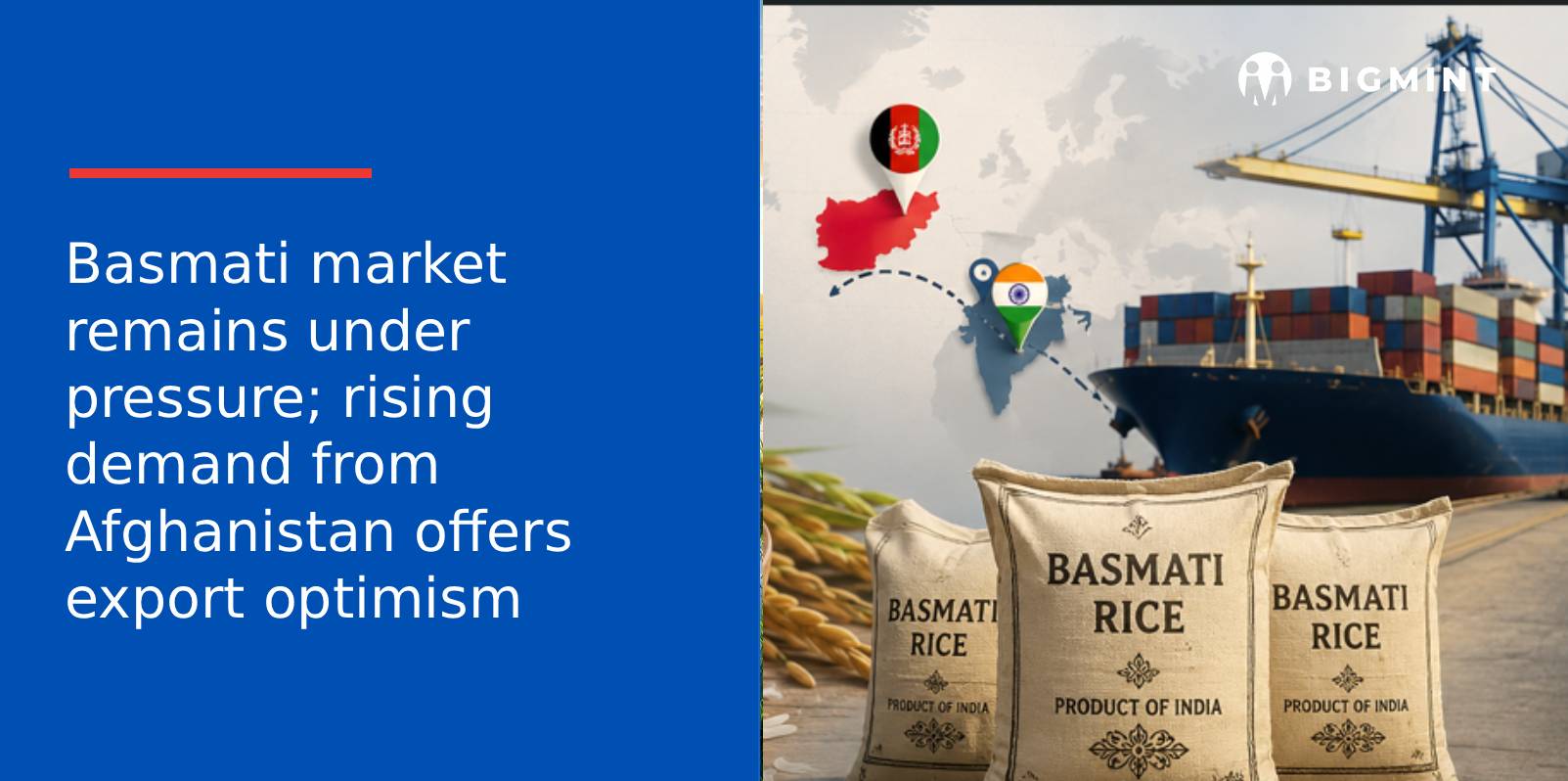
A key positive development for the basmati market is the prospect of higher exports to Afghanistan. Amid evolving regional trade dynamics, Afghanistan is exploring increased direct imports of Indian basmati rice. A meeting between Indian exporters and Afghan importers is scheduled for July, where both sides are expected to discuss measures to strengthen bilateral rice trade. If successful, the initiative could open a significant new export avenue for Indian basmati, particularly benefiting 1121, 1718, 1509 and 1401 varieties.
Global demand for premium basmati remains supportive
International demand for premium and traceable basmati rice continues to remain strong, particularly across the Middle East, Europe and other key importing markets. Indian basmati continues to enjoy strong acceptance owing to its superior grain length, aroma and cooking quality. Exporters are increasingly focusing on value-added products, improved packaging and stronger branding to enhance competitiveness in global markets. Meanwhile, the Government of India has approved humanitarian assistance comprising 500 metric tonnes of rice and 8,500 metric tonnes of cement to Seychelles, reinforcing India’s role as a reliable supplier in international markets. The government has also announced initiatives to promote premium agricultural products from Tripura, including aromatic rice, which could further strengthen the country’s export portfolio.
Outlook
The downside in the basmati market appears limited despite continued pressure from cautious buying. Expectations of stronger export demand, particularly from Afghanistan, along with sustained international interest in premium-quality Indian basmati, are likely to provide support to the market. However, in the near term, prices may continue to trade within a narrow range as mills and exporters maintain need-based procurement.
Leave a Reply