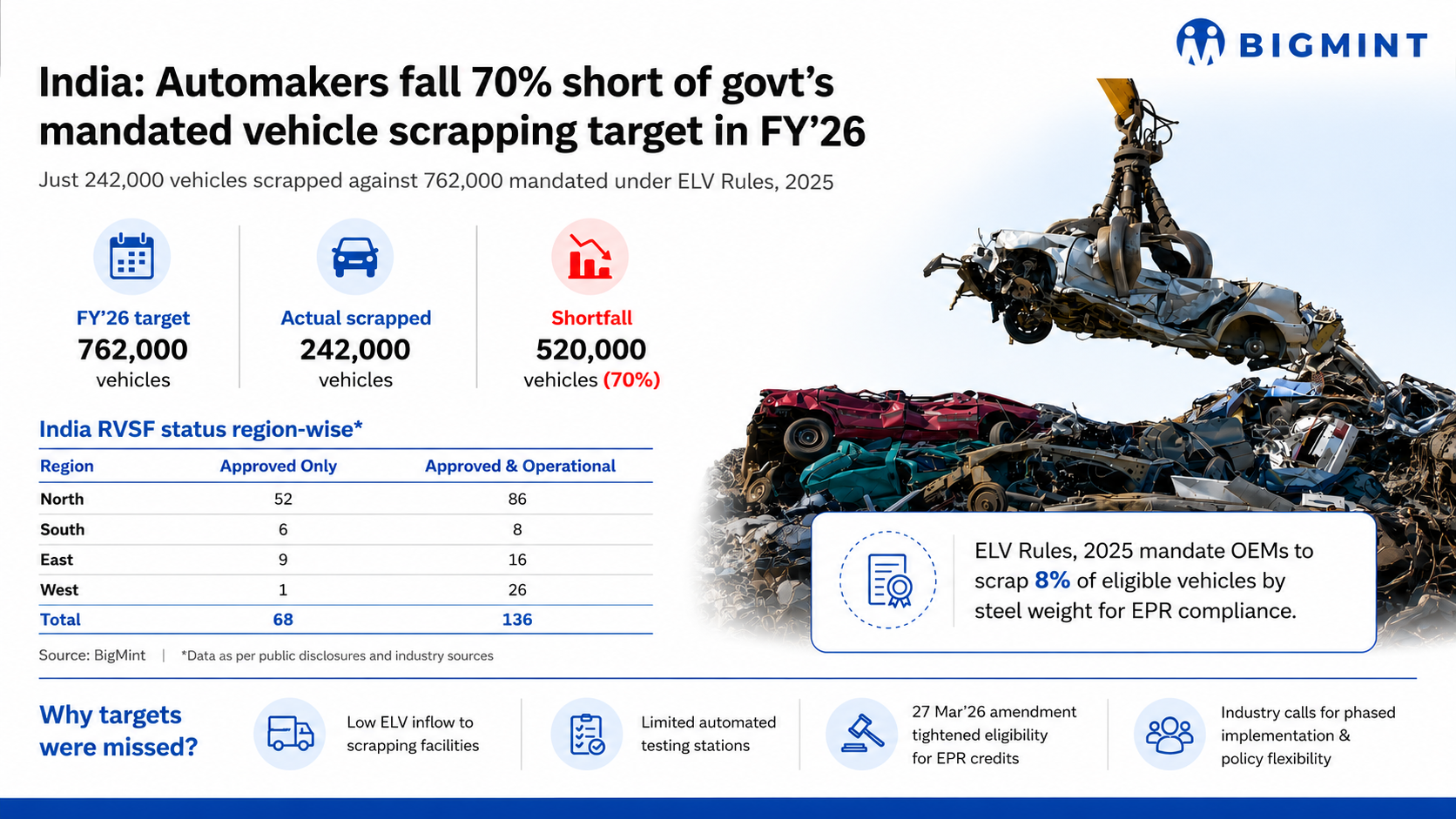
- OEMs achieve only 30% of mandatory scrappage obligations in FY26
- Weak ELV inflows may delay ferrous scrap availability for steelmakers
India’s automakers achieved just 30% of their steel-equivalent vehicle scrappage commitments in FY26 (April 2025-March 2026), falling 70% short of Environment Ministry mandates under the End-of-Life Vehicle (ELV) Rules, 2025. Industry executives attribute the non-compliance to “unrealistic” targets and a mid-year policy shift that tightened eligibility for credits.
Notified in January 2025 and effective 1 April, the rules impose Extended Producer Responsibility (EPR) on original equipment manufacturers (OEMs). Compliance hinges on scrapping ELVs sold 20 years prior for private vehicles (FY2005-06 sales) and 15 years for commercial ones (FY2010-11), measured by recovered steel weight.
FY26 targets and shortfall
In FY26, 9.52 million vehicles were eligible for fitness testing under ELV rules, requiring automakers to scrap at least 762,000 (8% minimum target) for EPR compliance-yet registered facilities processed just 242,000, leaving an industry-wide shortfall of 520,000 vehicles (70%).
Official data cited by executives underscores the gap, with low ELV inflows to scrapping centers-despite 9.52 million vehicles reaching age eligibility-exacerbated by limited automated testing stations.
A pivotal 27 March, 2026, draft amendment stripped “other steel scrap materials” from EPR certificate eligibility, restricting credits to vehicle-derived steel only. “OEMs had banked on blending ELV scrap with other sources to hit targets,” one executive noted anonymously. “This change made compliance impossible in year one.”
Industry pushback and SIAM concerns
The Society of Indian Automobile Manufacturers (SIAM) urged the Ministry of Environment, Forest and Climate Change (MoEFCC) to reinstate flexibility, citing negligible ELV volumes from testing stations. SIAM advocated a phased transition: allow non-ELV automotive steel scrap initially, scaling to pure ELV compliance as the ecosystem matures.
“Targets stay at 8% through FY30, then jump to 13% (FY31-35) and 18% thereafter,” another executive warned. “Without policy relief, shortfalls will compound every five-year cycle, straining steel scrap supply chains.”
Steel market implications
The EPR regime aims to channel ELV steel-potentially 1-2 million tonnes annually at scale-into secondary steelmakers, curbing imports amid ferrous scrap shortages in hubs like Mandi Gobindgarh and Alang. Yet FY26’s flop signals delays, with OEMs likely facing penalties or certificate shortfalls into FY27. Executives call for revised baselines tied to actual ELV availability, echoing geopolitical and logistics hurdles in India’s steel raw material chain.
MoEFCC has yet to finalise the amendment or respond to SIAM. Auto-steel linkages hang in balance as FY27 targets loom.
Leave a Reply