- Festive bookings expected to drive October deliveries
- New launches support passenger vehicle demand outlook
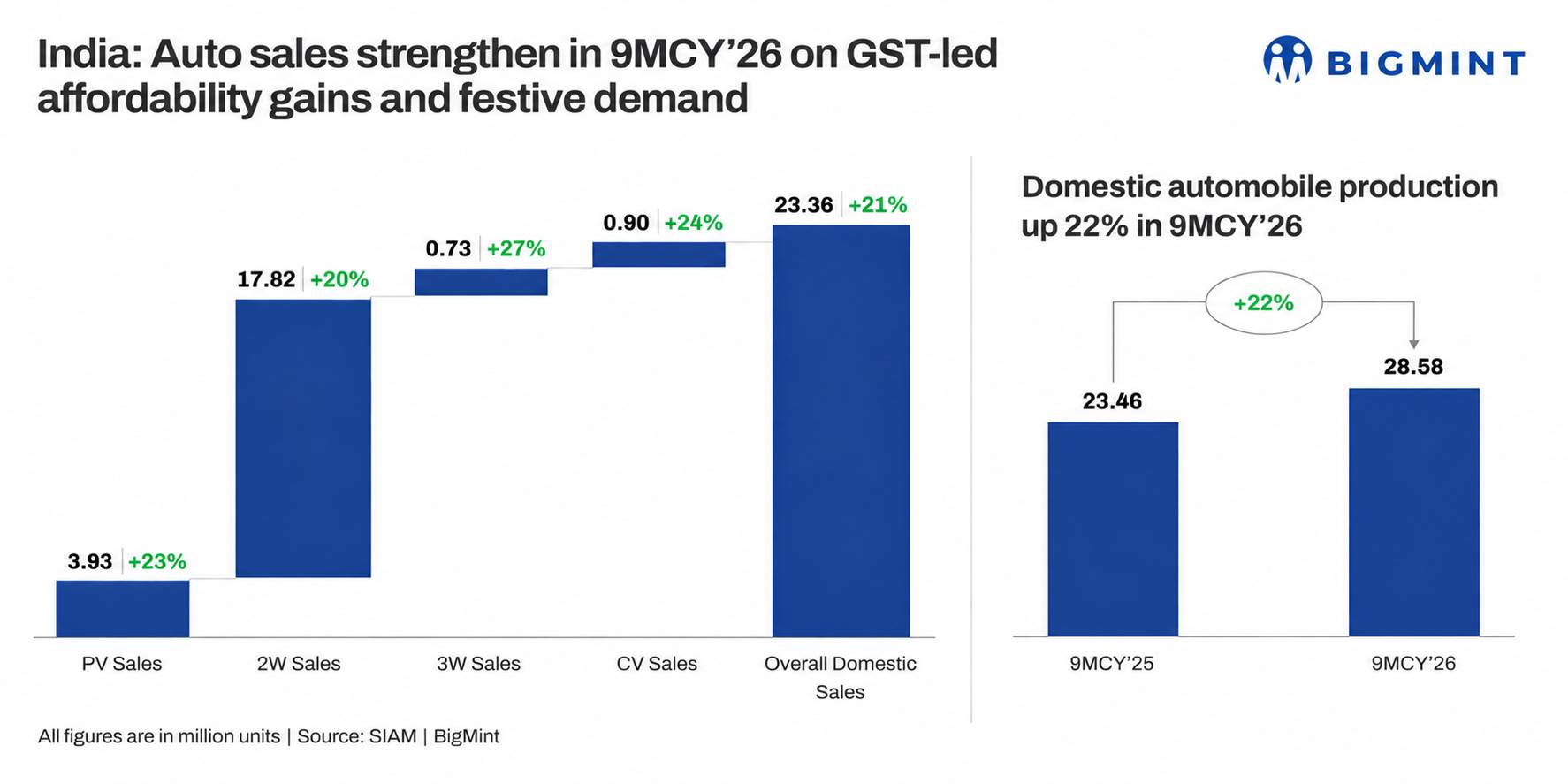
India’s automobile sector maintained strong growth during January-September 2026 (9MCY’26), according to data from the Society of Indian Automobile Manufacturers (SIAM), supported by robust demand across major vehicle segments. Passenger vehicle sales increased 23% y-o-y to 3.93 million units, while two-wheeler sales rose 20% to 17.82 million units. Three-wheeler sales grew 27% to 0.73 million units.
Commercial vehicle sales increased 24% y-o-y to 0.90 million units. Overall domestic automobile sales rose 21% to 23.36 million units, while total automobile production grew 22% to 28.58 million units in 9MCY’26.
Retail automobile sales grow 21% y-o-y in 9MCY’26
Meanwhile, FADA’s retail data for 9MCY’26 reflected healthy y-o-y growth across all major vehicle segments. Passenger vehicle sales increased 26% y-o-y to 3.82 million units, while two-wheeler sales rose 24% to 16.42 million units. Three-wheeler sales grew 18% to 1.08 million units.
Commercial vehicle (CV) sales increased 15% y-o-y to 0.89 million units, while tractor sales rose 21% to 0.83 million units. Overall retail automobile sales increased 21% to 23.03 million units, indicating broad-based growth across major vehicle segments.
Festive purchases boost two-wheeler and passenger vehicle sales
According to FADA President Sai Giridhar, Indian automobile retail recorded its best-ever September performance in 2026, with total registrations rising 31.82% y-o-y and 4.69% m-o-m to 2.54 million units. However, the sharp annual growth was partly influenced by a high base effect, as buyers deferred purchases in September 2025 ahead of the implementation of GST 2.0.
Despite this distortion, underlying demand remained strong, with retail sales during the first half of FY’27 reaching a record high, supported by broad-based growth across vehicle categories. Two-wheelers benefited from festive demand, steady rural and semi-urban consumption, increasing preference for premium motorcycles and rising EV adoption. Passenger vehicle sales were supported by festive purchases, while commercial vehicle demand remained strong due to replacement demand, infrastructure development, mining activity and bulk fleet purchases.
Three-wheelers and wheeled construction equipment also recorded healthy growth, while tractor sales grew y-o-y but declined m-o-m due to uneven monsoon conditions in some regions and a later festive calendar. The report also highlighted the growing adoption of electric mobility, with total EV retail sales across categories reaching an all-time monthly high and overall EV penetration touching approximately 13%.
However, rising passenger vehicle inventory ahead of the festive season remained a concern. Giridhar emphasised that affordability remains the key driver of the current growth cycle, while further vehicle price increases could erode the benefits of GST 2.0 and weigh on consumer demand.

Separately, according to the Society of Indian Automobile Manufacturers (SIAM), the Indian automobile industry recorded strong growth across all major vehicle segments during Q2 FY’27 (July-September 2026), supported by improved affordability following GST 2.0, resilient rural and urban demand, healthy freight movement, infrastructure spending and a gradual vehicle replacement cycle.
Domestic passenger vehicle sales recorded strong growth, led by utility vehicles, while two-wheeler sales increased, driven by improved affordability, replacement demand and strong scooter sales. Three-wheeler sales also grew, supported by last-mile mobility requirements, increasing cargo applications and the adoption of electric vehicles. Commercial vehicle sales witnessed healthy growth, benefiting from infrastructure development, freight movement, fleet expansion and the replacement of older vehicles.
SIAM also reported record Q2 exports for two-wheelers and three-wheelers, supported by stronger overseas demand, although passenger vehicle exports declined amid a higher base and logistics constraints linked to the West Asia crisis. SIAM President Shenu Agarwal highlighted the industry’s resilience and the growing adoption of electric and alternative-fuel vehicles, while Director General Rajesh Menon noted that Q2 FY’27 recorded the highest-ever quarterly sales for passenger vehicles, commercial vehicles, three-wheelers and two-wheelers.
Outlook
India’s automobile industry is expected to maintain positive growth momentum during October 2026-March 2027, supported by festive demand, new product launches, infrastructure spending, rural consumption and fleet replacement. According to FADA, dealer sentiment remains cautiously optimistic, with 75.57% of dealers expecting growth in October’26 and 78.28% anticipating growth over October-December’26. The festive season, including Navratri, Dussehra, Dhanteras and Diwali, is expected to support booking conversions and vehicle deliveries, although growth rates may moderate against the higher base of the previous year.
Across segments, passenger vehicle demand is expected to remain positive, supported by new launches and festive offers, while two-wheeler sales are likely to benefit from rural cash flows, easier financing and rising interest in electric vehicles. Three-wheeler demand is expected to remain firm on last-mile mobility and cargo applications, while commercial vehicles should gain support from infrastructure development, goods movement, fleet replacement and the PARIVARTAN scheme.
However, rising input costs and vehicle prices, inflationary pressures, potential interest rate increases, high inventory levels and geopolitical uncertainties could weigh on demand. Overall, the outlook for H2 FY’27 remains encouraging, with festive demand conversion, consumer affordability and inventory management emerging as key factors shaping the industry’s growth trajectory.
Leave a Reply