- Monsoon demand softness offsets stronger spot buying
- Domestic premiums remain firm near QMJP benchmark
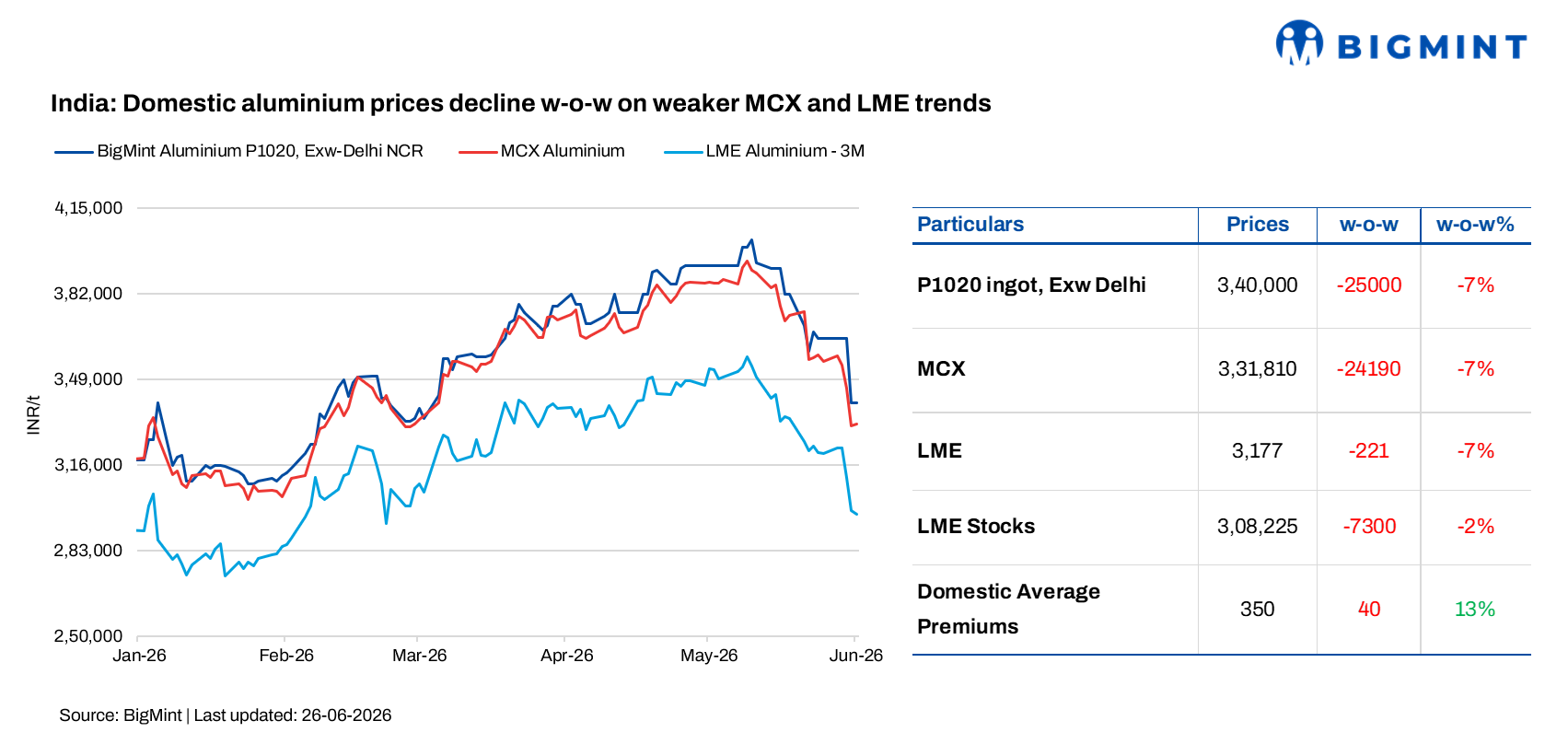
Domestic aluminium prices in India declined sharply w-o-w as of 26 June 2026, tracking weaker trends on both the Multi Commodity Exchange (MCX) and the London Metal Exchange (LME).
According to BigMint’s assessments, P1020 aluminium ingot prices in Delhi NCR fell by INR 25,000/t (7%) w-o-w to INR 340,000/t on 26 June from INR 365,000/t on 19 June. Similarly, Ex-Mumbai P1020 aluminium ingot prices declined by INR 18,000/t (5%) w-o-w to INR 346,000/t from INR 364,000/t during the same period, leaving Mumbai prices around INR 6,000/t higher than Delhi.
How did Indian and global exchanges perform?
Domestic aluminium futures on the MCX declined w-o-w by INR 24,190/t, or 7%, to INR 331,810/t on the latest assessment, from INR 356,000/t in the previous week.
Similarly, three-month aluminium prices on the LME fell by $221/t, or 7%, to $3,177/t from $3,398/t. Meanwhile, LME aluminium stocks declined by 7,300 t, or 2%, to 308,225 t from 315,525 t during the same period.
Market updates
India’s P1020 aluminium market remains supported by persistent physical tightness despite a recent correction in LME prices.
Current domestic premiums are largely aligned with the QMJP benchmark, hovering around $350/t, as lower LME prices have encouraged buyers to place spot orders and replenish inventories.
While the monsoon season is typically associated with softer demand across several end-use sectors, market participants report improved spot buying activity as consumers seek to capitalize on the recent decline in benchmark prices. This has helped maintain market liquidity despite seasonally weaker consumption trends.
On the supply side, physical metal availability continues to remain constrained. Market sources indicate that some participants have oversold volumes despite ongoing tightness, reinforcing concerns over near-term supply adequacy. As a result, import material, which is generally traded at a discount to prevailing domestic benchmarks, is currently being sold at parity with QMJP levels, reflecting the deficit conditions in the market. Consequently, import parity is estimated to be around QMJP levels at present.
Looking ahead, sentiment remains constructive, with several market participants expecting aluminium prices to recover toward the $3,400/t level.
The expectation is primarily driven by continued physical tightness, limited spot availability, and a still-challenging scrap supply environment.
Meanwhile, BALCO recorded a 4% w-o-w decline, with average prices falling to INR 378,708/t from INR 394,875/t. Similarly, Hindalco prices declined by 6% w-o-w to INR 367,750/t from INR 389,250/t during the same period.
Outlook
Despite the recent price correction, the domestic aluminium market is expected to remain fundamentally supported by tight physical availability, steady spot buying, and constrained scrap supply. While monsoon-related demand softness may limit any sharp upside in the near term, a recovery in LME aluminium prices and sustained supply tightness could help domestic prices stabilise and gradually regain lost ground over the coming weeks.
Leave a Reply