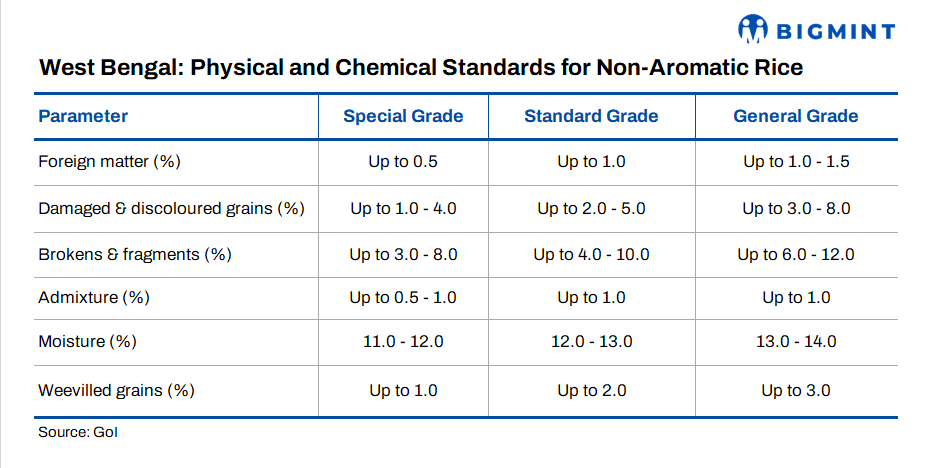
- 3 grades defined, “Special” grade to have strictest quality criteria
- Move seen improving trade transparency, export alignment
India has introduced formal grade designation and marking standards for West Bengal’s non-basmati aromatic rice, aiming to standardise quality across domestic and export markets. The rules, notified under the Agricultural Produce (Grading and Marking) Act, 1937, cover key varieties such as Gobindabhog, Tulaipanji, Kataribhog, Kalonunia, and Radhunipagal.
The framework defines three grades — Special, Standard, and General — based on parameters including foreign matter, damaged grains, brokens, admixture, and moisture content. The Special grade carries the strictest tolerances, while General allows relatively higher limits, enabling clear quality differentiation across trade.
Quality metrics and compliance requirements
Beyond physical parameters, the standards incorporate scientific indicators such as amylose content and alkali spreading value, which influence cooking quality and consumer preference. Grain dimensions and length-to-breadth ratios have also been standardised to ensure uniform appearance.
All graded rice must carry AGMARK labelling, with mandatory disclosure of batch details, packing date, and packer information. Only authorised packers can undertake grading, with access to approved testing infrastructure required to ensure compliance.
Trade implications and export alignment
The regulation reinforces food safety compliance and aligns export consignments with Codex and importing country requirements. Provisions for varietal verification through polymerase chain reactions (PCRs) have also been included.
The move is expected to improve price discovery, reduce quality disputes, and support premiumisation in aromatic non-basmati rice, although compliance costs may rise for smaller players.
Leave a Reply