- International scrap weakness prompts Hyundai’s second July price cut
- August maintenance shutdowns likely to shape near-term scrap demand
Hyundai Steel has announced a second reduction in domestic scrap purchase prices for July, reflecting weaker global scrap prices, comfortable inventory levels and softer domestic market conditions. The latest adjustment, effective 20 July, follows an earlier price cut on 6 July and indicates that South Korea’s largest steelmaker is responding to changing international market dynamics rather than purely domestic factors.
Global price correction weighs on buying strategy
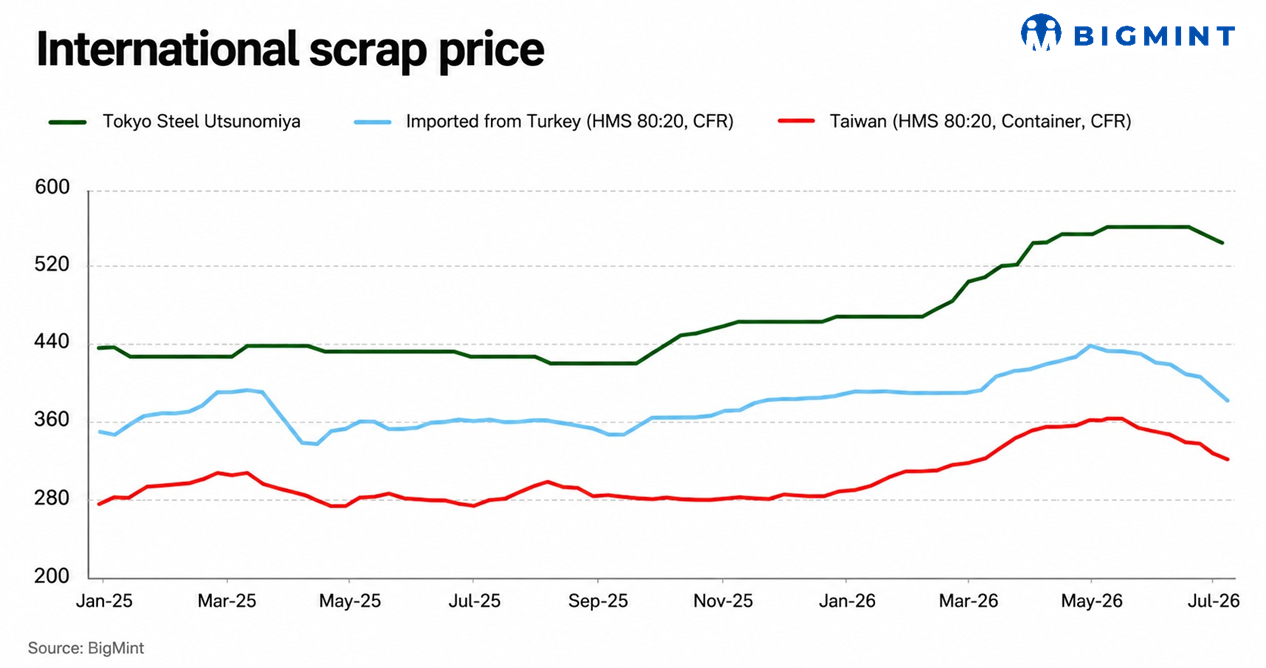
Market participants said Hyundai Steel’s latest decision was influenced by the continued correction in international scrap markets. Japan’s July Kanto H2 export tender fell by JPY 1,998/t m-o-m to JPY 52,508/t FAS, while Tokyo Steel reduced scrap purchase prices by JPY 1,000/t across most plants. Meanwhile, deep-sea import prices into Turkiye softened to around $370/t CFR, reinforcing expectations of further weakness in Asian scrap markets.
These developments reduced replacement costs for imported scrap, giving Hyundai Steel greater flexibility to lower domestic purchase prices.
Comfortable inventories reduce procurement urgency
Another key factor behind the latest price cut is the company’s comfortable inventory position. Since June, Hyundai Steel has reportedly been receiving around 10,000 t of scrap daily across its Incheon and Dangjin works, resulting in high stock levels. Excess arrivals at Dangjin were even redirected to Incheon, highlighting the company’s ample raw material availability.
Market participants indicated that Hyundai Steel believes existing inventories are sufficient to maintain production even if scrap inflows decline following the latest price reduction.
August maintenance remains the key market focus
Industry participants believe Hyundai Steel’s latest price cut is aimed at maintaining scrap circulation ahead of the seasonal slowdown, as mills prepare for summer holidays and maintenance shutdowns scheduled across South Korea in August.
Although lower prices may temporarily reduce scrap collection, maintaining adequate market circulation before August is viewed as essential for ensuring stable raw material availability after maintenance concludes.
Will other mills follow?
Hyundai Steel’s latest price cut has prompted similar moves across the domestic market, with Dongkuk Steel also lowering scrap purchase prices, while rebar producers in the Busan and Gyeongnam regions are expected to follow amid rising inventories.
However, plate and specialty steel producers are expected to adopt a more cautious approach. Hyundai Steel limited reductions for pig scrap to KRW 5/kg, while POSCO reduced prices only at its Gwangyang works. SeAH Besteel largely maintained official buying prices, making only minor adjustments to incentive schemes.
Outlook
South Korea’s domestic scrap market is expected to remain under pressure through July amid comfortable inventories and weaker global prices. However, market attention is shifting to August, when post-maintenance scrap availability will determine mills’ procurement strategy and price direction.
Note: This article has been published in accordance with a content exchange agreement between Japan Metal Daily and BigMint.

Leave a Reply