- Scarcity of DR-grade ore a major obstacle in low-carbon transition
- DR-ESF route allows for use of below-DR grade iron ore
- Costs, scalability remain key challenges
Morning Brief: Major iron ore miners, Rio Tinto and BHP, as well as steel companies such as BlueScope have thrown their weight behind a new technology, which promises to deliver significant reductions in steelmaking emissions, while ensuring the use of existing raw materials and steelmaking infrastructure and value chains.
With a view to facilitating the use of generally below-DR grade iron ore for production of DRI and its subsequent melting and refinement, the electric smelting furnace (ESF) retains the potential to lower steelmaking emissions, although adoption of renewable electricity is a must.
“It is a fact universally accepted that there is simply not enough high-quality iron ore suitable for efficient DRI/EAF production to meet global steel demand,” a steel mill spokesperson informed BigMint.
“DRI production must use the very highest quality iron ore, with average iron content in the range of 67% Fe. Such deposits, worldwide, are scarce,” he said.
As per experts, the ESF technology has the promise to emerge as a significant low-carbon alternative, among a host of other smelting reduction technologies, amid general tightness in availability of DR-grade iron ore globally.

Transition pathways
The decarbonisation of the global steel industry will depend on companies switching to low-emissions steelmaking through a) aligning existing BF-BOF processes with state-of-the-art technologies such as top gas recycling and carbon capture utilization and storage (CCUS); b) DRI-EAF technologies with lower CO2 footprint, including a host of smelting reduction technologies; and c) direct electrolysis of iron ore.
It is an accepted fact that direct electrolysis-such as processes pioneered by Boston Metal which have raked in considerable investments-still has a long way to go.
DRI potential
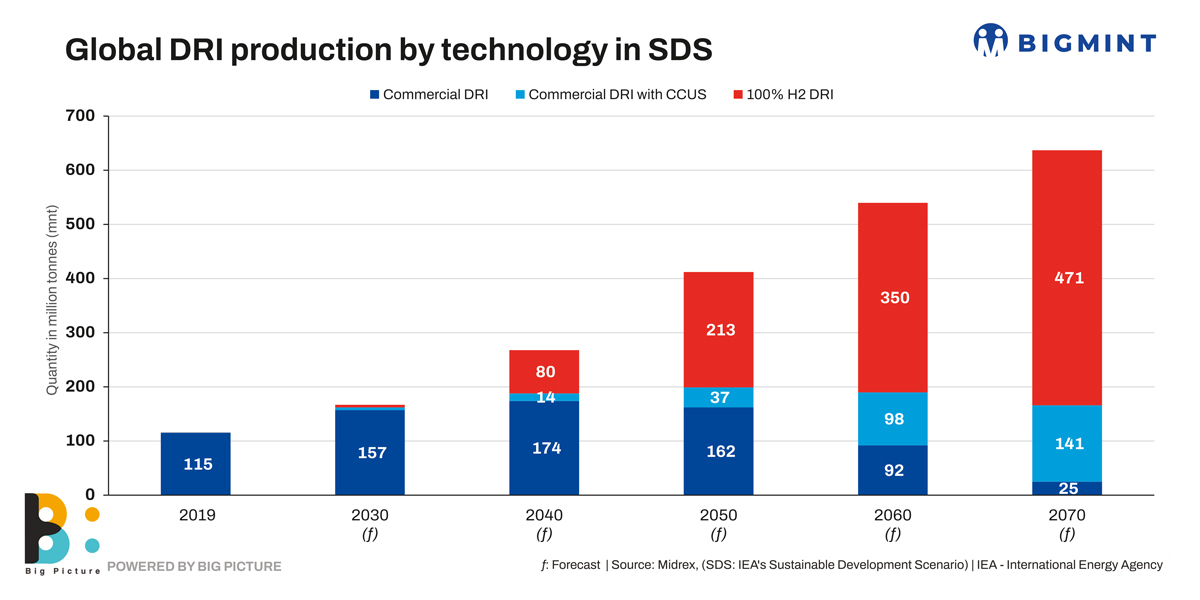
After 2030, DRI capacity expansion will need to accelerate to maintain a net-zero pathway. Bloomberg New Energy Finance anticipates 56% of primary steel production coming from DRI-EAF processes using hydrogen and 3% from DRI-EAF processes based on natural gas by 2050 under a net-zero steel sector scenario.
This would mean 840 mnt of steel production from DRI-EAF-hydrogen processes and 49 mnt from DRI-EAF-natural gas processes by 2050, requiring a tenfold rise in DR-grade supply unless technology innovations allow DRI processes to use lower-grade ore.
The electric furnace routes that use DRI are appealing for deep greenhouse gas (GHG) emissions abatement as, unlike the BF, the DRI plant does not require carbon-containing coke to operate and instead may use hydrogen-containing gas mixtures to chemically convert iron ore into iron, which will greatly lower the CO2 emissions intensity, experts from BHP note.
Presently, these process gas mixtures are derived from fossil fuels, but in the future there is the potential to transition DRI process gas toward 100% hydrogen. Therein lies the potential of DRI.
EAF challenges
- The EAF was originally designed and optimised for rapidly melting batches of scrap-not suitable for ore reduction
- When EAFs are operated with high levels of DRI, higher slag volumes are generated from the gangue impurities and iron is easily lost to this slag. Losing iron in the process is expensive and inefficient
- To limit iron losses in the EAF, the DRI unit is also configured to metallise as much of the iron ore as possible and the DRI that is produced is usually mixed with at least 50% scrap. Even with this high quality mix of feedstocks, EAFs are currently unsuitable for producing the highest grades of steel (e.g., auto sheet for car manufacture)
ESF features
- Unlike EAFs, the ESF can work on any sort of physical DRI and a metallization level much lower than required for EAF processes (<85% Fe)
- The ESF operates continuously, with reducing conditions maintained by adding small amounts of carbon. DRI is continually fed to the furnace to maintain a layer of gradually reducing and melting solid material
- The furnace operating environment also allows the slag chemistry to be controlled in a way that resembles BF slag rather than EAF slag.
- Molten metal and slag are periodically drained from the furnace through tap holes without stopping the furnace operation
Outlook
The ability of the ESF to produce a molten metal and slag that are similar to what a BF produces also offers upstream synergies, by relaxing the stringent DRI quality thresholds that apply to the EAF. Iron losses to slag are lower and phosphorus from the ore feed can be managed by the downstream refining processes.
However, scale is always a challenge, as with all smelting reduction technologies-especially in the Indian context. Also, the costs of incorporating an extra smelting process before transfer of hot metal to BOF will surely add extra cost burden on steelmakers.