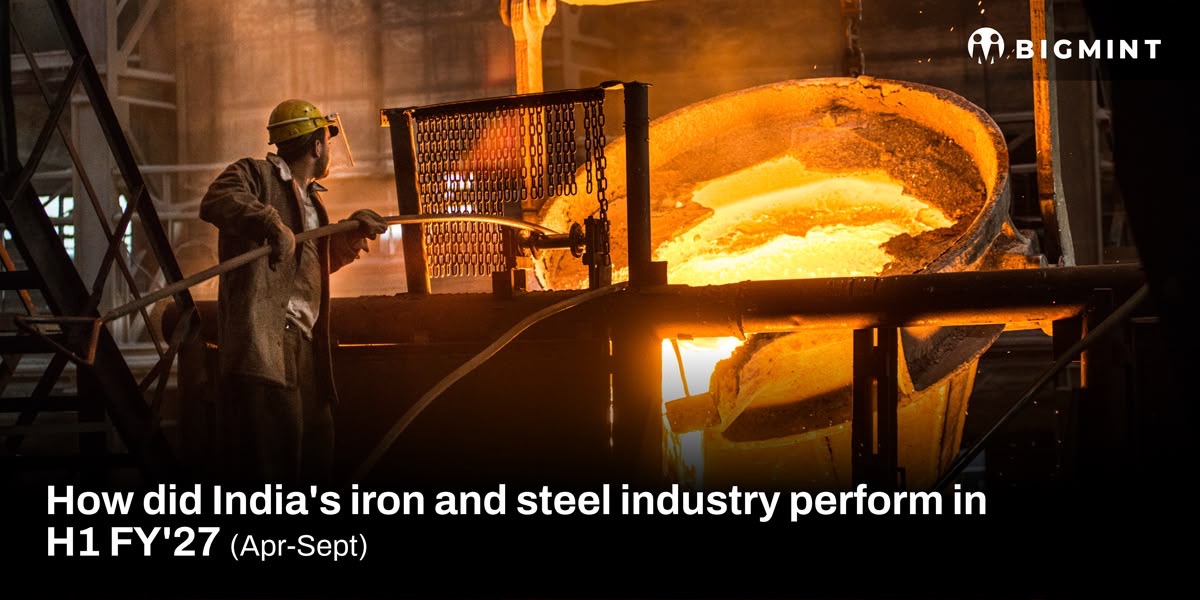
- India’s steel consumption up 7% y-o-y, outpaces 3% production growth
- BigMint’s India Steel Composite Index rises by 12% as input costs surge
- Iron ore production rises but so do imports; coal output, imports fall
Morning Brief: India’s steel industry entered FY’27 with demand growing faster than domestic crude steel production, but higher raw material costs, intermittent plant disruptions, and tighter coal availability limited the pace of output growth.
Crude steel production rose 3% y-o-y to 85.1 million tonnes (mnt) in H1FY’27 (April-September 2026), sharply slower than the 12% growth in H1FY’26, according to BigMint data.
Finished steel production increased 4% y-o-y to 81.8 mnt, while consumption rose 7% to 84.9 mnt. The resulting gap between demand and production lifted prices and boosted imports, even as exports also increased sharply. Meanwhile, BigMint’s India Steel Composite Index averaged 147.6 points, up 12% y-o-y, as tighter availability and higher input costs supported prices.
Steel production slows amid cost, operational pressures
Crude steel production growth slowed sharply in H1FY’27, reflecting tighter raw material availability, operational constraints, and intermittent disruptions at large steel plants. Higher coal and energy costs also reduced the incentive to raise output aggressively, particularly during the monsoon when steel prices typically weaken.
Among major producers, JSW Steel’s crude steel output declined 8% y-o-y during April-August 2026, partly due to a scheduled furnace upgrade at Vijayanagar, while RINL’s output fell 6% following a fatal accident and financial pressures.
The slowdown was broad-based across ironmaking routes. Hot metal production rose only 2% to 48.3 mnt in H1FY’27, against 7% growth in H1FY’26, while DRI production increased 3% to 30.4 mnt, compared with 9% growth a year earlier.
Demand growth remains strong, outpacing production
Steel consumption rose 7% y-o-y to 84.9 mnt in H1FY’27, exceeding the 3% increase in crude steel production, although demand growth slowed from 9% in H1FY’26.

Manufacturing sentiment also moderated. India’s manufacturing PMI averaged 54.0 points during April-August 2026, down from 58.7 a year earlier, although it remained above the 50-point threshold indicating expansion.
Steel-intensive sectors remained supportive. Infrastructure and construction goods output, as per the Index of Industrial Production (IIP), rose 7.3% y-o-y during April-August, while capital goods output increased 16.9%, accelerating from 7.6% a year earlier.
The data suggests that the production slowdown has been driven more by supply and cost constraints than by a sharp deterioration in end-use demand. Infrastructure, construction, and capital-goods activity continue to provide a floor for steel consumption, although higher fuel costs and weaker manufacturing momentum remain risks.
India remains net finished steel importer
India remained a net finished steel importer in H1FY’27 despite a sharp rise in exports. Finished steel exports increased 26% y-o-y to 3.55 mnt, while imports rose 24% to 4.14 mnt, widening the trade deficit slightly to 0.59 mnt from 0.55 mnt in H1FY’26.
Exports were supported by stronger shipments to the UAE and Vietnam, while the UK also emerged as an important destination, with the India-UK free trade agreement improving market access.
However, exports to the EU remain constrained by the safeguard regime and CBAM-related requirements. BigMint calculations show India’s duty-free quota allocation across five flat steel categories fell 40.8% to 1.42 mnt from 2.4 mnt.
Imports, meanwhile, continued to rise despite the 11.5% safeguard duty on certain flat steel imports. The Advance Authorisation Scheme has allowed eligible export-oriented manufacturers to import steel without the same domestic duties and restrictions, keeping imported HRC commercially viable for some downstream users.
Steel prices rise as supply tightens
The India Steel Composite Index averaged 147.6 points in H1FY’27, up 12% y-o-y and reaching a more than four-year high by end-September. This was a sharp reversal from H1FY’26, when prices were at more than four-year lows.
The recovery was driven more by supply constraints and higher costs than by stronger demand alone. Rebar production declined 21.4% from 5.09 mnt in March to 4 mnt in August, partly due to lower output at Jindal Steel and RINL.
Domestic HRC availability also tightened amid maintenance shutdowns at major eastern mills. HRC production declined 1.5% y-o-y to 12 mnt during April-August, while rebar production remained broadly stable at 22 mnt.
With coking coal and both domestic and imported non-coking coal costs rising sharply, mills have had limited scope to absorb higher production costs. This supported steel prices despite the moderation in consumption growth.
Iron ore production surges, but imports also climb up
Domestic iron ore production increased 21% y-o-y to 159 mnt in H1FY’27, substantially outpacing crude steel growth. However, imports, including pellets, jumped 45% to 8.71 mnt as integrated mills continued to seek high-grade, low-impurity material amid localised supply shortages and competitive international prices.
Meanwhile, iron ore exports, including pellets, rose 30% to 12.95 mnt on favourable realisations and stronger Chinese demand. Notably, pellet exports reached a two-year high of 1 mnt in August, supported by better realisations in July, Chinese buyers’ preference for pellets amid higher lump premiums, and improved domestic pellet availability.
Coal production, imports decline
Domestic coal production declined 2% y-o-y to 439 mnt in H1FY’27. Metallurgical coal imports fell 8% to 40.5 mnt, while thermal coal imports dropped 14% to 74 mnt.
Data suggests that imports of metallurgical coal — including premium hard coking coal, hard coking coal, and softer grades, as well as pulverised coal injection (PCI) — fell, but BigMint understands that this may be due to a misclassification of PCI imports as non-coking coal.
BigMint recorded a 12% increase in coking coal imports to 36.8 mnt, while PCI imports fell by a sharp 65% to 3.7 mnt. The sharp drop in PCI volumes may be due to Russian PCI being classified as non-coking coal; Russian non-coking coal inflows surged 72% y-o-y in H1FY’27. BigMint data suggests that India’s coking coal imports increased by 12% y-o-y to 36.8 mnt, driven by growth in hot metal output and a slight decline in domestic coking coal production.
Meanwhile, Indonesian and South African non-coking coal imports fell by around 20% y-o-y as higher freight, rupee depreciation, and elevated delivered prices reduced their competitiveness.
Additionally, Coal India increased dispatches by 7% to 382 mnt despite a 3% decline in production, drawing down pithead stocks to sustain supplies.
However, higher power demand increased pressure on coal-fired plants, leaving industrial consumers such as sponge iron producers facing tighter availability. Monsoon-related logistics disruptions also affected rake movements.
Scrap shifts towards domestic supply
Domestic scrap generation increased 38% y-o-y to 19.8 mnt, while scrap imports fell 41% to 2.48 mnt. Higher domestic collection and vehicle scrappage improved local availability, while a weaker rupee and higher freight costs raised the landed cost of imported scrap, leading users to favour cheaper domestic material.
Overall, scrap consumption increased by 20% in H1FY’27, accelerating from the 13% growth in the year-ago period.
Outlook
H2FY’27 is seasonally stronger for India’s steel market, and demand growth is likely to remain around 7% if infrastructure, construction, and capital goods activity hold up. However, El Nino-related weather risks, elevated fuel costs, and tighter monetary conditions could eventually weigh on downstream steel absorption.
The bigger variable will be supply. Domestic coal availability should improve as the monsoon recedes and logistics normalise, while improving Chinese mine supply could ease global coking coal prices. However, high freight costs, elevated power prices, and potential domestic coal shortages could still limit the pace of production recovery.
For steel prices, this points to continued support in H2, but with a more measured upside. Supply normalisation should cap price gains if mills restore output, while firm H2 demand and still-high input costs should prevent a sharp correction.
Leave a Reply