- Indian copper cathode prices rise 4.5% amid uptick in LME
- High refined copper prices increase interest in scrap
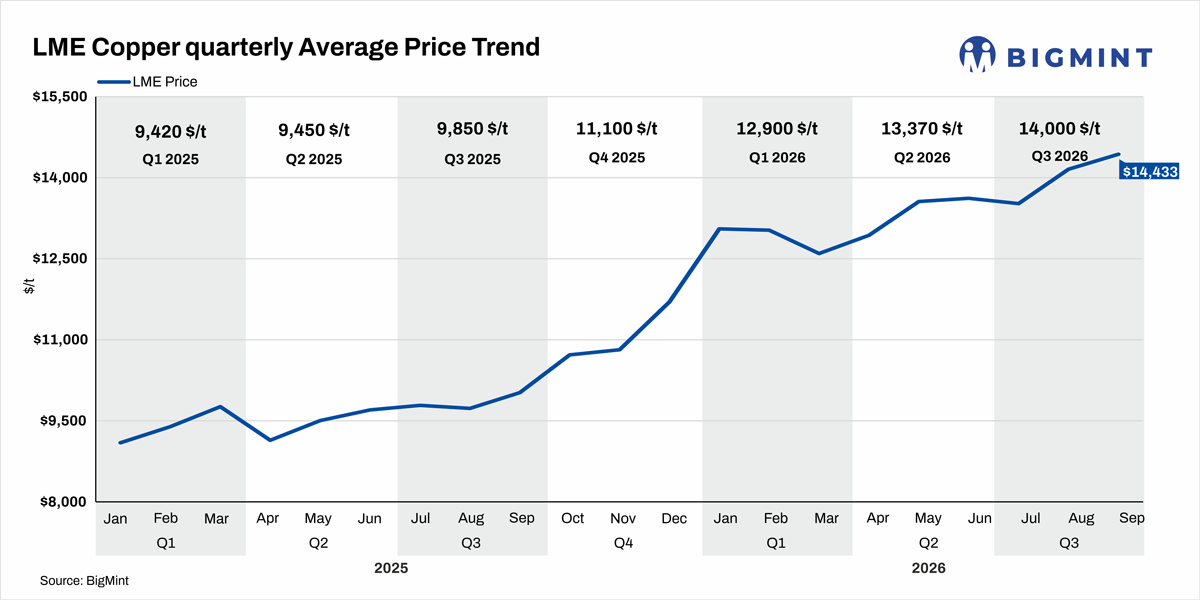
Indian copper cathode prices rose 4.5% in Q2FY’27 (June-September 2026), tracking a sharp rise in international copper prices and higher import costs as the global market tightened. BigMint’s assessment shows ex-Mumbai cathode prices averaged INR 1,363,000/tonne (t) during the quarter, up from INR 1,304,000/t in Q1FY’27, as firm LME prices and rising Japan-origin premiums lifted the landed cost of imported material.The increase came as the global copper market moved into a tighter supply phase, with disruptions at major mines, declining treatment and refining charges, and concerns over concentrate availability supporting prices. London Metal Exchange (LME) three-month copper averaged $14,000/t in Q2FY’27, up 4.6% from Q1, before reaching a record $14,858/t on 9-10 September. At the same time, Japan-origin cathode premiums for India rose to $350-400/t from around $250/t earlier in the year, adding to domestic costs and signalling tighter availability of spot material.

What lifted global prices in Q2FY’27?
Global copper prices surged during the June-September quarter (India’s Q2FY’27), primarily driven by upstream tightness. The International Copper Study Group (ICSG) revised its 2026 global mine-production growth forecast down to 1.6%, citing constraints in Chile, Indonesia and the Democratic Republic of Congo. Incidents at Grasberg in Indonesia and Kamoa in the DRC continued to affect supply expectations.
This fed directly into the concentrate market. Treatment and refining charges (TC/RCs) fell sharply, with CIF China clean copper concentrate TC/RCs assessed at a record low of negative $132/t and negative 13.2 cents/lb in early July and fallen to -$200/t earlier in September. In simple terms, many smelters were paying to secure copper concentrate, signalling that feedstock — not refined cathode — was the tightest part of the chain.
China’s copper concentrate TC/RCs were expected to remain under pressure in the June-September quarter because new smelting capacity was increasing demand for concentrate, while spot availability remained tight. Several additional smelting projects are expected to further increase demand from the October-December quarter.
The US copper tariff regime also tightened in 2026. From 6 April 2026, the US applied a 50% Section 232 tariff to the full customs value of most covered copper articles and derivatives, rather than only the copper content.
For the copper market, the tariff has encouraged importers to secure material ahead of policy changes and increased the incentive to redirect refined copper towards the US market. This contributed to tighter availability in other regions and added support to international copper prices. The US administration also indicated that it would review whether a 15% tariff on refined copper from January 2027 and 30% from January 2028 would be warranted.
Consequently, the market set fresh all-time highs in September 2026. LME three-month copper touched an intraday record of $14,694/t on 8 September, surpassing the previous January peak of $14,527.50/t, before extending to an all-time high of $14,858/t on 9-10 September. COMEX copper also reached a record $6.89/lb, or about $15,057/t, on 22 September.
India production

How were Indian market dynamics in Q2FY’27?
Indian copper prices rose in Q2FY’27, driven by higher LME prices, tightening concentrate availability, supply disruption risks, and uncertainty over US tariff decisions. Strong demand from power, grid infrastructure, renewables, and electrification continued to support the market, with Indian copper demand projected to grow around 9% in CY’26, according to International Copper Association India.
High refined copper prices increased interest in scrap, but tight availability of high-recovery grades such as Millberry, Birchcliff, and Candy Berry limited supplies. Chinese and Far East buyers reportedly offered $70-100/t more than Indian buyers, diverting cargoes and keeping Indian scrap premiums elevated. This made cathode relatively more attractive despite high prices.
Kutch Copper’s 500,000 t/y facility continued to ramp up, adding domestic Grade-A cathode supply, while imported cathode premiums of around $350-400/t remained high. India produced 183,000 t of refined copper in Q1FY’27 and imported 153,000 t of cathodes, anodes, and blister copper, indicating that domestic consumers continue to rely on both local and overseas supplies.
Additional updates
India’s refined copper capacity expands with Kutch Copper ramp-up
Kutch Copper’s 500,000 t/y copper smelter at Mundra continued to ramp up during 2026, strengthening India’s domestic refined copper supply. The company’s Grade-A cathodes also received LME brand registration in July, enabling the material to be delivered against LME copper futures. The development is expected to improve domestic cathode availability and gradually reduce India’s reliance on imported refined copper.
Copper industry seeks lower GST
In September 2026, Indian copper producers urged the government to reduce GST on copper products to 5% from the current 18%. Industry participants argue that the high tax rate ties up significant working capital and increases the financial burden across the copper value chain. If implemented, a lower GST rate could improve liquidity and reduce the working-capital burden for manufacturers and downstream users.
Hindalco advances copper capacity expansion
Hindalco is progressing with a 300,000 t/y expansion of its copper smelting capacity at Dahej, targeted for FY’29. The company is also commissioning a 50,000 t/y copper e-waste recycling facility, with plans to scale the capacity to 200,000 t/y. These projects are expected to strengthen India’s domestic refined copper supply and support the country’s efforts to reduce dependence on imported copper.
Gravita expands copper recycling capacity
Gravita India announced a INR 160 crore, 29,400 t/year copper recycling plant at Mandvi, Gujarat, followed by 59,200 tpa additional capacity at Mundra with INR 64 crore capex, planned in phases by March 2029. Combined capacity of 88,600 t/year will strengthen domestic scrap processing and backward integration.
DRC tightens copper concentrate exports.
On 29 June 2026, the DRC signed an order banning copper and cobalt concentrate exports to promote domestic processing. The move raised concerns over concentrate availability and further pressured copper TC/RCs, which had already fallen to record lows. CIF China clean copper concentrate TC/RCs reached -$132/t and -13.2 cents/lb in July. However, the impact may be partly offset by Kamoa-Kakula’s 500,000 t/y smelter ramp-up.
India reviews pre-shipment inspection rules for metal scrap
After DGFT tightened mandatory pre-shipment inspection certificates (PSIC) procedures in August, several recyclers reported shipment delays, penalties and higher compliance costs, prompting the government to review the requirements. India imports about 13 mt of scrap annually from over 160 countries. Relaxation could improve copper-scrap availability and reduce sourcing costs, although no final decision had been made.
India faces a long-term copper capacity gap
Despite major capacity additions by Kutch Copper and Hindalco, India’s copper consumption is expected to grow rapidly. The International Copper Association India estimates that the country will require around 500,000 t of additional refined copper capacity every five years to keep pace with demand. This suggests that current capacity additions may reduce near-term import dependence but further investments will be required to meet longer-term consumption growth.
Outlook
India’s copper demand is expected to strengthen in Q3FY’27, supported by the festive season, when consumer spending typically increases on automobiles, electrical appliances, consumer electronics and housing-related products. These segments are copper-intensive and may encourage higher purchases of refined copper and semi-finished products. In addition, improved construction and infrastructure activity could support demand from the electrical and power sectors. With festive restocking by manufacturers and traders, domestic copper prices may continue to gain strength, particularly if global copper prices remain elevated and availability in the domestic market stays relatively tight.
Meanwhile, the global copper market is likely to remain tight in October-December, with concentrate availability emerging as the key factor for elevated prices. Record-low TC/RCs and the DRC’s concentrate export restrictions indicate that smelters are competing aggressively for limited feedstock, while additional Chinese smelting capacity could keep pressure on the concentrate market. At the same time, the potential implementation of higher US tariffs on refined copper from 2027 could continue to encourage front-loading of purchases and tighten availability in other regions.
With LME copper already near $14,858/t, prices are likely to remain elevated, with the upper end of $14,000-15,000/t emerging as the key near-term range, while any fresh mine disruptions or stronger US buying could push prices above this range.
Leave a Reply