- Domestic processing takes precedence over exports
- Circular economy ambitions reshape global markets
Aluminium and copper scrap are no longer viewed simply as industrial waste. As countries pursue decarbonisation, resource security and domestic manufacturing, recyclable metals are increasingly being recognised as strategic raw materials. This shift is prompting governments to introduce export restrictions, levies and policy measures designed to retain scrap for domestic processing rather than exporting it overseas.
The changing policy landscape reflects the growing importance of secondary metals in the global energy transition. Recycling aluminium consumes approximately 95% less energy than producing primary aluminium from bauxite, while recycled copper also requires significantly less energy than primary production. Consequently, securing domestic scrap has become an important component of industrial policy, helping countries strengthen circular economies, reduce emissions and support downstream manufacturing.
Against this backdrop, several major exporting regions are beginning to reshape global scrap trade.
UAE scrap export curb signals shift towards domestic value addition
In June 2026, the United Arab Emirates imposed a temporary four-month restriction on exports of selected aluminium, copper and ferrous scrap until 8 October 2026. The measure aims to strengthen domestic recycling and downstream manufacturing by retaining more recyclable material within the country.
While the restriction is temporary, its implementation has already affected market activity.
According to Jawed Ahmed, Founder and CEO, Al Qaryan International DMCC, “The current UAE restriction is temporary, but in practice no new export contracts are being permitted. Existing contracts may receive approval, but fresh export business has effectively come to a standstill.”
Beyond the temporary measure, the UAE’s strategy reflects a broader long-term objective of increasing domestic consumption of recyclable metals.
Commenting on the country’s recycling ambitions, Ahmed noted, “EGA’s recycling capacity is larger than the aluminium scrap currently generated within the UAE. In the long run, domestic consumption of aluminium scrap is expected to increase significantly, reducing export availability.”
His remarks suggest that retaining scrap is not merely a short-term market intervention but part of a broader strategy to expand domestic recycling and value-added aluminium production.
Saudi Arabia also tightening oversight
While the UAE’s export restriction has attracted significant market attention, similar developments are beginning to emerge elsewhere in the Gulf.
According to Ahmed, Saudi Arabia has started introducing tighter oversight of non-ferrous scrap exports through export approvals and quota mechanisms as it seeks to encourage greater domestic processing.
“Governments are increasingly encouraging companies to build secondary smelters domestically instead of exporting scrap. The objective is to create value-added products within the country rather than shipping recyclable raw materials overseas,” Ahmed explained.
Although Saudi Arabia has not officially announced an export ban or formal restrictions on aluminium and copper scrap exports, Ahmed believes the increasing use of export approvals and quota mechanisms reflects a gradual move towards tighter regulatory oversight. While these measures are not yet equivalent to an export ban, they indicate the Kingdom’s broader intent to prioritise domestic recycling and downstream manufacturing.
Although the approaches differ across countries, the underlying policy objective remains the same: retaining strategic recyclable materials to support domestic industrial development and strengthen the circular economy.
European Union considers export levy
A similar debate is unfolding in Europe, where policymakers are seeking to balance industrial competitiveness, recycling, and open trade.
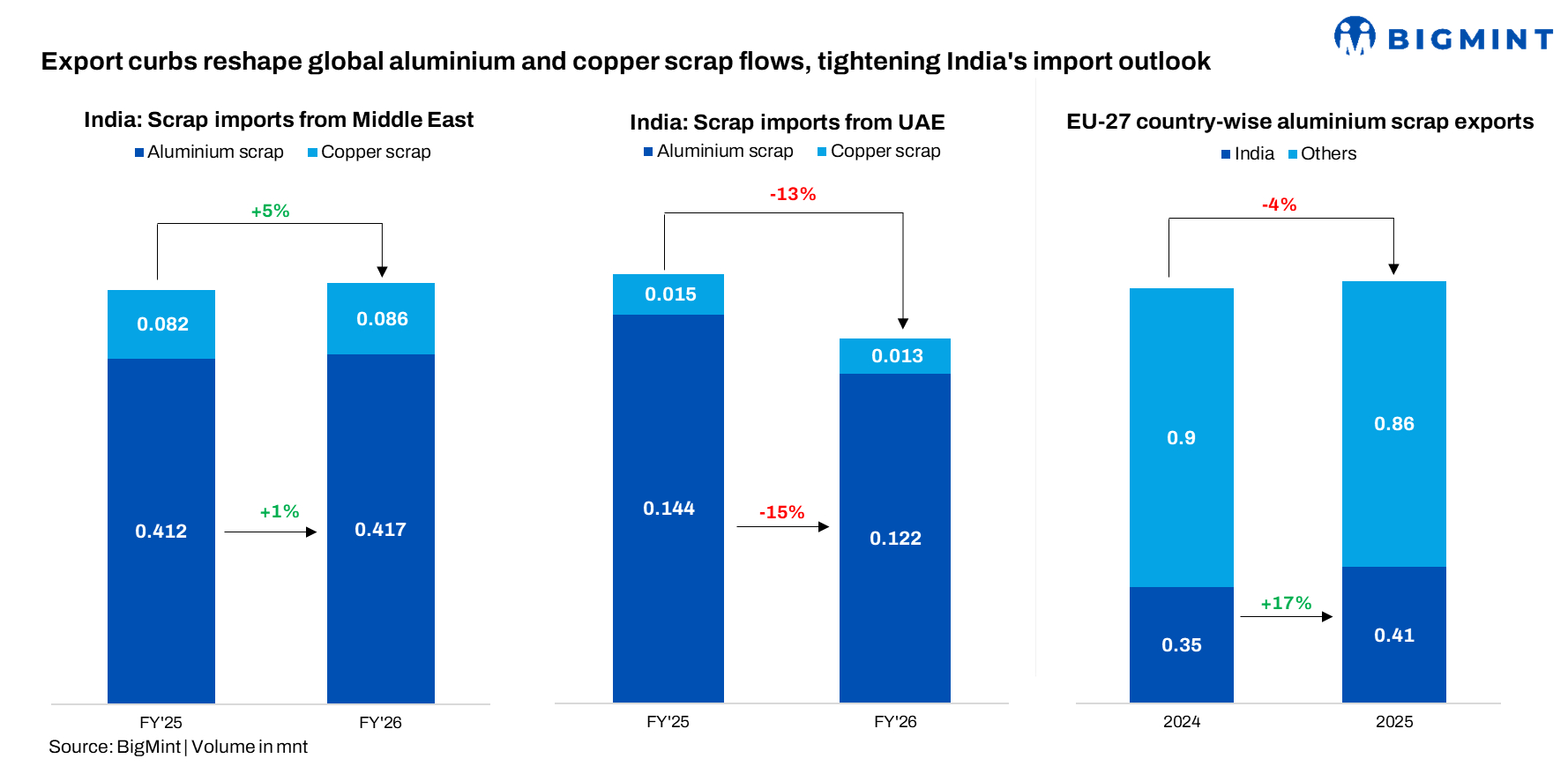
The European Commission is expected to table a proposal in September 2026 to introduce a 15% levy on aluminium scrap exports, following record exports of 1.27 million tonnes (mnt) in 2025, nearly 50% higher than 2019 levels. The proposal reflects Europe’s growing focus on securing secondary raw materials to support domestic recycling, strengthen downstream manufacturing and accelerate low-carbon aluminium production.
Many believe the proposal reflects a broader shift in industrial policy.
Aluminium scrap is increasingly being viewed as a strategic secondary raw material rather than simply recyclable waste. Ensuring adequate domestic feedstock has become central to supporting Europe’s circular economy and low-carbon manufacturing ambitions.
At the same time, the proposal has sparked considerable debate within the recycling industry, with many participants continuing to advocate for open and efficient global markets.
Industry participants argue that open international trade allows different grades of aluminium scrap to be processed in the markets where they can be recycled most efficiently. They also contend that restricting exports may not necessarily increase domestic recycling and could instead weaken collection incentives, discourage investment and reduce the overall efficiency of the circular economy.
The contrasting viewpoints highlight the policy challenge facing Europe, balancing domestic resource security and industrial competitiveness while preserving the economic viability of the recycling sector and the efficiency of global circular supply chains.
A structural shift in global scrap markets
Taken together, these developments indicate that export controls on recyclable metals are becoming an increasingly important policy tool rather than isolated trade measures.
Summarising this broader trend, Ahmed observed, “This is not just about the UAE. Across the region, governments are increasingly treating recyclable metals as strategic resources and encouraging domestic value addition instead of exporting scrap.”
For importing countries such as India, this evolving policy environment has significant implications. India remains heavily dependent on imported aluminium scrap to support its growing secondary aluminium industry. As more exporting nations prioritise domestic recycling and downstream manufacturing, Indian recyclers may face higher procurement costs, greater competition for available material, and increasing pressure to diversify sourcing.
At the same time, these developments reinforce the importance of strengthening India’s domestic scrap collection, recycling infrastructure and circular economy to reduce long-term import dependence.
Outlook
The global scrap market is entering a new phase where government policy is becoming as influential as supply and demand fundamentals. Whether through temporary export restrictions, export levies or tighter regulatory oversight, countries are increasingly seeking to retain recyclable metals to support domestic recycling, improve resource security and capture greater value within their own economies.
As these policies evolve, they are likely to reshape global aluminium and copper scrap trade flows, influence procurement strategies and redefine the role of secondary metals in the global manufacturing landscape.
These developments and their implications for India’s recycling ecosystem will be among the key discussion themes during the “Secondary Aluminium: Scrap Supply, Policy Gaps & Alloy Market Outlook” session at the Global Commodity Conclave (GCC) 2026, hosted by MCX with BigMint as the Event Partner, from 12-14 August 2026 at the Jio World Convention Centre, Mumbai.
As India accelerates its transition toward a circular non-ferrous economy through policy reforms, recycling and sustainable manufacturing, GCC 2026 will bring together policymakers, producers, recyclers, traders, downstream consumers and global commodity leaders to discuss market trends, trade policies, technology, sustainability, business opportunities and the future of India’s non-ferrous metals and recycling ecosystem.

Leave a Reply