-
BF-BOF route makes for 41% of crude steel output
-
India produces 91 mnt of hot metal, 55 mnt of DRI
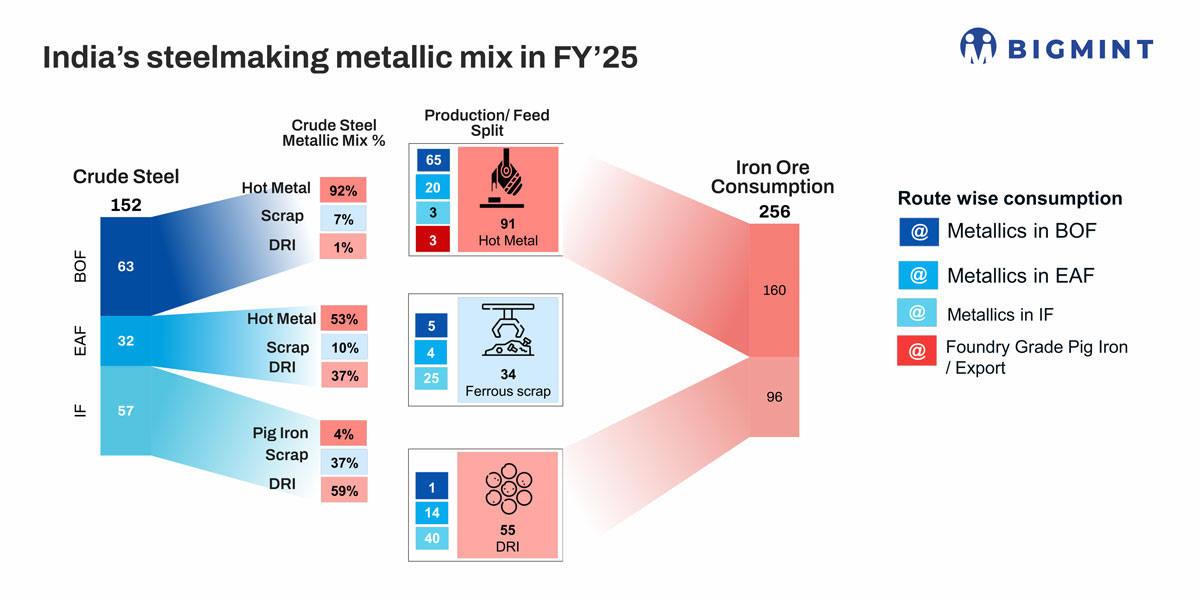
India’s crude steel production increased by 6% y-o-y to 152 million tonnes (mnt) in FY’25, with the blast furnace (BF)-basic oxygen furnace (BOF) route contributing 63 mnt (41%). Induction furnace (IF) mills produced 57 mnt (38%), while the remaining 32 mnt (21%) came from the electric arc furnace (EAF) route. As such, IF-EAF units (59%) continued to dominate India’s crude steel production matrix.
Metallic mix in each route
BF-BOF: In the BF-BOF route, hot metal comprised 92% of the metallic mix, scrap 7%, and direct reduced iron (DRI) a minimal 1%.
EAF: Steelmaking from the EAF route was largely dependent on hot metal, which comprised 53% of the metallic mix. DRI made up 37% and scrap a modest 10%.
IF: Production by IF mills was overwhelmingly reliant on DRI, at 59%, while scrap accounted for 37% of the metallic mix. Pig iron’s share was at a minor 4%.
Raw material consumption
Hot metal: India produced 91 mnt of hot metal in FY’25, with the lion’s share (65 mnt) being employed in BOF steel manufacturing. EAF-based producers consumed 20 mnt of hot metal, with IF mills taking in a mere 3 mnt. Additionally, 3 mnt was used to produce foundry-grade pig iron.
Ferrous scrap: Of the 34 mnt of domestic scrap generated, 25 mnt went into IF production. Modest volumes — 5 mnt and 4 mnt – were utilised in the BF-BOF and EAF routes, respectively.
DRI: The majority share -40 mnt – of the 55 mnt of DRI produced was deployed in IF-route steelmaking. EAF-based producers consumed 14 mnt, while BF-BOF mills utilised 1 mnt.
Iron ore consumption
Of the 256 mnt of iron ore produced, 160 mnt (62.5%) was absorbed for hot metal production, while 96 mnt (37.5%) was consumed for DRI.
Leave a Reply