- Indian HRC strengthens into Europe while Chinese export prices remain under pressure
- Iron ore extends losses as coking coal rallies on Chinese supply disruptions
- Regional supply conditions increasingly determine steel prices across export markets
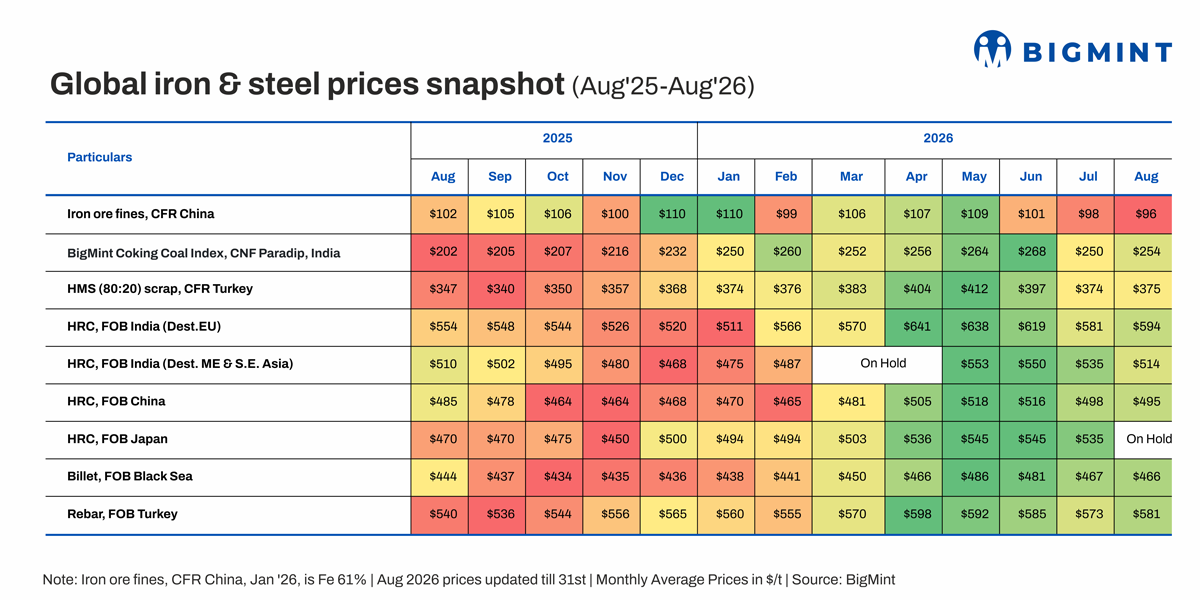
Morning Brief: Global steel markets moved in different directions during August as finished steel prices increasingly diverged from raw material trends. Chinese iron ore prices extended their decline on weak steel mill margins and abundant seaborne supply, while metallurgical coal strengthened after tightening supplies in China, Russia and Mongolia revived seaborne buying. Finished steel prices, meanwhile, remained comparatively resilient. Indian HRC strengthened into Europe, Turkish long steel recovered and Chinese HRC export prices slipped only marginally despite subdued overseas demand.
Chinese steel production continues to shape both sides of the raw material market. Weak mill profitability and cautious procurement are weighing on iron ore demand, while supply disruptions in metallurgical coal have tightened availability and lifted replacement costs for blast furnace producers. Mills have responded by maintaining pricing discipline, managing export allocations and directing material towards markets offering stronger returns.
Chinese steel margins weigh on iron ore while coking coal tightens
China’s benchmark Fe 61% iron ore fines index averaged $96/dmt CFR China in August, down from $98/dmt in July and extending the correction from this year’s peak of $109/t in May.
Weak steel mill margins, production cuts and abundant seaborne cargo availability continued to weigh on the market. Mills largely maintained hand-to-mouth procurement strategies, particularly for low- and medium-grade ore, while waiting for further price declines before rebuilding inventories. Several suppliers, particularly in Jiangyin, reportedly withdrew spot offers as prices fell below acceptable levels, preferring to hold inventories rather than sell into a weaker market. The reduction in spot liquidity did little to change procurement behaviour.
Metallurgical coal moved in the opposite direction. Australian premium hard coking coal prices increased by around $6/t m-o-m during August as tighter Chinese domestic supplies and lower Russian and Mongolian availability revived Chinese spot buying.
BigMint’s premium hard coking coal index averaged $254/t CNF Paradip during August before strengthening sharply into September. The benchmark reached $299/t CNF Paradip on 4 September, up $19/t week-on-week and the highest level since the index was launched in August 2024.
Mysteel’s survey of 523 Chinese coking coal mines showed washed coal inventories falling to their lowest level in more than four years as mine safety inspections and constrained domestic production tightened supply. Russia’s July coal production also declined to 32.7 mnt, the lowest monthly output this year, while weaker Mongolian supplies further increased China’s reliance on seaborne cargoes.
Indian HRC outperformed as mills prioritised stronger export markets
Indian HRC export prices showed contrasting trends across key destinations during August. BigMint’s HRC FOB India assessment for Europe increased to $594/t from $581/t in July, while export prices to the Middle East and Southeast Asia declined to $514/t from $535/t.
The month began with cautious buying across the Middle East and Vietnam as geopolitical uncertainty and weak downstream demand weighed on activity. Market conditions improved during the second half of August as enquiries strengthened and pipe manufacturers returned to the Middle East for restocking, with around 90,000 t of Indian HRC reportedly booked during the month.

Higher domestic realisations and largely filled export allocations strengthened mills’ pricing power towards month-end. Producers increasingly prioritised markets offering stronger export realisations, reducing their willingness to lower offers into Vietnam, where buyers remained resistant to prevailing price levels and awaited price announcements from major domestic mills before committing to fresh purchases.
Buying in Europe also remained constrained despite firmer Indian offers, with safeguard quota availability continuing to limit import opportunities.
China’s HRC export market remained subdued throughout August. Offers edged lower to around $495/t FOB Rizhao from $497.5/t in July as overseas buying interest remained weak and trading activity stayed muted. Adverse weather disrupted loading and berthing operations at Chinese ports, delaying vessel movements by 10-15 days. Mills nevertheless maintained firm offer levels as higher production costs limited their willingness to reduce prices further.
Scrap stabilises as Turkish rebar prices recover
Imported HMS 80:20 scrap into Turkiye remained broadly stable during August at around $374-376/t CFR after correcting sharply over recent months. Trading activity remained steady, with around 13-15 deep-sea cargoes concluded each week involving US, European and Baltic-origin material at $367-374/t CFR.
Firm freight rates and tighter scrap availability continued to support supplier offers. US-Turkiye freight increased to around $36-38/t, while low Rhine water levels and continued Black Sea disruptions raised replacement costs.
Turkish rebar export prices strengthened towards month-end to $590-600/t FOB, improving scrap competitiveness. Mills nevertheless remained largely requirement-driven, with stronger rebar demand and margins still needed to support more aggressive scrap buying. Freight costs, Far East billet availability and US scrap collection costs remain the principal variables for the market.
Black Sea billet prices were broadly unchanged at $466/t FOB, indicating that the correction seen through June and July has begun to stabilise.
Outlook
Global steel markets enter September with increasingly divergent drivers across the value chain. Chinese steel margins continue to pressure iron ore demand, while supply disruptions in metallurgical coal have tightened seaborne availability and lifted blast furnace input costs. Finished steel prices have remained comparatively resilient as mills maintain pricing discipline and allocate material towards markets offering stronger returns.
A recovery in Chinese steel production would support iron ore demand, while any improvement in Chinese domestic coking coal supply or Russian and Mongolian exports could ease pressure on metallurgical coal. Until then, regional supply conditions, export allocation strategies and mill discipline are likely to remain the principal drivers of global steel prices.
Leave a Reply