- Indian HRC into EU strengthens on domestic price support
- Chinese HRC recovers on higher raw material costs; cautious demand limits gains
- Turkish scrap rallies on mill restocking and tight metallics supply
Morning Brief: Global steel markets moved higher across several key benchmarks in September, but the drivers remained regional rather than demand led.
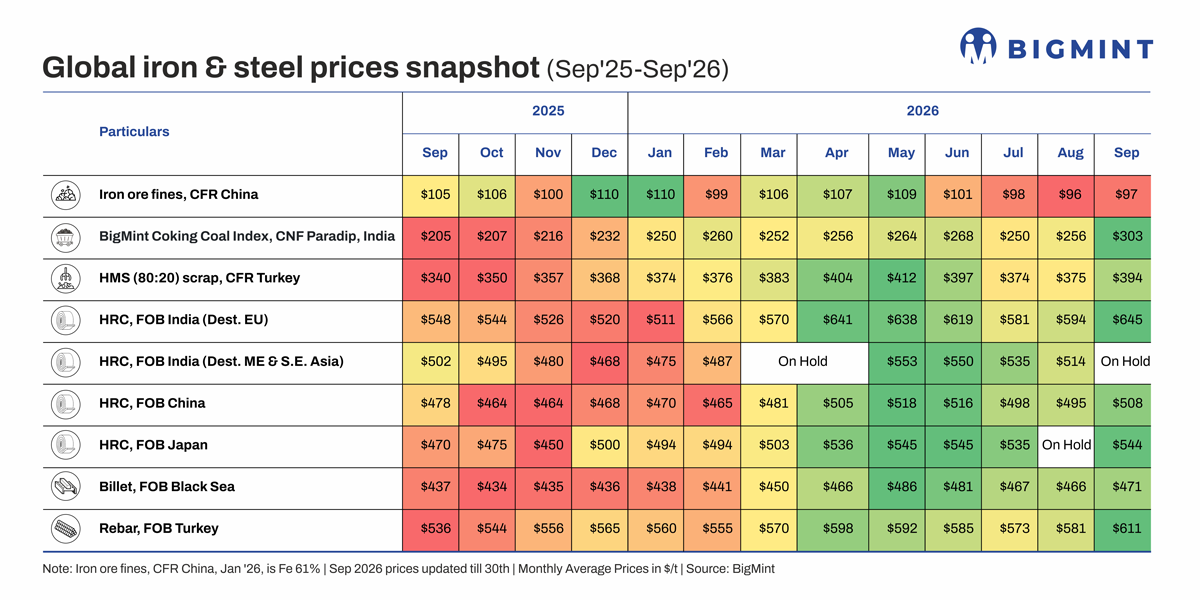
Indian HRC strengthened into Europe as higher domestic realisations and limited export availability reduced incentive for mills to sell overseas, while Chinese HRC recovered on higher raw material costs and improved restocking but faced cautious overseas buying.
Turkish scrap rallied as mill restocking coincided with limited Black Sea metallics and higher replacement costs, while iron ore’s pre-holiday recovery faded as weak underlying steel demand and expectations of production cuts kept sentiment subdued.

Indian HRC strengthens as export availability tightens
Indian HRC export prices to Europe rose to an average of $645/t in September from $594/t in August, as stronger domestic realisations and limited export availability lifted mills’ price expectations. Most export allocations were already committed, reducing the incentive for mills to offer additional volumes.
The opening of the Q1CY’27 EU quota window brought buyers back to the market, while expectations of further price increases encouraged selective bookings. The combination of limited availability and renewed buying allowed mills to maintain higher offers despite cautious demand.
Indian HRC offers to the Middle East and Southeast Asia remained on hold during September. With domestic prices elevated and export availability limited, mills continued to prioritise domestic sales rather than add fresh export volumes.
Chinese HRC recovers as raw material costs rise
Chinese HRC export prices increased to $508/t FOB in September from $495/t in August. Offers strengthened at the beginning of the month as higher iron ore and coking coal prices raised mills’ cost pressure, while improved restocking demand in key overseas markets, including Vietnam, supported buying.
The recovery remained limited as overseas buyers stayed cautious. Higher raw material costs supported mill offers, but cautious buying limited the ability of sellers to push prices higher. Market participants expect Chinese HRC prices to remain rangebound after the National Day break, with the balance between raw material costs and buyer resistance likely to determine the next move.
Growing challenges in standalone export trading are also prompting mills and traders to explore project-led export channels combining steel supplies with technical services and project support, particularly in Southeast Asia and Africa. This development may be best treated as a change in export strategy by Chinese suppliers.
Turkish scrap rallies on restocking amid tight supply
Turkish imported HMS 80:20 scrap strengthened sharply during September. The monthly average increased to $394/t CFR Türkiye from $375/t in August, while spot prices reached $404/t CFR during the month. US East Coast HMS also increased to $366/t FOB, from $344/t in August.
Mill restocking, limited Black Sea metallics availability, higher freight and collection costs and firm rebar prices supported the market. Turkish export rebar prices increased to $625/t FOB from $590/t in August, widening the scrap-rebar spread from around $210-215/t to about $221/t.
Around 16-20 HMS 80:20 deals were captured during September, mostly in the $380-404/t CFR range. Buying momentum moderated in the final week as mills became more cautious amid weaker rebar demand. The Turkish scrap market is expected to remain at around $400-410/t CFR in October.
Iron ore edges higher before month-end correction
Chinese Fe 61% iron ore fines averaged $97/dmt CFR China in September, up $1/dmt m-o-m from $96/dmt in August. Prices firmed ahead of the 1-7 October Golden Week holidays as market participants completed short-term restocking before the break.
Improved ferrous sentiment following China’s latest housing support and targeted monetary measures provided additional support. However, the increase in procurement did not signal a meaningful recovery in underlying iron ore demand.
Expectations of steel production cuts and continued pressure on finished steel prices kept sentiment subdued, and prices eased to around $93/dmt by month-end.
Outlook
Global steel markets enter October with finished steel prices supported by limited availability and mill pricing power, while underlying demand remains uneven. Indian HRC is entering the month with stronger European realisations and limited export availability. Chinese HRC is likely to remain rangebound after the National Day break as higher raw material costs support mill offers but cautious overseas buying limits further gains.
Turkish scrap is expected to remain around $400-410/t CFR as tight metallics availability and replacement costs support the market, although weaker rebar demand could constrain buying momentum.
Iron ore is likely to remain subdued during the first week of October because of the Chinese holiday break, before potentially rebounding towards $97-98/dmt as the market resumes. The month-end decline to around $93/dmt reflected the continued weakness in underlying steel demand and expectations of production cuts rather than a sustained recovery in ore procurement.
Across the finished steel markets, regional supply conditions, raw material costs and buyer resistance are likely to determine how far mills can push prices in October.
Leave a Reply