- Global production growth accelerates from CY’25’s 2.5%
- Chinese output climbs up by 7% on manufacturing demand
- Strong infra, consumer goods demand lifts Indian output by 5%
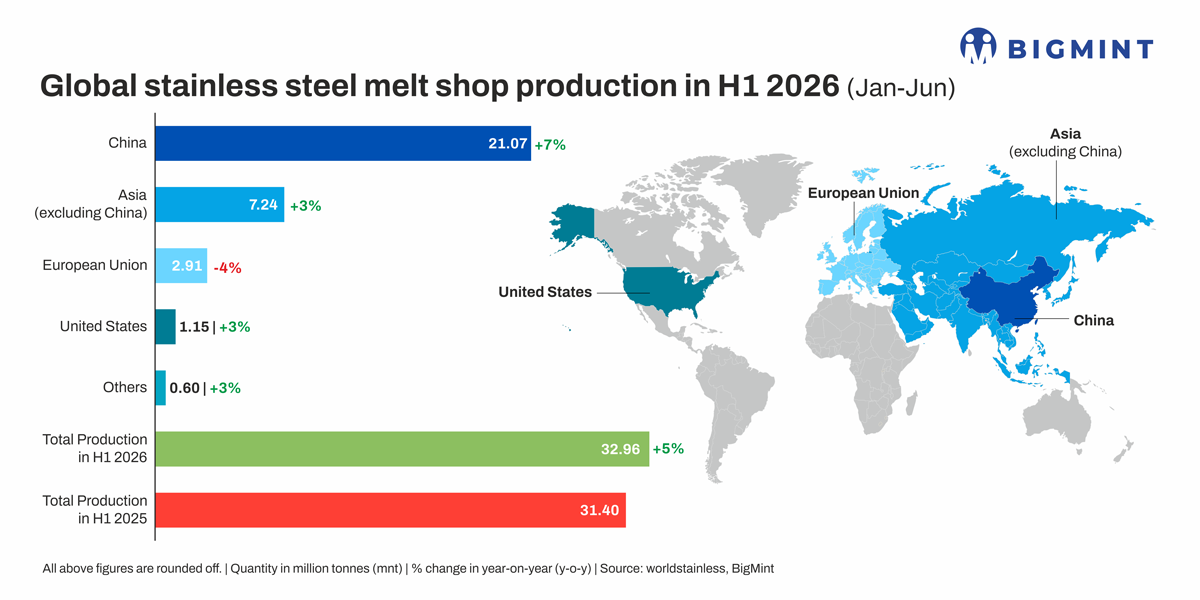
Morning Brief: Global stainless steel melt shop production increased 5% y-o-y to 33.0 million tonnes (mnt) in H1CY’26, according to world stainless, with growth primarily driven by Asia, particularly China.
This marks an acceleration from CY’25, when global crude stainless steel production had climbed up by 2% y-o-y. Additionally, production momentum strengthened considerably as the second quarter progressed, given that global output was higher by only 2.5% in Q1CY’26. Global crude stainless steel production in Q2CY’26 stood at 17.2 mnt, a 7.6% increase y-o-y.
In H1CY’26, Asian production rose 6.1% y-o-y to 28.3 mnt, accounting for more than 85% of global output. China alone produced around 21.1 mnt during the period, maintaining its dominant position in global stainless steel production.
China drives Asian output growth
In Asia, Chinese production increased by 7.1% to 21.1 mnt, accounting for around 64% of global output. Chinese stainless steel output growth was sustained despite a challenging domestic market environment characterised by relatively low stainless steel prices and persistent margin pressure on mills.
Several factors underpinned China’s production resilience. Continued capacity availability across large integrated producers, steady downstream demand from infrastructure, manufacturing, and consumer sectors, and a seasonal production recovery following the Chinese New Year period — during which mills typically reduce operating rates and defer maintenance — all contributed to a stronger Q2 that offset a softer Q1 start.
To illustrate, China’s production of air conditioners, refrigerators, and washing machines increased y-o-y, with refrigerators recording the strongest growth of 12.8% y-o-y to 57.8 million units.
India also posts robust production growth
India’s stainless steel production reached 2.16 mnt in H1CY’26, up 5% y-o-y from 2.05 mnt in the year-ago period, across both flat and long products. The growth reflects sustained domestic demand across infrastructure, consumer goods, food processing, and industrial sectors.
India’s stainless steel production capacity is set to expand further, led by investments from Jindal Stainless (JSL). The company is expanding its cold-rolled capacity by around 620,000 t to 2.67 mnt by FY’28, supporting higher-value products for the automotive, appliances, food processing and industrial sectors.
JSL is also expanding annealing and pickling facilities at Jajpur and targeting product sales of around 3.5 mnt by FY’29. Separately, the company is evaluating a 4 mnt/year stainless steel plant in Maharashtra, supporting long-term capacity growth. These investments are expected to strengthen India’s domestic stainless steel supply, improve product availability and reduce dependence on imports, particularly for thin and specialty grades.
Indonesia emerges as key production hub
Additionally, Indonesia has emerged as an increasingly important stainless steel producer in Asia, backed by its integrated nickel-processing and stainless steel production base. The country has around 25 mnt of installed steel capacity and has already reached the capacity level targeted under its 2035 industrial plan.
However, domestic consumption has expanded more slowly than production, increasing the importance of exports for Indonesian producers. The country’s restrictions on nickel ore exports have also encouraged greater domestic processing into nickel products, stainless steel slabs, and finished steel.
Demand weakness weighs on European production
European stainless steel production contracted 4% y-o-y to 2.9 mnt in H1CY’26 from 3.0 mnt in H1CY’25. However, in Q2, production edged marginally higher to 1.50 mnt versus 1.49 mnt a year earlier, offering a tentative sign of stabilisation, though this was insufficient to alter the half-year trend.
The decline reflects a combination of structural and cyclical pressures: weak stainless steel demand across key European end-use sectors, elevated production costs relative to Asian competitors, and sustained pressure on mill profitability. Import competition has added a further layer of margin compression, with Asian — particularly Chinese and Indonesian — material competing aggressively on price in European markets.
On the policy front, the EU’s Carbon Border Adjustment Mechanism (CBAM) and active trade defence measures are beginning to reshape the competitive landscape by raising barriers and import costs for certain origins. While these measures hold the potential to support European producers over the medium term by levelling the cost playing field, the immediate benefit has been limited by the weakness of underlying demand — the more fundamental constraint on European output in H1CY’26.
US sees measured recovery as trade protection continues
US stainless steel melt shop production increased 3% y-o-y to 1.11 mnt in H1CY’26, with Q2 output rising 4% y-o-y to 0.58 mnt from 0.55 mnt in Q2CY’25 — a sequential acceleration mirroring the broader global pattern of stronger second-quarter momentum.
The US recovery reflects a relatively supportive domestic market environment, driven primarily by data centres and energy projects, and meaningfully reduced import competition, partly attributable to trade protection measures that have improved the competitive position of domestic producers against Asian imports.
However, US stainless production remains structurally constrained by higher operating costs relative to Asian peers, limiting the headroom for volume-driven growth even in a favourable trade policy environment.
Outlook
Global stainless steel production is expected to remain on a growth trajectory in H2CY’26, supported by continued capacity availability and resilient demand in Asia. China is likely to remain the key driver, while Indonesia’s expanding integrated nickel-to-stainless steel base will intensify competition across Asian and export markets.
India’s production is expected to maintain steady growth, backed by infrastructure and manufacturing demand and ongoing capacity additions. In contrast, Europe is likely to face continued pressure from weak end-user demand, high production costs, and import competition, although CBAM and trade defence measures could provide some medium-term support.
The US market is expected to see a gradual recovery, aided by trade protection and firmer domestic demand, but higher production costs will limit the pace of expansion. Overall, global production growth is likely to remain Asia-led, with rising Indonesian capacity and Chinese export competitiveness continuing to shape global stainless steel trade flows and pricing dynamics.
Leave a Reply