- Bangladesh, Pakistan see steepest decline in volumes
- Currency volatility keeps buyers away
- Turkey quake may impact volumes this year
- Indian shipbreakers seen opting for greener methods
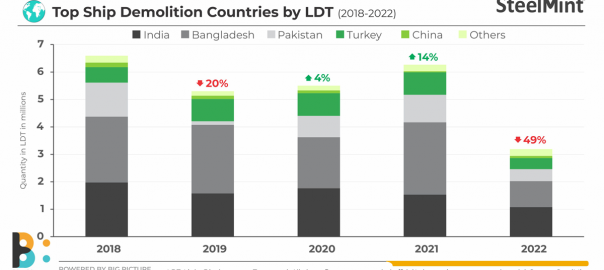
Morning Brief: Global ship recycling activities fell into choppy waters, diving down a steep 49% in 2022, reveals SteelMint data, against a 14% increase in 2021. Total tonnage scrapped last year amounted to 3.19 million light displacement tonnage (LDT) against 6.27 million LDT in 2021. LTD refers to the weight of a ship excluding cargo, fuel, water, ballast, stores, passengers, crew etc but with water in boilers to a steaming level.
In terms of the number of vessels scrapped, these were at 438 last year compared to 766 in 2021, down 43% y-o-y.
Bangladesh and Pakistan also registered the steepest drop in tonnage volumes y-o-y.
The three countries that receive the highest number of ships globally for breaking are India, Bangladesh and Pakistan, together contributing over 90% of the dismantling volumes.
India bags top slot
However, data also reveals that India displaced Bangladesh as the leading ship-dismantler in 2022. India ended last year with a ship-breaking tonnage of 1.08 million LDT against Bangladesh’s 0.95 million LDT. Pakistan closed last year in third slot with 0.44 million LDT.
Of course, all three showed a y-o-y drop with Bangladesh and Pakistan floundering on the deepest side. Bangladesh was down a steep 64% (2.63 million LDT in 2021), while Pakistan also showed a sharp 56% y-o-y drop (1.00 million LDT).
India, despite steaming up to the top slot, ended y-o-y down 30% against 1.54 million LDT in 2021.
If judged from the number of vessels beached for breaking, India revealed a 40% decrease to 126 (211 in 2021). Bangladesh was down 57% to 122 vessels (254). Turkey took third slot but also showed a 38% decrease to 48 vessels (77) and Pakistan recorded the steepest drop at 64% to 43 (119).

Reasons for the drop in ship-breaking tonnage
- Bangladesh swims against the tide: Ship-breaking activities in Bangladesh almost stalled for a period because the government was not allowing importers to open new LC accounts in the face of a dollar crisis, putting importers in a bind. As a result, not only did Bangladesh slide to second position, its volumes plunged the deepest, by 64%.
Ship-breaking is a hugely capital-intensive business. However, the runaway inflation last year led to a severe liquidity crunch and an escalating dollar against the Bangladeshi taka (BDT) made imports costlier. These factors combined to put many vessels out of the reach of buyers.
“The LC issue badly hit the ship-breaking industry in Bangladesh,” a source observed.
That apart, the overall steel scenario was dull last year. Frequent power outages — because of high energy prices — disrupted or curtailed mills’ production schedules while consumption dropped because of the inflation and lack of purchasing power.
- Pakistan plagued by several challenges: This country too faced similar issues as Bangladesh last year, apart from political instability and natural calamities. Power outages curtailed steel production while demand remained poor. Opening of new LCs was banned. Consequently, tonnage plunge 56% y-o-y, the second-highest drop.
- India fares better but volumes drop: India was the brightest spot last year amongst all the steel-producing countries, reporting an almost 6% y-o-y increase in crude steel production when all the other major players floundered in the negative. Thus, it needed enough ship-recycled material as raw material.
The tonnage fell 30% — but which was much lower than what the other South Asian players witnessed. This was mainly on account of a lesser currency depreciation compared to the taka or Pakistani rupee.
Thirdly, the credit availability was marginally better in India than in the other two South Asian nations. It takes 2-3 months for a ship to get procured, dismantled and then find its way into the market to be sold as plates (80%) and scrap (20%). This entire cycle is mainly funded through credit.
- Currency volatility keeps buyers away: Currencies were volatile in 2022. Buyers, wary of incurring losses amid fluctuating currencies, stayed away.
Moreover, there was uncertainty over the resale value of ships, because of the volatile currencies, which restrained many fresh vessels from getting beached.
It may be recalled the dollar had appreciated over 12% last calendar. As per reports, in 2022, the BDT lost 21.88% to the dollar in 2022, PKR by 28.15% and the Indian rupee by 11.37%.
- Ship recycled prices higher than domestic prime materials: Ship recycled prices reigning last year were higher than that of prime materials available in the local market. The 15% export duty in India kept prices of domestic prime materials down. Therefore, it was not viable to import vessels, dismantle and cut into “plates” and sell. Since these plates are melted and remade into rebar, angles, channels etc, these actually compete with billets, which were cheaper.

Outlook
Turkey, which is the fourth-largest ship dismantler, saw tonnage dropping over 50% last year. It may see volumes declining further this year because of the earthquake.
But, Bangladesh buyers are now seen buying vessels of small tonnages through 100% self-financing.
“Bangladesh players are slowly coming back into the game,” observed an Indian shipbreaking source.
Where India is concerned, players are likely to focus more on the Hong Kong Convention (HKC)-certified vessels, because globally this industry is trying to convert to Green recycling.

Leave a Reply