- Vessel supply contracts as higher freight rates keep ageing ships in service
- India emerges as only South Asian recycling hub to record growth in volumes
- Activity in Bangladesh, Pakistan slows amid regulatory uncertainty, financial constraints
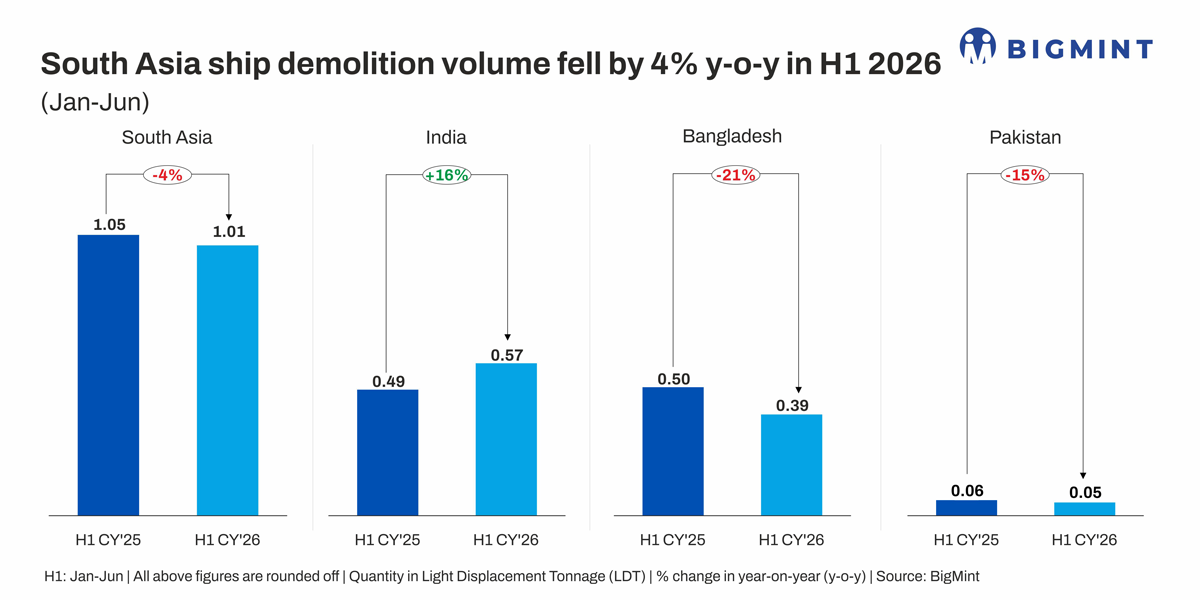
Morning Brief: Global ship recycling activity remained relatively subdued during H1CY’26, with demolition volumes declining 4% y-o-y to 1.01 million light displacement tonnes (LDT).
The decline reflected limited availability of recycling candidates as relatively firm freight markets, geopolitical disruptions in the Red Sea and Middle East, and improving vessel earnings encouraged owners to continue operating older ships rather than selling them for demolition.
Notably, although Bangladesh and Pakistan recorded lower arrivals, India strengthened its position as South Asia’s leading ship recycling destination, supported by expanding Hong Kong International Convention (HKC) compliance, relatively stronger infrastructure and increased vessel arrivals.
India expands regional leadership as Bangladesh, Pakistan lose ground
India was the only major South Asian recycling destination to record growth during H1CY’26. Ship demolition volumes in India increased 16% y-o-y to around 569,000 LDT, while Bangladesh declined 21% to 392,000 LDT and Pakistan fell 15% to nearly 51,000 LDT.
The stronger performance enabled India to increase its share of regional recycling activity, benefiting from better HKC compliance, relatively better financing, operational stability, and continued investment in recycling infrastructure. In contrast, Bangladesh and Pakistan continued to face regulatory uncertainty, financial constraints, and slower vessel inflows, limiting overall recycling activity despite a gradual uptrend in demolition prices.

India benefits from HKC compliance, infrastructure, policy support
India strengthened its leadership in global ship recycling in H1CY’26, accounting for 35.4% of worldwide ship recycling volume, with the Alang-Sosiya yard handling 98% of the country’s recycling activity. More than 115 operational yards are now compliant with the Hong Kong International Convention (HKC), giving India the highest certified recycling capacity globally. During this period, India also advanced applications for additional EU approvals while continuing infrastructure expansion under the Alang redevelopment programme.
The Shipbreaking Credit Note Scheme, which rewards shipowners for recycling vessels at HKC-compliant Indian yards with a tradeable credit worth 40% of the scrap value, continues to strengthen Alang’s position as a safe, environmentally compliant, and globally competitive ship recycling hub. Ongoing capacity expansion from 4.5 million tonnes (mnt) to 9 mnt per annum and continued efforts to secure EU approval for Indian yards also helped India increase its share of the global recycling landscape.
Another notable trend during H1CY’26 was the increasing arrival of OFAC-sanctioned vessels. These ships, typically sold at discounted prices because of sanctions-related restrictions, provided Indian recyclers with attractive procurement opportunities despite associated compliance challenges.

Bangladesh struggles with regulatory transition
Bangladesh experienced one of the sharpest declines among major ship recycling nations during H1CY’26, with demolition volumes falling 21% y-o-y to around 392,000 LDT. The slowdown was primarily driven by regulatory uncertainty surrounding the simultaneous implementation of the Basel Convention and the HKC, creating uncertainty for both recyclers and vessel owners.
Although more than 25 recycling yards have obtained HKC certification and additional facilities continue upgrading infrastructure, the industry remains divided over future regulatory implementation. Ship recyclers argue that applying Basel Convention requirements alongside HKC could significantly increase operating costs and reduce Bangladesh’s competitiveness against regional peers.
Beyond regulatory uncertainty, weaker domestic steel demand, persistent banking constraints, political instability, and monsoon-related disruptions further limited procurement appetite despite gradually improving demolition prices. Consequently, many recyclers continued to adopt a cautious buying approach, resulting in lower vessel arrivals throughout the first half.
Pakistan advances with Gadani modernisation
Pakistan’s ship recycling volumes declined 15% y-o-y to nearly 51,000 LDT during H1CY’26, reflecting limited vessel availability, liquidity constraints, and cautious buying by local recyclers. However, unlike Bangladesh, the country’s long-term outlook continued to improve as the government accelerated structural reforms aimed at modernising the Gadani Ship Breaking Yard.
During the review period, Pakistan granted industrial status to the ship recycling sector, accelerated upgrades of recycling plots, established hazardous waste management infrastructure, and expanded compliance with the HKC. Nine of Gadani’s sixteen recycling plots have already been upgraded, while the remaining facilities continue inspections and infrastructure improvements.
Authorities estimate Gadani could eventually supply nearly one-third of Pakistan’s domestic steel scrap requirement, reducing dependence on imported ferrous scrap and strengthening the country’s circular steel economy. Nevertheless, subdued domestic steel demand, limited financing, and relatively low vessel availability continued to restrict recycling activity during H1CY’26, preventing the sector from fully benefiting from improving demolition prices.
Turkiye consolidates its position in green ship recycling
Unlike South Asian markets, Turkiye continued strengthening its position in environmentally compliant ship recycling.
The Aliaga ship-breaking yard saw healthy recycling activity throughout H1CY’26, supported by regular vessel arrivals and growing preference among European shipowners for EU-approved recycling facilities. Market participants also expect several Royal Navy vessels, including HMS Montrose, HMS Westminster and HMS Northumberland, to arrive during the coming months, supporting activity during H2CY’26.
Turkiye continues to benefit from its dual compliance with both the EU Ship Recycling Regulation (EU SRR) and the HKC, positioning the country as Europe’s primary recycling destination.
Vessel composition changes significantly
The composition of vessels recycled during H1CY’26 shifted considerably.
Container vessel demolition increased nearly 376% y-o-y to approximately 89,000 LDT, supported by greater availability of ageing container ships following the normalisation of global shipping markets after the de-escalation of the Middle East conflict. General cargo recycling also increased 9%.
Conversely, tanker recycling declined 15%, remaining the largest drag on overall demolition volumes, while bulk carrier recycling fell 10% as owners retained vessels amid relatively healthy freight earnings. Other vessel categories recorded a modest 4% decline.
The changing vessel mix reflects evolving fleet economics rather than broad-based weakness in recycling demand.
Demolition prices recover through H1CY’26
Demolition prices improved steadily across South Asia after weakening during early 2026.
Indian container vessel prices recovered from around $418/LDT in January to approximately $453-454/LDT by June-July. Bangladesh strengthened from nearly $433/LDT to around $495/LDT, while Pakistan improved from about $430/LDT to approximately $480/LDT.
The recovery was supported by tighter vessel availability, improving domestic plate prices and cautious competition among recyclers for limited tonnage. Nevertheless, acquisition costs remained relatively high compared with finished steel prices, preventing aggressive buying.

Currency movements influence competitiveness
Currency fluctuations continued influencing procurement strategies during H1CY’26.
India experienced the sharpest depreciation among major recycling markets, with the rupee weakening nearly 9% y-o-y against the US dollar. Bangladesh’s currency remained broadly stable while Pakistan’s rupee showed modest appreciation during the period.
Although a weaker rupee increased imported vessel acquisition costs for Indian recyclers, stronger domestic fundamentals and higher compliance standards enabled India to remain competitive throughout H1.

HKC implementation, environmental scrutiny remain industry priorities
HKC compliance is increasingly becoming a deciding factor for shipowners, financiers and insurers when selecting recycling destinations. India currently leads global compliance with over 115 HKC-certified yards, while Bangladesh has more than 25 certified facilities and Pakistan continues upgrading Gadani under its modernisation programme. Till June, of Gadani’s 16 ship recycling plots, nine have been upgraded recently, while the remaining seven are undergoing inspection and approval. The government also plans to establish a Treatment, Storage, and Disposal (TSD) facility to ensure the environmentally sound handling of hazardous waste generated during ship dismantling. India has also submitted additional applications seeking EU recognition for several Alang yards, potentially expanding access to higher-value European vessels.
Despite the progress, environmental scrutiny intensified during H1CY’26. The European Commission’s proposal to include additional Indian recycling yards within the EU-approved list drew criticism from environmental organisations, which argued that traditional beaching methods remain incompatible with EU environmental standards. Bangladesh also witnessed renewed debate regarding simultaneous implementation of Basel Convention requirements alongside HKC, highlighting the continuing challenge of balancing environmental compliance with commercial competitiveness.
Outlook
Global ship recycling activity is expected to improve gradually during H2CY’26 as ageing fleets expand and decarbonisation requirements encourage retirement of older vessels. However, freight market strength, geopolitical developments, and vessel acquisition costs are likely to continue determining the pace of demolition.
India is expected to consolidate its leadership through expanding HKC compliance, infrastructure investments, capacity expansion and potential EU approvals. Pakistan’s ongoing modernisation programme could gradually improve vessel arrivals over the medium term, while Bangladesh’s recovery will largely depend on regulatory clarity, improved financing conditions and stronger domestic steel demand. As environmental compliance increasingly shapes shipowners’ recycling decisions, modernised and compliant recycling destinations are expected to capture a larger share of global ship recycling volumes.
Leave a Reply