- GCC production plunges amid geopolitical, operational disruptions
- African production falls following Mozal Aluminium’s shutdown
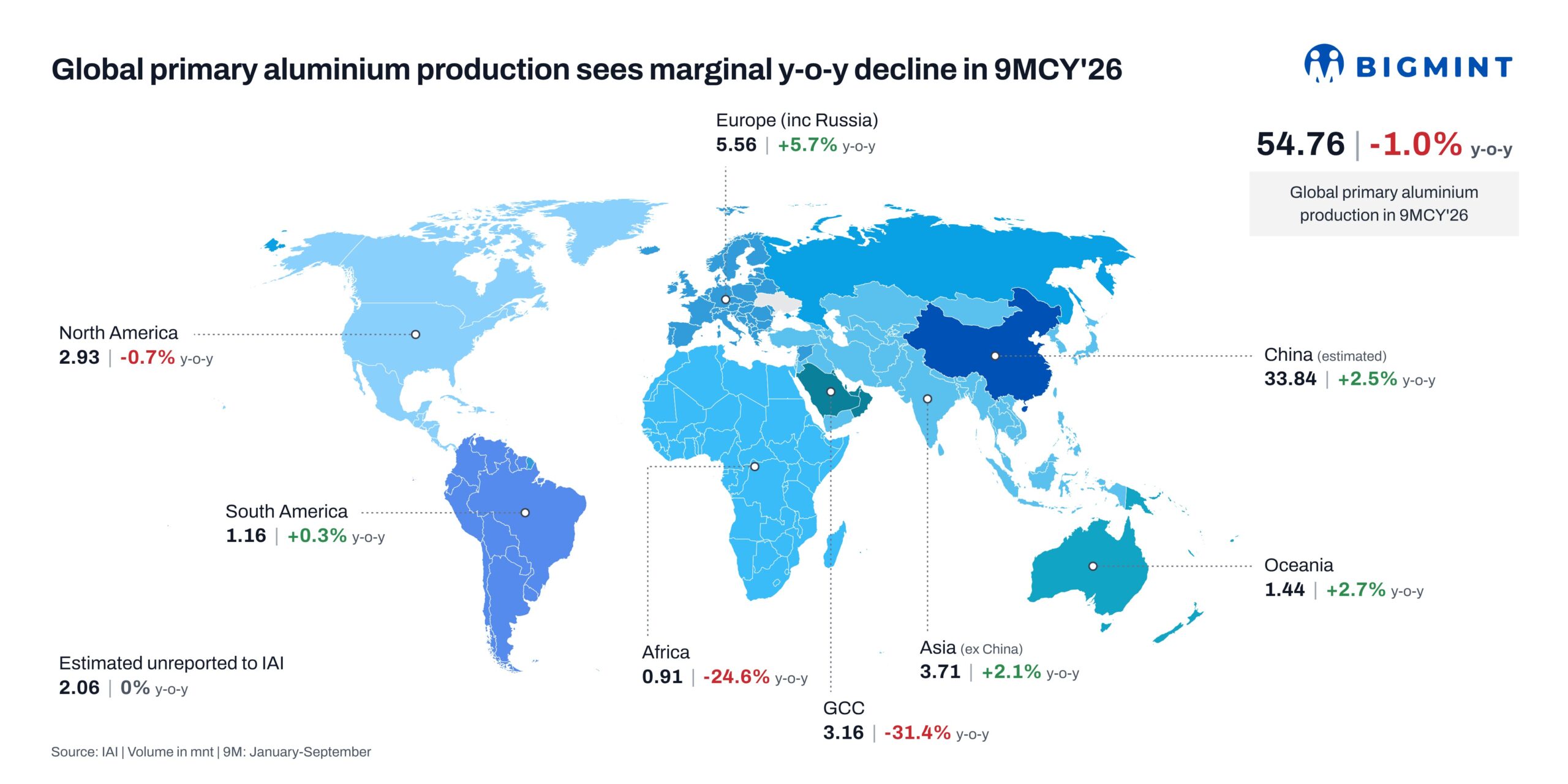
Global primary aluminium production declined 1% y-o-y to 54.76 million tonnes (mnt) in January-September (9MCY’26), compared with 55.29 mnt in the corresponding period last year, according to International Aluminium Institute (IAI) data.
Production trends remained mixed across regions, with sharp declines in the Gulf Cooperation Council (GCC) and Africa weighing on global output. Higher production in China, Europe, Asia excluding China and Oceania partly offset these losses. China’s rising output helped cushion the Gulf supply shock, although the increase was insufficient to prevent an overall contraction.
Regional drivers shaping global output in 9MCY’26
Africa recorded a 24.6% y-o-y decline in primary aluminium production to 0.91 mnt in 9MCY’26, primarily due to the shutdown of South32’s Mozal Aluminium smelter in Mozambique in March 2026. The facility was placed on care and maintenance after the company failed to secure sufficient and affordable electricity beyond March. The closure significantly reduced regional supply, while electricity constraints continued to limit production flexibility elsewhere in Africa.
North America recorded a marginal 0.7% y-o-y decline in production to 2.93 mnt, indicating broadly stable smelting activity. Canada’s aluminium industry benefits from access to hydroelectric power, while producers in the US remain exposed to energy and operating costs. Changes in US tariffs and cross-border trade flows also influenced regional market dynamics. However, the available evidence does not establish a specific major smelter disruption as the direct cause of the decline.
South America recorded a marginal 0.3% y-o-y increase in production to 1.16 mnt, with output remaining broadly stable. Brazil, the region’s principal producer, provided support through improved performance at certain smelting operations. South32 reported a 4% increase in FY26 saleable aluminium production at its Brazil Aluminium operation to 144,000 tonnes, following efforts to stabilise operations after unplanned pot outages and energy disruptions in December 2025. However, this improvement alone does not explain the entire regional increase.
Asia excluding China recorded a 2.1% y-o-y increase in production to 3.71 mnt, supported by established producers, particularly in India. Vedanta, Hindalco and NALCO continued to contribute to regional supply through their existing smelting capacities and operational improvements. Vedanta reported record cast aluminium production of 2.456 mnt in FY26, up approximately 1% y-o-y, reflecting continued output from its aluminium operations. These developments supported regional growth, although the contribution of individual countries to the overall increase remains unquantified.
Europe, including Russia recorded a 5.7% y-o-y increase in production to 5.56 mnt, supported by higher smelter operating rates and the restart of previously idle capacity. Improved output during the first half of 2026 contributed to the regional recovery. The inclusion of Russia is significant, as the reported figures cover a broader production base than the European Union alone.
Oceania recorded a 2.7% y-o-y increase in production to 1.44 mnt, with Australia remaining the region’s principal producer alongside New Zealand. The region’s established smelting base and electricity arrangements supported production stability. However, the available evidence does not identify a specific capacity expansion or operational development that fully explains the increase.
GCC recorded the steepest regional decline, with production falling 31.4% y-o-y to 3.16 mnt amid disruptions linked to the Middle East conflict. In Bahrain, Aluminium Bahrain (Alba) shut down three reduction lines, representing around 19% of its total capacity, while Qatar’s Qatalum faced reduced gas supplies. In the UAE, Emirates Global Aluminium’s (EGA) Al Taweelah smelter was forced into an emergency shutdown in March following an attack on the Khalifa Economic Zone Abu Dhabi.
As of 21 October, EGA had restarted 631 of 1,262 reduction cells, restoring 50% of the smelter’s cells, and expects to recover full production capacity in Q1 2027. The gradual restart process and continuing supply-chain constraints have prolonged the impact on regional output.
China (estimated) recorded a 2.5% y-o-y increase in production to 33.84 mnt, supported by high smelter operating rates and favourable production economics. China’s rising output and exports helped cushion Gulf supply disruptions, with aluminium exports increasing 16% y-o-y during the first eight months of 2026, adding around 670,000 tonnes and partly offsetting the decline in UAE exports. A separate industry report put Chinese primary aluminium production at 35.03 mnt in January–September, up 3.8% y-o-y.
Estimated unreported production to the IAI remained unchanged at 2.06 mnt in 9MCY’26. This category represents estimated output not directly reported to the International Aluminium Institute.
Outlook
Global primary aluminium supply will depend on the pace of GCC smelter recovery, the restoration of stable operations at affected facilities and electricity availability in Africa. EGA’s restart of half of Al Taweelah’s reduction cells provides an indication of gradual recovery, while continued growth in China could help cushion supply losses.
Nevertheless, geopolitical tensions, shipping constraints and uncertainty surrounding the full restoration of Gulf capacity remain key risks to global supply. Continued production growth in China, Europe and Asia excluding China may provide support, but the pace of recovery in disrupted regions will be critical to the global outlook.
Leave a Reply