- Aluminium production declines amid Gulf supply disruptions
- China, Europe offset sharp production losses in Gulf region
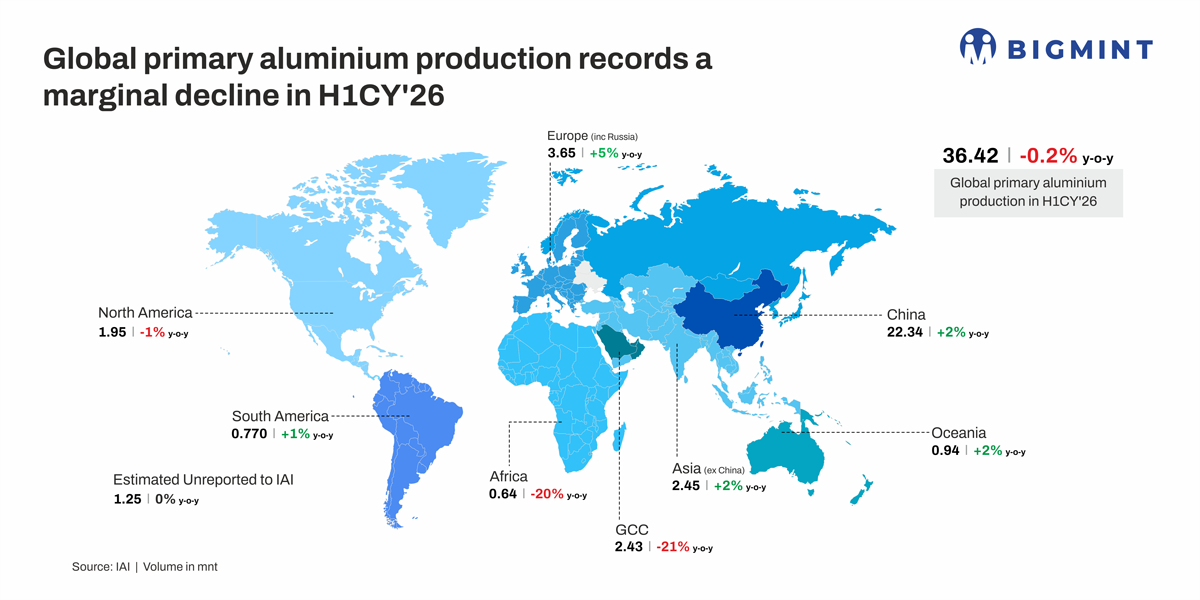
Global primary aluminium production stood at 36.42 mnt in H1CY’26, marginally lower than 36.49 mnt in H1CY’25, according to the International Aluminium Institute (IAI).
Trends remained mixed across regions, reflecting the impact of energy costs, geopolitical developments, and changing operating conditions across major producing regions.
Production increased in Europe (including Russia), Asia (excluding China), China, Oceania, and South America, while output declined in the Gulf Cooperation Council (GCC), Africa, and North America. The sharp drop in GCC and African production offset gains in other regions, highlighting continued supply-side challenges across key aluminium-producing hubs.
Regional drivers shaping global primary aluminium output in H1CY ’26
The decline in global aluminium production was primarily driven by a sharp contraction in output from the Gulf Cooperation Council (GCC), where production fell 21% y-o-y to 2.43 mnt from 3.06 mnt. The region was severely impacted by the US-Iran conflict, which resulted in missile strikes on major aluminium facilities, including Emirates Global Aluminium’s (EGA) Al Taweelah smelter and Aluminium Bahrain (Alba), forcing emergency shutdowns, capacity curtailments, and prolonged repair work.
The conflict also disrupted logistics through the Strait of Hormuz, the world’s most critical export route for Gulf aluminium, restricting the movement of alumina, bauxite, petroleum coke, and finished metal. Several producers were forced to rely on alternative supply routes, while labour shortages, power disruptions, and elevated freight costs further weighed on production. Although EGA has begun restoring operations, the company has indicated that a full return to pre-conflict production levels could take several months, leaving GCC output well below historical run rates throughout the first half of 2026.
Outside the GCC, Africa’s production declined sharply following operational disruptions and the closure of the Mozal aluminium smelter in Mozambique, while North America recorded a marginal decline amid elevated electricity costs, maintenance-related outages, and limited capacity additions. In contrast, China, which accounted for over 61% of global production, increased output on a half-year basis, supported by resilient demand from the electric vehicle, renewable energy, power transmission, and infrastructure sectors, along with improved alumina availability and high smelter operating rates.
However, June production eased m-o-m because of seasonal maintenance, environmental inspections, and adherence to China’s 45-mnt annual capacity cap. Europe (including Russia) recorded higher H1 output as easing energy prices enabled the restart of previously idled smelting capacity, while Asia (excluding China) and Oceania benefited from stable operations, capacity expansions, and improved raw material availability. Overall, these gains were insufficient to offset the steep decline in GCC production, resulting in a marginal contraction in global primary aluminium output during H1CY’26.
Impact of pricing
On an H1CY basis, LME aluminium prices averaged $3,362/t in H1CY’26, marking a 32.2% y-o-y increase from $2,544/t in H1CY’25, supported by geopolitical tensions in the Middle East that disrupted supply expectations, tightening global aluminium availability, declining exchange inventories, and resilient demand from the automotive, power transmission, and renewable energy sectors. Elevated energy costs and concerns over trade policies and tariffs also kept market sentiment firm during the period.
Meanwhile, LME aluminium inventories declined by 12.9% y-o-y, averaging 2,478,184 t compared with 2,844,550 t during the corresponding period last year.
Outlook
In the near term, global primary aluminium production is expected to improve gradually as GCC smelters continue restoring operations and supply chains normalise following disruptions in the Middle East. A key positive development is Emirates Global Aluminium’s (EGA) restart of 89 reduction cells at its Al Taweelah smelter in early July, with the phased recovery expected to continue over the next year.
The restart has strengthened expectations of improved Middle East aluminium supply and weighed on market sentiment, with LME aluminium prices easing from late June and declining by nearly 10% through July 2026. However, overall production growth is likely to remain constrained by China’s 45-mnt capacity cap, elevated energy costs, geopolitical uncertainties, and potential trade policy changes.
While LME inventories remain relatively low and demand from the automotive, power transmission, renewable energy, and infrastructure sectors is expected to stay resilient, aluminium prices are likely to remain supported over the medium term despite the gradual recovery in global supply.
Leave a Reply