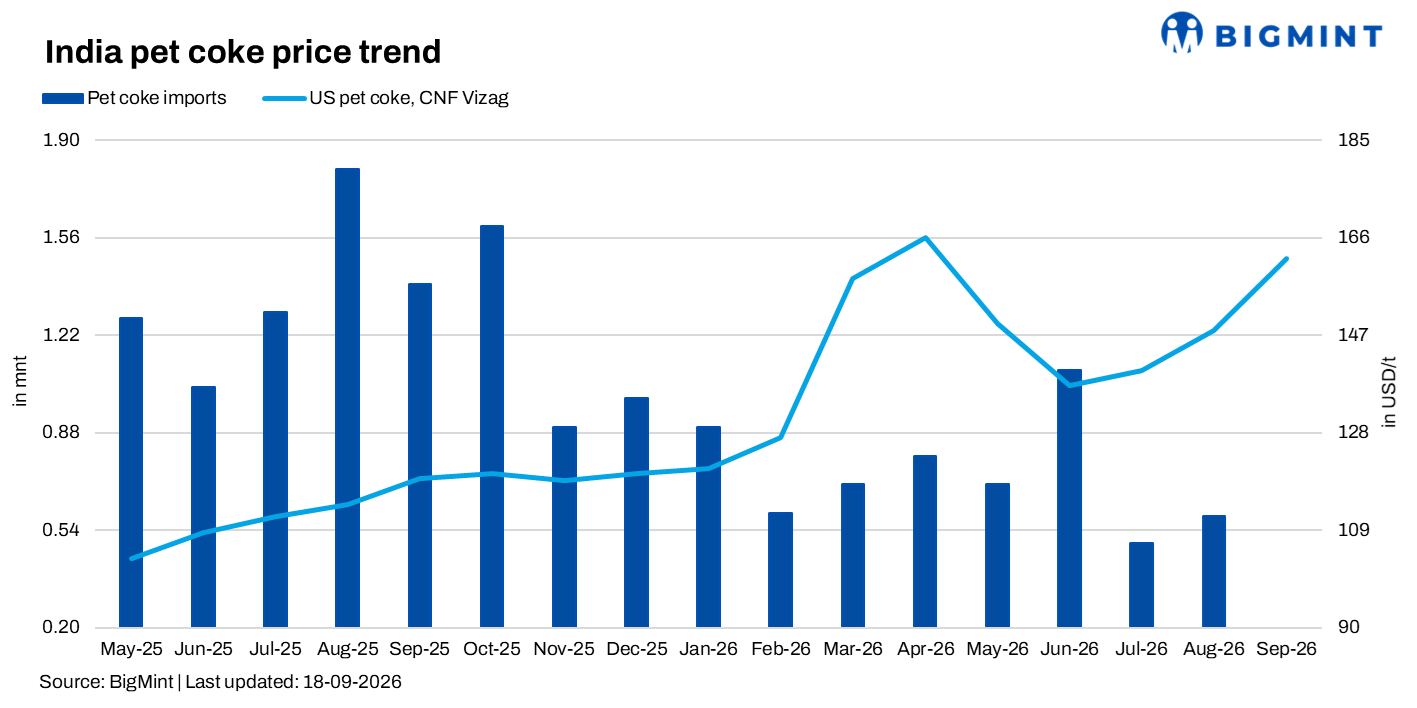
- Petcoke offers rise to $165-175/t CFR India as US Gulf Coast prices strengthen
- NAPP coal tightness deepens; Nov-Dec cargoes offered around $170/t CFR India
Global high-calorific fuel markets have tightened sharply in September 2026, with both petroleum coke (petcoke) and US Northern Appalachian (NAPP) thermal coal becoming significantly more expensive.
For India’s cement industry, the simultaneous rise is particularly significant. Cement producers have traditionally switched between petcoke, NAPP, and domestic coal according to delivered energy costs and availability. Earlier this year, expensive petcoke encouraged greater NAPP consumption. That alternative is now becoming scarce and expensive as well.
Petcoke rally gathers pace
US Gulf Coast (USGC) petcoke prices have risen sharply, with 6.5% sulphur USGC petcoke heard at $93/t FOB on 16 September, up $3/t w-o-w.
Indian market indications have since moved even higher, with 6.5% sulphur petcoke at $149-151/t CNF/CFR India on 21 August, rising to $153-165/t on 3-4 September and reaching $165-175/t by 18 September. Market checks on 18 September were concentrated around $170/t, with some indications reaching $175/t. Buyers nevertheless appear increasingly reluctant to chase these levels.
The underlying global move is broad-based rather than India-specific: USGC FOB prices and delivered values into China, Turkey and India have all strengthened.
Indian cement producers reassess petcoke purchases
Cement companies are responding through fuel optimisation rather than simply accepting higher petcoke prices.
In late August, several producers were already reporting greater use of NAPP or domestic coal as imported petcoke approached $150/t. By early September, offers had risen towards $155-160/t, while some producers relied on previously secured petcoke inventories and domestic alternatives.
At current $165-175/t levels, resistance has strengthened further. Market feedback suggests some plants are avoiding fresh imported petcoke purchases or buying only where necessary.
However, physical imports continue. September vessel movements show US petcoke cargoes destined for Shree Cement, Ambuja Cement, JK Cement and other industrial consumers, while additional cargoes are scheduled for arrival later in the month.
This does not necessarily indicate willingness to buy at today’s replacement price. Many current arrivals represent cargoes contracted weeks earlier.
US NAPP supply tightens sharply
The complication for Indian cement producers is that the principal imported alternative to petcoke has tightened simultaneously.
Market information indicates November and December-loading NAPP cargoes are being offered around $170/t CFR India.
More importantly, Core Natural Resources is understood to be fully booked through January 2027, with fresh February-onwards cargoes currently being offered around $120/t FOB Baltimore.
This suggests that the NAPP squeeze is not merely a prompt-market phenomenon. Limited availability is extending well into the forward period.
For cement producers, therefore, the earlier fuel-switching equation is breaking down. NAPP replacement cargoes at around $170/t CFR are now being offered at broadly similar headline levels to petcoke.
NAPP retail stocks collapse in India
The tightness is particularly acute in India’s NAPP retail market.
Combined retail NAPP/ILB stocks at Kandla and Tuna stood at 50,841 t on 7 September, comprising 27,453 t at Kandla and 23,388 t at Tuna. Weekly lifting was 21,987 t.
By 14 September, combined stocks had fallen to only around 24,200 t, a decline of approximately 52% in one week.
The longer-term decline is even more striking. Stocks at the two ports stood at 314,037 t on 27 April, having already fallen from 404,942 t two weeks earlier.
Thus, the retail market has moved from more than 300,000 t of available inventory in late April to barely 24,000 t by mid-September.
Portside offers have consequently risen to around INR 17,000-18,000/t, with some indications reaching INR 18,200/t. But trading activity remains relatively thin as buyers resist elevated prices.
The high price is therefore increasingly an availability premium rather than evidence of strong transactional liquidity.
Direct cargoes shield larger cement producers
The industrial NAPP market presents a somewhat different picture.
September arrivals and line-up show substantial US coal cargoes for UltraTech Cement, Nirma, Chettinad Cement, Aditya Birla and Shree Cement, including shipments into Kandla, Bhavnagar and Krishnapatnam.
This creates two distinct Indian NAPP markets.
Large cement producers that secured cargoes earlier continue receiving physical material. The retail market, meanwhile, is operating with exceptionally low stocks and very high replacement costs.
Consequently, vessel arrivals should not be interpreted as evidence that Indian buyers are comfortable purchasing fresh NAPP at $170/t CFR.
Cement industry’s fuel optionality narrows
The emerging issue for India’s cement industry is therefore not simply higher petcoke or NAPP prices. It is the simultaneous erosion of fuel optionality.
Earlier in 2026, rising petcoke prices strengthened the economics of switching towards NAPP. Now petcoke is around $165-175/t CFR, while fresh NAPP cargoes are being offered around $170/t CFR, and retail NAPP inventories have been depleted.
Cement producers are consequently likely to optimise more aggressively between previously contracted NAPP, imported petcoke, domestic petcoke and domestic coal according to individual plant economics and technical constraints.
Outlook
Near-term conditions remain tight for both fuels. Petcoke replacement costs have risen sharply, while NAPP availability appears constrained through January.
For NAPP, the key question is when meaningful fresh supply returns. February cargoes being offered around $120/t FOB Baltimore suggest replacement costs remain elevated well into early 2027.
For Indian cement producers, the market has therefore shifted from a straightforward fuel-substitution opportunity to a fuel-security and procurement challenge.
With both imported high-CV fuels expensive simultaneously, the key indicator through Q4 will be how aggressively cement producers alter their fuel mix — and whether domestic coal and petcoke can provide enough relief before imported supply conditions normalise.
Leave a Reply