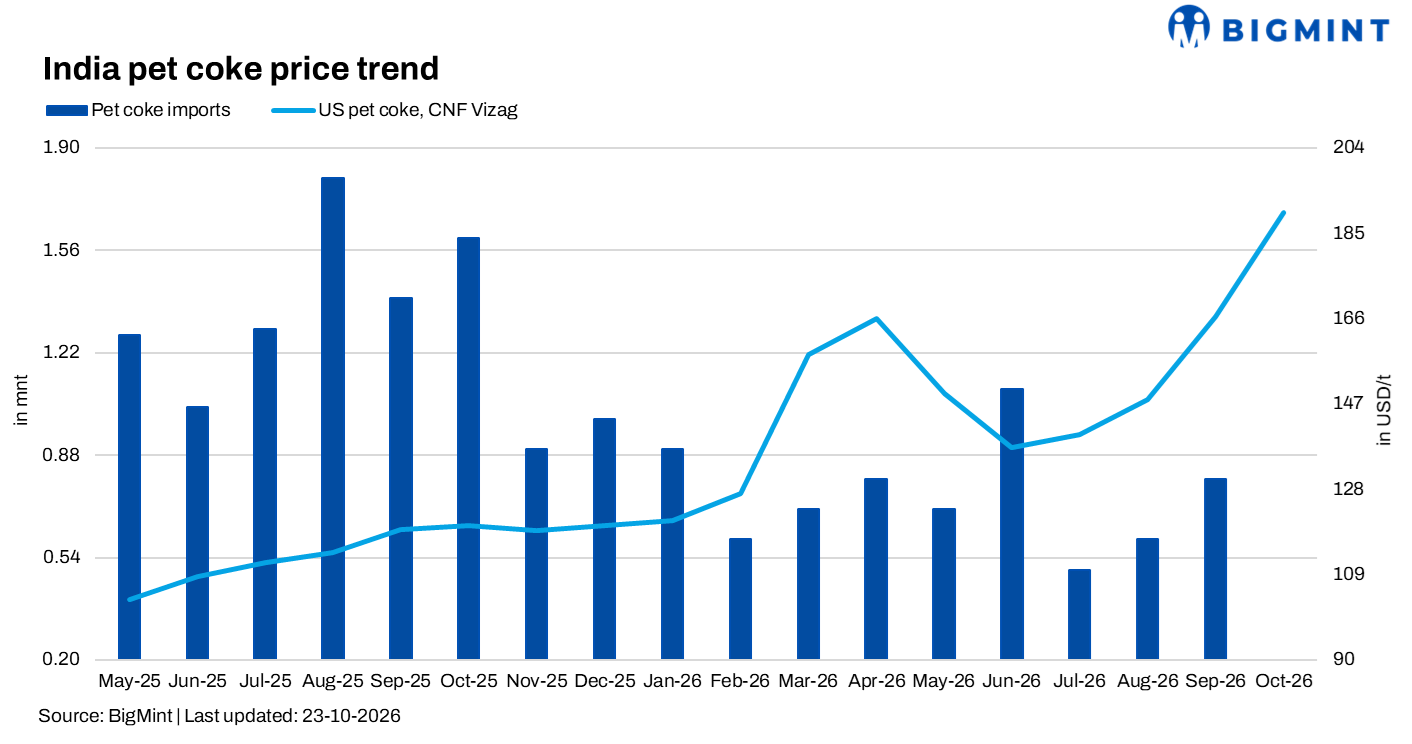
- Indian delivered prices rise to $189/t; higher freights keep costs elevated
- Cement producers favour existing inventories, alternative coal blends
Global fuel-grade petcoke prices strengthened again in the week ended 21 October, increasing replacement costs for Indian cement producers already facing expensive imported coal and uneven domestic fuel availability.
US Gulf Coast 6.5% sulphur petcoke rose $2/t w-o-w to $117/t FOB. The corresponding east coast India benchmark increased $4/t to $189/t CFR, while offers for November-December loading reached $193-195/t.
Indian buyers remain selective. Cement production is growing, but higher fuel costs are encouraging consumers to use existing inventories, increase domestic coal consumption and evaluate alternative imported coal blends.
US prices strengthen, but the pace slows
US Gulf Coast 5.5% sulphur petcoke increased to $122/t FOB, while 4.5% sulphur material reached $127/t. Both gained $2/t over the week.
The increase in high-sulphur petcoke was smaller than the previous week’s $5/t rise. This suggests that upward momentum is moderating, although prices have yet to reverse.
Competing markets continue to support US sellers. Brazilian 6.5% sulphur petcoke stood at $152/t CFR, while Turkish 5.5% sulphur material reached $164/t CIF. These are different specifications and delivery routes, but they demonstrate that India competes with other destinations for US supply.
Freight keeps Indian replacement costs elevated
US Gulf-east coast India freight stood at approximately $58/t on 21 October, up $20.25/t y-o-y.
For a 55,000-t cargo, that annual freight increase represents approximately $1.11 million of additional shipping expenditure.
Indian bids for November-December cargoes ranged from $188-191/t, against offers of $193-195/t. The gap indicates continuing resistance rather than an absence of demand.
Buyer feedback dated 22-23 October placed broader indications around $185-190/t, with some consumers reporting offers near $195/t without concluding bookings. These indications cover different commercial terms and should not be treated as a single executable price.
Cement growth does not guarantee higher petcoke consumption
Cement producers are seeking flexibility across fuels rather than accepting every increase in imported petcoke prices.
UltraTech’s September-quarter commentary provides a clear example. The company reported approximately 14% volume growth, but reduced petcoke dependence to around 25% as fuel costs increased. Its blended fuel cost rose approximately 10% q-o-q to INR 2.09/kcal.
Other buyer feedback points to continued use of older petcoke inventories and domestic coal. Domestic availability, however, remains a constraint for some consumers.
Low-ash imported coal can help balance higher-ash domestic coal, but the saving depends on the full blend. Calorific value, sulphur, ash and grinding requirements influence kiln economics.
At the 21 October benchmarks, petcoke at $189/t and 7,500 NAR costs approximately $25.20/Gcal. Coal at $132.85/t and 5,500 NAR costs approximately $24.15/Gcal.
The illustrative comparison puts petcoke about 4% higher on energy cost alone, before inland transport, taxes and plant-specific operating considerations.
Oct’26 arrivals improve availability
BigMint’s vessel records show 653,517 t of petcoke imports through 18 October, compared with 428,247 t through 11 October.
A further 375,322 t remained in the lineup dated 19 October, taking combined recorded and outstanding visibility to approximately 1.03 mnt.

Source: BigMint vessel lineup. “Shri Cement” in the source. Recorded imports follow the dataset’s “sailed” classification. Outstanding positions are dated 19 October; elapsed arrival dates do not confirm completed discharge.
UltraTech remained the largest identified receiver, accounting for approximately 38% of total visibility. Its outstanding cargoes comprised 54,164 t at Kandla and 55,000 t at Gangavaram.
Dalmia’s pipeline included 48,416 t for Jaigarh and 52,000 t for Karaikal. Chettinad was identified against 56,325 t for Karaikal.
All outstanding petcoke was listed as US-origin. Rain CII and Sanvira belong to the calcining segment and should be distinguished from cement fuel demand; cargo specifications are needed to determine precise end use.
BigMint assessment
October arrivals are replenishing supplies, but more cargoes do not necessarily mean cheaper replacement fuel.
Indian cement producers face a difficult combination: expensive petcoke, costly US coal and constraints on domestic coal procurement. This supports selective buying and greater attention to blending.
The next price adjustment will depend on whether buyers accept higher replacement costs or sustain substitution long enough to weaken sellers’ offers.
Leave a Reply