- Indian steelmakers have inventories for 1-2 months
- Weak steel prices, rising stocks in China weigh on prices
PCI outperforms amid weakening coke market
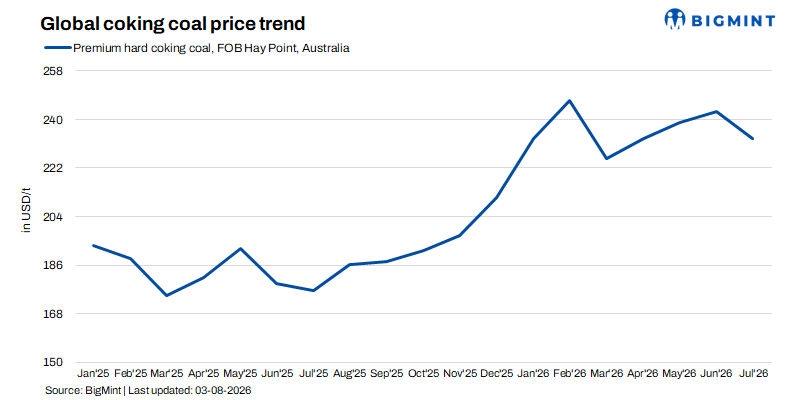
Global metallurgical coal and coke markets softened further in the week ended 31 July as improving Australian cargo availability coincided with subdued steel demand, comfortable mill inventories, and declining hot metal production.
Australian premium hard coking coal (PHCC) continued to retreat, China’s steelmakers secured further coke price reductions, and Indian mills largely deferred fresh purchases despite increasingly competitive offers. At the same time, pulverised coal injection (PCI) prices remained comparatively resilient, highlighting its continuing role in reducing blast furnace coke consumption.
The current correction is therefore no longer confined to premium coking coal alone. Instead, steelmakers are actively reducing raw-material costs across the value chain, placing the greatest pressure on metallurgical coke while maintaining relatively stronger support for PCI.

Australian premium coal clears at progressively lower prices
Australian PHCC continued to establish lower transaction benchmarks through July.
Goonyella traded at $229/t FOB on 15 July, before successive deals at $224/t, $223.11/t, and finally $221.50/t FOB for September-loading material on 28 July.
Unlike a market weakening because of inactivity, cargoes continued changing hands, but each successive trade established a lower price point. The correction reflects improving Australian spot availability just as Chinese and Indian buyers reduced procurement.
By the end of July, several premium brands were being discussed around $217-219/t FOB, suggesting the market had entered a price-discovery phase rather than a supply-driven squeeze.
India remains absent from buying side
India has provided little support to the seaborne coking coal market despite lower prices.
Most integrated steelmakers remain comfortably covered for one to two months, while weak steel margins, monsoon-related demand softness and expectations of further price declines continue to delay purchases.
The failed RINL auction for 150,000 t of imported Goonyella and Brooks Run coal illustrates current sentiment. Although mills expressed preliminary interest, no bids were ultimately submitted, reflecting expectations that Australian PHCC could soften further.
India’s coking coal imports fell 25% m-o-m to 5.6 mnt in June, following elevated arrivals in May. Australia remained the largest supplier, followed by Russia and the US. Fresh bookings have remained slow as mills continue to rely on inventories and term contracts.
Most buyers now appear prepared to re-enter the market only if Australian premium coal approaches the $210-215/t FOB range.
China balances weaker demand against tighter supply
China’s coking coal market remains caught between weakening steel production and unresolved supply constraints.
Hot-metal production at surveyed blast furnace mills declined for the third consecutive week to around 2.38 mnt/day, while rising finished steel inventories and weaker steel prices encouraged mills to seek additional reductions in raw-material costs.
However, the supply outlook remains more constructive. Shanxi continues reopening suspended mines, but stricter safety requirements are expected to prevent a rapid return to previous operating levels. Mongolian border arrivals also remain below pre-holiday levels, while inventories at Ganqimaodu continue to decline.
As a result, China’s domestic coking coal market is expected to remain broadly rangebound. Demand is insufficient to support a sustained rally, but supply constraints continue to provide support at lower price levels.
Met coke emerges as the weakest segment
Metallurgical coke has become the weakest component of the steelmaking raw-material chain.
Chinese steel mills implemented a second round of coke price cuts of RMB 50-55/t, reflecting weaker steel prices, compressed mill margins and declining hot-metal production. Although coke producers have discussed coordinated production cuts, meaningful supply discipline remains unlikely while producers continue competing for market share.
Chinese export coke consequently weakened towards $278-280/t FOB, increasing competitive pressure on Indonesian suppliers.
Indonesian 65/63 CSR coke offers remained around $280-290/t FOB, while BigMint’s assessment fell by $4/t to $308/t CFR India as buyers remained cautious and anticipated further declines.
The current correction therefore appears driven less by oversupply than by steelmakers successfully pushing lower costs back through the value chain.
India’s definitive ADD changes policy, not market fundamentals
India’s five-year definitive anti-dumping duty on low-ash metallurgical coke has ended months of policy uncertainty but has not fundamentally altered market behaviour.
The lower-than-expected final duties allow imported coke to remain competitive for many integrated steelmakers, particularly where higher CSR, consistent ash chemistry and blast furnace performance offset the additional duty.
Domestic BF coke remained stable at INR 35,150/t ex-Jajpur, while western India softened by INR 500/t to INR 33,500/t ex-Gandhidham. Foundry coke remained unchanged near INR 36,400/t.
The lack of a domestic price recovery following the definitive duty highlights the overriding influence of steel demand rather than policy protection.
PCI remains comparatively resilient
PCI has significantly outperformed both premium coking coal and coke.
Australian low-vol PCI eased only marginally to $152.60/t FOB, while mid-vol PCI slipped to $147.60/t. Delivered values into India remained broadly unchanged around $160/t CFR.
The relative resilience reflects PCI’s role in reducing coke consumption and lowering blast furnace operating costs.
Mills continue to optimise injection rates wherever technically feasible, limiting downside despite weaker hot-metal production.
Unlike coke, PCI demand is being supported by operational efficiency rather than outright steel demand, explaining its comparatively stable performance.
Outlook
The global metallurgical coal complex is expected to remain under pressure through August, although the weakness is becoming increasingly differentiated.
Australian PHCC faces the greatest downside risk as improving spot availability coincides with cautious Indian and Chinese procurement. Additional September cargoes could test $210-215/t FOB before meaningful restocking emerges.
Metallurgical coke is likely to remain the weakest segment as Chinese mills continue pressing for lower input costs and export offers become increasingly competitive. India’s definitive anti-dumping duty will alter origin economics but is unlikely to generate a broad domestic recovery without stronger steel demand.
PCI should continue outperforming both coking coal and coke because it remains an effective tool for lowering blast furnace coke rates and overall hot-metal costs.
The defining feature of the current market is therefore a growing divergence across the steelmaking raw-material chain: premium coking coal is correcting as Australian supply returns, metallurgical coke remains under the greatest pressure from steelmakers’ cost-cutting efforts, while PCI continues to display relative resilience through its operational and economic advantages.

Leave a Reply