- Australian coking coal declines as Chinese buying slows
- Tight coke supply redirects blast-furnace demand towards PCI
Global metallurgical coal markets weakened in the week ended 24 September 2026 as Chinese mine restarts, higher Mongolian imports and poor steelmaking margins reduced demand for seaborne coking coal. However, the adjustment remained uneven: premium hard coking coal (PHCC) and metallurgical coke softened, while PCI retained support from its coke-substitution value.
India reflected this divergence. Mills remained cautious about coking coal and imported coke, but constrained coke availability encouraged greater interest in PCI. Domestic coke prices consequently held near multi-year highs despite declining coking coal replacement costs.

China’s supply deficit contracts sharply
China’s metallurgical coal supply deficit was estimated to narrow from 3.18 million tonnes (mnt) in August to just 0.13 mnt in September. Authorities have accelerated the resumption of mines suspended following accidents and safety inspections, particularly across Shanxi and Changzhi.
Improved weather also supported production in Inner Mongolia and Shaanxi. This has started to reverse the supply squeeze that drove domestic and seaborne prices sharply higher during August and early September.
China’s metallurgical coal consumption was estimated at 50.64 mnt in September, down 1% from August but still 2.2% higher y-o-y. The combination of rising domestic supply and slightly lower consumption explains the weakening in coking coal prices.
Port inventories nevertheless remained relatively tight, falling by 0.21 mnt w-o-w to 2.97 mnt on 18 September. The market has therefore moved from an acute shortage towards gradual rebalancing rather than oversupply.
Mongolian coal reduces China’s seaborne requirement
China imported 93.57 mnt of metallurgical coal during January-August 2026, up 29% y-o-y. Mongolia supplied 53.2 mnt, an increase of 49%, and accounted for 57% of total imports.
China’s August imports declined 4% m-o-m to 13.07 mnt. Mongolian shipments nevertheless increased 3.2% to 6.41 mnt, while Russian volumes fell 13.1% to 3.66 mnt amid diesel shortages and logistics disruptions. Australian shipments dropped 27.6% to 1.64 mnt after Chinese buyers reduced fresh procurement.
The growth in Mongolian supply is structurally reducing China’s dependence on premium seaborne coal. Australian material retains an important role in quality blending, but Chinese mills can delay discretionary purchases when domestic and Mongolian availability improves.
Australian PHCC retreats as mills resist
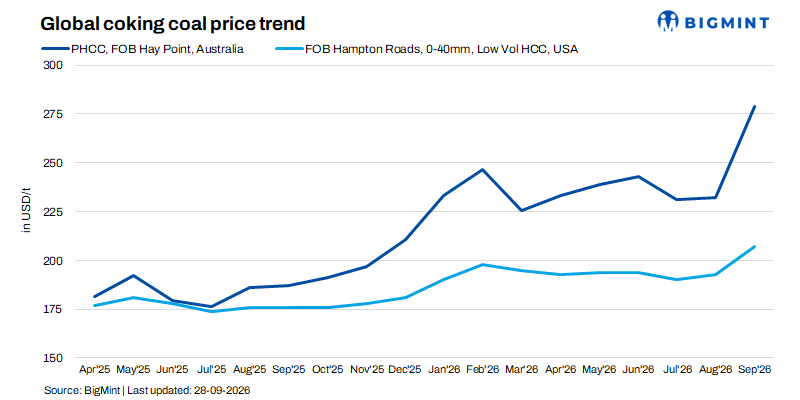
Australian PHCC declined to $273.60/t FOB on 24 September from $277.50/t on 21 September. The CFR China assessment fell by $3/t to $296/t.
The correction followed earlier transactions at elevated levels. Goonyella C traded at $283/t FOB for October loading on 10 September, while an Australian premium mid-vol cargo was concluded at $280/t FOB for November loading. A separate Goonyella cargo for September delivery into India was reported above $300/t CFR.
These trades reflected the earlier supply squeeze. By late September, Chinese mills had largely completed pre-holiday restocking and reduced fresh buying. Steel profitability remained below 10%, with one industry survey placing profitable mills below 7%.
Indian mills were similarly reluctant to procure at elevated levels. Higher freight reinforced this caution, with Australia-India Panamax freight increasing to $24.05/t and USEC-India freight reaching $52/t.
Atlantic-origin coal remained stable, but high freight restricted its competitiveness in India. US low-vol HCC held at $210/t FOB USEC, high-vol A at $195/t and high-vol B at $170/t.
PCI separates from weaker coking coal trend
PCI strengthened even as PHCC declined. Australian low- and mid-vol PCI increased by $3.40/t between 21 and 24 September, while delivered values into China rose by $4/t.
Confirmed Russian mid-vol PCI transactions support the firmer trend. A 21,000 t September cargo traded at $198/t CFR China on 15 September. Two further 21,000 t parcels, covering September-October and October delivery, were concluded at $198.50/t CFR China on 22 September.
Russian mid-vol PCI was also indicated around $207/t CFR India by 24 September. The price strength reflects reduced Russian availability, firm Chinese procurement and greater PCI utilisation as blast-furnace operators attempt to limit coke consumption.
India’s coke rally pauses, but availability remains tight
Indian BF-grade coke remained unchanged at INR42,000/t ex-Jajpur, while ex-Gandhidham prices slipped INR200/t w-o-w to INR38,000/t. Foundry coke held at INR39,000/t ex-Rajkot.
Imported Indonesian 65/63 CSR coke was assessed around $364-370/t CFR India. Prompt supply remained restricted, with Indonesian cargoes reportedly booked through mid-November.
Earlier confirmed transactions showed the sharp rise in replacement costs. November-loading Indonesian coke traded at $330/t and $335/t FOB on 4 and 7 September, followed by a 20,000 t deal at $350/t FOB on 11 September. By 24 September, indicative FOB values had moderated to $335-340/t, while Indian buyers resisted delivered prices around $370/t.
Outlook
Global coking coal prices face continued pressure from Chinese mine restarts, expanding Mongolian supply and weak steel margins. Australian PHCC remains particularly exposed to reduced Chinese spot buying.
Met coke should correct more gradually because Indian domestic and imported availability remains constrained. PCI is positioned to outperform coking coal and coke while blast-furnace operators pursue lower coke rates, although sustained weakness in hot-metal production would eventually limit demand across all three markets.
Leave a Reply