- Australian PHCC rises as Chinese demand, fresh trades lift market
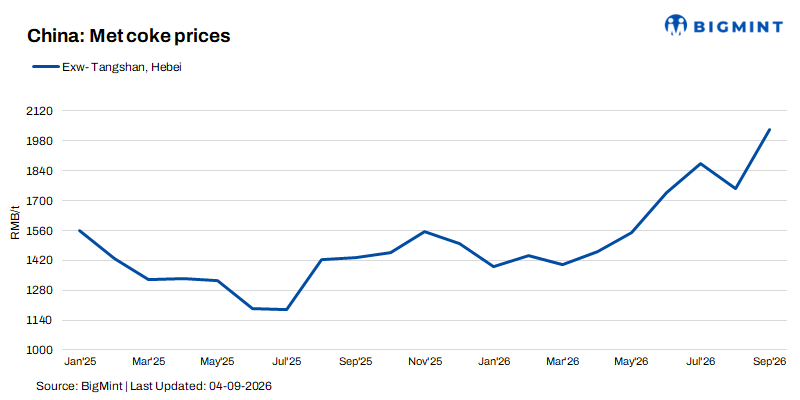
- Fifth Chinese coke-price hike raises costs across steelmaking chain
Global metallurgical coal and coke markets strengthened in the week ended 11 September 2026, although the rally remained uneven. Premium hard coking coal (PHCC) and metallurgical coke recorded the strongest gains, while PCI prices diverged across origins and markets.
China remained the principal driver. Mine-safety restrictions and slow production resumptions tightened domestic coking-coal availability, encouraging seaborne purchases and raising coke-production costs. These pressures spread to India, where lower merchant-coke output, thin inventories and expensive replacement cargoes intensified the squeeze.
Key price movements

Prices are not directly interchangeable because specifications and delivery bases differ.
Australian PHCC rises on fresh trades
Australian PHCC strengthened after fresh transactions reset the physical market. A 75,000-t Goonyella C premium mid-vol cargo was concluded at $283/t FOB Australia for 21-30 October loading. Another 80,000-t unbranded premium mid-vol cargo was bought at $280/t FOB for first-half November loading.
The trades helped lift BigMint’s PHCC CFR India index to $306/t CNF Paradip, up $7/t w-o-w. India-bound indications rose to $305-310/t CFR.
Chinese buyers drove the momentum as domestic shortages encouraged offshore procurement. Indian mills remained reluctant to chase the rally, but reduced August imports and future replacement requirements may limit how long they can defer purchases.
Prompt cargoes commanded premiums over later deliveries, indicating that the market is pricing an immediate shortage while anticipating some recovery in Chinese production later in the year.
China supply squeeze supports coal and coke
Safety inspections, accidents and slow mine restarts in Shanxi restricted domestic coking-coal availability. Although several mines received approval to resume operations, output recovered gradually.
Mongolian supply offered only partial relief. Ganqimaodu truck movements fell below early-summer levels, while lower customs clearance and declining inventories contributed to the August squeeze.
China’s Mongolian coking-coal imports could reach 82.6-84.4 mnt in 2026 and 82-95 mnt in 2027. The Gashuunsukhait-Ganqimaodu railway, scheduled for commercial operation in 2027, could add around 30 mnt/year of capacity.
However, gauge differences, transshipment infrastructure, customs integration and port handling could delay the release of this capacity. Mongolia may become a stronger supply-response mechanism, but Chinese mine production will continue to set the broader market direction.
Fifth coke hike passes costs downstream
Chinese mills accepted a fifth domestic coke-price increase since early August, raising prices by RMB 100-110/t. The increase lifted 62/60 CSR coke to around RMB 2,120/t DDP North China.
Low coke inventories and elevated coal costs strengthened producers’ negotiating position. However, weaker steel demand, narrowing mill margins and maintenance-related production cuts could constrain additional increases.
India met coke reaches multi-year highs
Indian BF-grade coke rose to INR 41,500/t ex-Jajpur and INR 38,000/t ex-Gandhidham. Foundry coke reached INR 39,000/t ex-Rajkot.
BigMint data show merchant met-coke production fell 30% y-o-y to around 2.5 mnt during January-August 2026, compared with 3.59 mnt a year earlier. High coal costs, weak conversion margins, and production curtailments reduced spot availability.
Indonesian 65/63 CSR coke increased to around $361/t CFR India. Suppliers were reportedly committed through November, while higher FOB prices, freight, insurance and Chinese procurement restricted prompt supply.
Indian pig-iron exports also supported demand, rising 214% y-o-y to around 1.1 mnt during January-August.
PCI markets diverge
Chinese Shanxi PCI rose to RMB 1,680/t ex-washplant as domestic supply tightened. In contrast, India-bound Russian mid-tier PCI was indicated at around $204-215/t CFR, remaining competitive against Australian material.
Higher coke prices strengthen the incentive for Indian mills to optimise PCI injection. However, furnace configuration, injection capacity and coke-strength requirements limit how much coke can be displaced.
Outlook
The near-term bias remains firm, supported by Chinese supply constraints, limited Australian cargo availability, and restricted Indonesian coke supply.
However, weak steel margins are becoming the principal constraint. Faster Chinese mine restarts, improved Mongolian flows or deeper steel-production cuts could trigger a correction.
PHCC and coke prices are likely to remain elevated until Chinese domestic supply normalises. The PCI market should remain more fragmented, with competitively priced Russian material limiting the upside in India.
Leave a Reply