- Subdued steel demand, ample supply pressure Australian prices
- Selective buying slows downtrend but near-term recovery unlikely
The metallurgical coal raw material complex weakened during the week ended 24 July as subdued steel demand, ample Australian coking coal availability, and the reversal of China’s coke rally shifted negotiating power towards buyers.
Premium hard coking coal prices have returned to levels attracting selective Indian and Chinese procurement, but recent deals appear opportunistic rather than evidence of a broad restocking cycle. Steelmakers remain constrained by softer finished steel prices, rising inventories, and compressed margins, while traders continue attempting to clear unsold position cargoes.
Metallurgical coke faces greater downside pressure after China implemented its first price reduction following nine consecutive increases. PCI has remained comparatively resilient because of its role in reducing blast-furnace coke consumption, although declining hot-metal production limits its upside.
Australian coking coal correction deepens
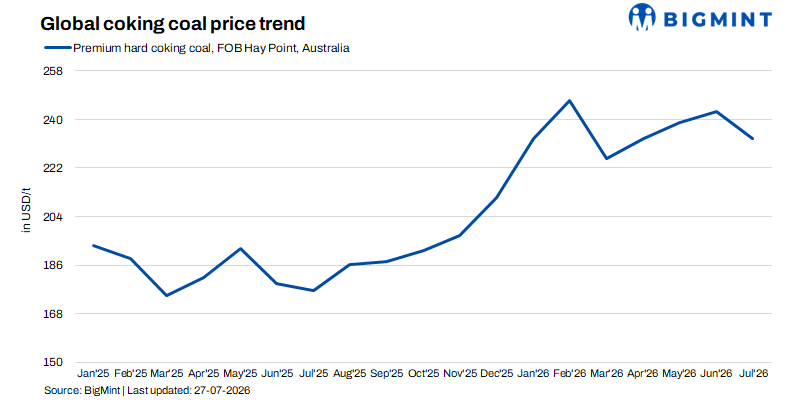
Premium low-vol hard coking coal was assessed near $222/t FOB Australia on 24 July, while delivered China values were around $240/t. The market has corrected rapidly as available August and September-loading cargoes exceeded immediate end-user demand.

The progression from $229/t to around $223-224/t FOB within little more than a week highlights the speed of the correction.
Traders had accumulated premium mid-vol positions in anticipation of stronger Indian and Chinese demand, but actual procurement fell short. Multiple Moranbah North, Goonyella, and other premium cargoes subsequently returned to the market.
The Peak Downs deal at $223.11/t temporarily supported the benchmark, but the wider physical market remained weaker. By the end of the week, several premium brands were indicated near $219-220/t FOB. Unless Chinese buying accelerates or Australian availability tightens, the market may test $218-220/t FOB.
China offers selective support, not demand recovery
China remains the principal swing buyer. Its metallurgical coal imports increased 9% m-o-m to 12.17 mnt in June, with Mongolia supplying 7.18 mnt and Russia 3.17 mnt. Australian arrivals almost doubled to 1.3 mnt.
H1CY’26 imports reached 66.87 mnt, up 26.6% y-o-y. The increase partly reflected concerns over domestic mine supply and tighter safety inspections, which had earlier supported Chinese coking coal prices and improved the competitiveness of imported material.
Current conditions are less supportive. Chinese buyers returned selectively as Australian premium coal approached $222/t FOB, but mills remain reluctant to commit to forward cargoes.
Domestic coke prices are declining, steel mills are reducing output and traders continue liquidating imported coal already held at ports. Low-vol hard coking coal (HCC) faces particular pressure because buyers can access portside inventories without taking fresh seaborne exposure.
Premium coal may attract intermittent buying because its availability at ports is tighter. However, this is unlikely to reverse the broader correction while steel margins and hot-metal demand remain weak.
India’s import slowdown weighs on PHCC
BigMint’s premium hard coking coal (PHCC) index fell by $7/t w-o-w to $243/t CNF Paradip on 24 July, approaching a four-month low.
India’s coking coal imports declined 25% m-o-m to 5.6 mnt in June from 7.5 mnt in May. Australia remained the largest supplier at around 3 mnt, followed by Russia and the US.
The decline reflects slower procurement following the arrival of previously booked cargoes, weaker domestic steel demand, and liquidity constraints. Mills are largely purchasing against immediate requirements as HRC prices soften and downstream orders remain subdued.
The 40,000 t Goonyella/Moranbah North purchase at $224/t FOB shows that Indian end-users will enter when prices become attractive. However, the absence of wider buying suggests most mills expect further downside.
RINL’s auction of 150,000 t of imported Goonyella and Brooks Run coal at Gangavaram and Visakhapatnam adds visible material to an already adequately supplied market. Market participants have linked the sale either to cargo-specific issues or a shift in raw material requirements.
Freight is limiting the fall in delivered prices. Australia-India Panamax freight was around $21.2/t. At this level, coal purchased at $222/t FOB lands close to $243/t CFR, broadly aligned with the prevailing India index. A substantial further decline in Indian prices therefore requires Australian FOB values to fall below $220/t or freight to soften.
Atlantic coal stable but freight limits competitiveness
US metallurgical coal prices remained relatively stable, with low-vol HCC near $189.50/t FOB US East Coast, high-vol A around $156.5/t and high-vol B at $147/t.
Availability is fragmented. Some producers are reportedly sold out of prompt material, while trader-held and second-hand cargoes remain available in Asia. A second-hand Bailey semi-soft cargo was heard at $130/t CFR India, highlighting the competitiveness of lower-rank US coal in suitable blends.
However, freight remains the main obstacle. US East Coast-India Panamax freight was around $51/t compared with approximately $21/t from Australia. US coal must therefore carry a substantial FOB discount or offer superior blending value to compete in India.
Chinese coke market reverses
China’s metallurgical coke market has shifted from a producer-led rally to a steelmaker-led correction.
Mills implemented the first coke price reduction of RMB 50-55/t on 22 July after nine consecutive increases. Another one or two reductions are expected as steelmakers seek to lower input costs.
Coke producers argue that the first cut has pushed many facilities close to break-even and have called for coordinated output reductions. However, meaningful curtailments may remain limited because producers are reluctant to sacrifice cash flow and market share.
Steelmakers continue to hold the stronger position. Daily hot-metal output among surveyed blast-furnace mills fell for a third consecutive week to around 2.38 mnt/day during 17-23 July, while finished-steel inventories continued rising.
Domestic 62/60 CSR coke declined to around RMB 1,770/t DDP North China. Seaborne values were near $274/t FOB for 62/60 CSR and $286/t for 65/63 CSR. Further domestic cuts are likely to gradually pressure export offers.
India and Indonesia remain divided on coke values
Indonesian suppliers attempted to maintain 65/63 CSR offers near $287-288/t FOB for September loading, citing limited availability. Indian buyers continued targeting prices below $300/t CFR as falling coking coal prices and weak steel margins reduced their willingness to accept higher offers. Some September cargoes may trade as mills cover immediate requirements, but sustained upside appears unlikely.
Indian BF-grade coke prices remained broadly stable at around INR 35,150/t ex-Jajpur and INR 34,000/t ex-Gandhidham. However, stability masks weak demand and uncertainty over anti-dumping duties on imported coke.
Imports under export-linked schemes are becoming increasingly competitive, reducing demand for domestic merchant coke and placing pressure on standalone producers without integrated steel or pig-iron operations.
Lower coke costs are nevertheless supporting Indian pig-iron exports. India shipped 247,000 t to the US during April-May 2026, exceeding exports during the whole of FY’26. This trade is helping mills maintain blast-furnace output despite weak domestic steel demand.
PCI relatively resilient
Low-vol PCI remained near $154.40/t FOB Australia, while mid-vol PCI was around $149.40/t. Mid-vol PCI delivered to India was assessed near $160/t.
PCI continues to benefit from its role in reducing coke consumption and lowering hot-metal costs. However, falling coke prices reduce the incentive to maximise injection rates, while declining blast-furnace production lowers total demand. Competitive Russian supply also limits upside in China and India.
Outlook
Premium hard coking coal remains vulnerable to a move below $220/t FOB Australia. Selective Chinese and Indian buying may slow the decline but is unlikely to generate a sustained recovery without stronger steel demand.
Metallurgical coke has further downside risk as Chinese mills pursue additional price reductions. Indian CFR prices may receive temporary support from freight and September requirements, but buyers are unlikely to accept materially higher values while coking coal is falling.
PCI should continue to outperform coking coal on a relative basis, although outright prices are expected to remain largely stable.
The broader market is being driven by inventory liquidation, weak steel margins, and mills’ determination to reduce raw-material costs. Near-term support will come from opportunistic procurement rather than genuine demand growth, leaving the complex vulnerable to another decline before a durable floor emerges.

Leave a Reply