- Chinese manganese ore imports up 21% y-o-y, India sees 27% surge
- India’s manganese alloys production rises 24% in H1, exports up 32%
- Higher Chinese port stocks, improving global supplies cloud H2 outlook
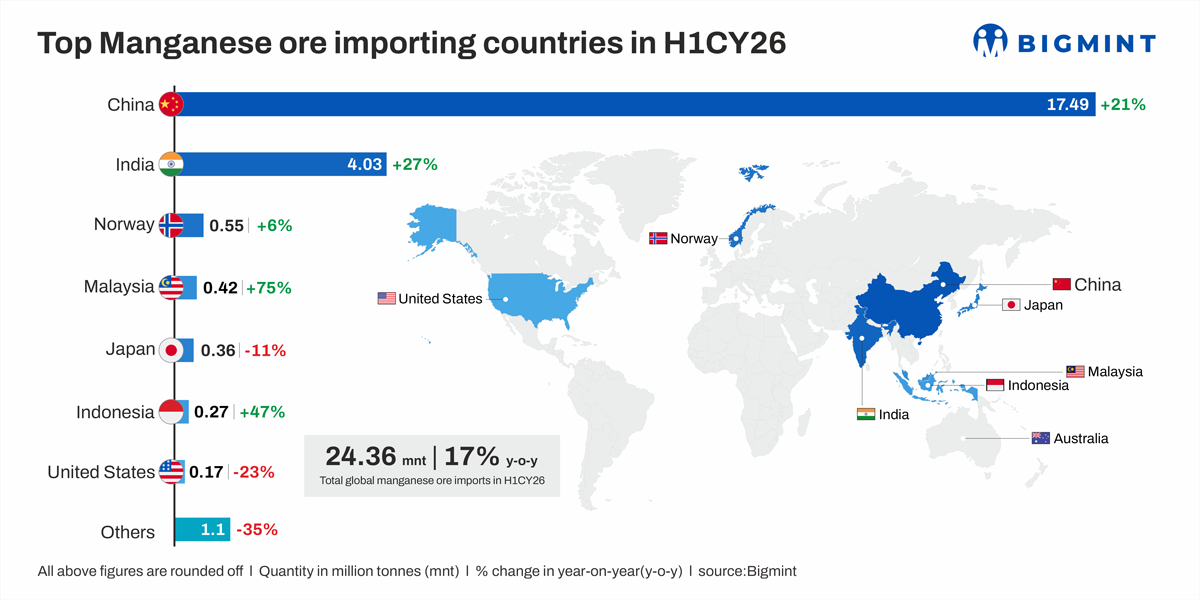
Morning Brief: Global manganese ore trade entered CY26 on a much stronger footing, with January-June (H1) imports rising sharply despite uneven downstream alloy demand. Global manganese ore imports reached 24.36 mnt in H1CY26, up 16.9% y-o-y from 20.83 mnt in the year-ago period, adding around 3.53 mnt to seaborne demand. The growth was overwhelmingly driven by China and India, while higher Chinese alloy production supported ore buying.
However, the sharp rise in Chinese port inventories, coupled with emerging alloy production curbs and improving availability from major miners, suggests that the market may shift from restocking-led strength in H1 to more measured buying in H2.
China drives global import growth
China remained the dominant force in the global manganese ore market, with H1 imports rising 21% y-o-y to 17.49 mnt, compared with 14.46 mnt in H1CY25. The country alone contributed around 3.03 mnt, or nearly 86%, of the global increase.
The rise in ore consumption was supported by stronger manganese alloy production. China’s silico manganese output increased 15.3% y-o-y to 5.62 mnt in H1 from 4.88 mnt during the same period last year, more than offsetting a 5.7% decline in ferro manganese production to 0.73 mnt. Combined manganese alloys production consequently increased around 12.4% y-o-y to 6.35 mnt.
However, the demand picture is less bullish. BigMint reported that Chinese manganese alloy producers initiated voluntary production curbs from April, estimated at around 221,000 t/month, equivalent to roughly 2.6-2.7 mnt on an annualised basis, as the industry seeks to address oversupply and weak alloy realisations.
Chinese manganese ore stocks rise 31%
China’s manganese ore port inventories climbed 31% y-o-y to 5.87 mnt in late July from 4.50 mnt a year earlier, led by Qinzhou, up 70% to 1.37 mnt, and Tianjin, up 18% to 4.36 mnt. The rise in stocks, despite China’s manganese ore imports increasing 21% to 17.49 mnt in H1CY26, indicates that ore inflows have outpaced immediate consumption.
Strong H1 restocking, improved supply availability and softer alloy margins contributed to inventory accumulation, while emerging production curbs could slow drawdown. At current import run-rates, stocks provide around 1.4 months of import cover, potentially limiting fresh spot buying in H2.
BigMint’s latest market assessment also points to moderate manganese ore demand growth in H2CY26, while Eramet Comilog and South32 have already reduced September ore prices amid cautious Chinese procurement.

India’s imports surge; Japan, South Korea see divergent trends
India emerged as the second-largest growth market, with manganese ore imports increasing 27% y-o-y to 4.03 mnt from 3.17 mnt in H1CY’25, supported by stronger alloy-making activity and healthy steel demand.
India’s combined manganese alloy production rose 24% y-o-y to 3.60 mnt in H1 from 2.91 mnt in the year-ago period, with ferro manganese production nearly doubling to 2.07 mnt from 1.10 mnt, more than offsetting a decline in silico manganese output to 1.53 mnt compared to 1.82 mnt in the year-ago period. The sharp rise in overall alloy production increased manganese ore requirements and supported higher imports.
On the other hand, India’s exports of manganese alloys also surged during the period under review. In H1CY’25, silico manganese exports were 0.547 mnt while 0.415 mnt of ferro manganese exports were recorded by BigMint, with the total coming to 0.962 mnt. In H1CY26, total exports rose by 32% to 1.273 mnt, with silico accounting for 0.84 mnt and ferro manganese at 0.433 mnt. India is a major exporter of manganese which constitute a significant chunk of domestic production.
Among other major consumers, the trend was mixed. Malaysia’s imports surged 75% to 0.42 mnt, while Indonesia’s rose 47% to 0.27 mnt and France’s more than doubled to 0.37 mnt.
In contrast, Japan’s manganese ore imports fell 11% to 0.36 mnt, as weaker steel production, lower alloy-plant operating rates and adequate inventories reduced the need for fresh ore procurement. Japan’s crude steel production stood at 40.43 mnt in H1CY’26, marginally lower than the year-ago period, continuing the downward trend seen in recent years.
South Korea recorded an even sharper 54% decline in manganese ore imports to 0.10 mnt, despite crude steel production rising 2% y-o-y to 31.79 mnt in H1. The steep fall in ore buying therefore appears to be driven less by steel output and more by subdued ferro alloys production, inventory drawdowns and competitive imports of manganese alloys, which reduced the requirement for domestic smelters to procure fresh ore. Lower smelter utilisation, inventory drawdowns and competitive alloy imports were also key factors behind South Korea’s weaker manganese ore demand.
The divergence suggests that the global recovery is broadening, but remains heavily dependent on China and India rather than being evenly distributed across major consuming regions.
Supply recovery gathers pace in H1CY’26
The global manganese ore supply picture remained mixed in H1CY’26. Eramet’s manganese ore production declined 11% y-o-y to around 3.2 mnt, mainly due to equipment-availability issues at the Moanda mine, while ore transportation increased 6% y-o-y to around 3.2 mnt as rail performance improved. Meanwhile, South32’s Australia manganese operations recorded a sharp recovery from the heavily disrupted H1CY’25 base, while South Africa manganese output remained broadly stable. The recovery in Australian production significantly improved seaborne availability during H1CY’26.
At the same time, higher shipments from South Africa and Australia to China indicate that supply availability improved during the first half, partly offsetting lower Gabonese mine production. With major producers restoring output and Chinese port inventories already elevated, the global ore market entered H2 with less supply-side tightness than a year earlier, potentially limiting price upside unless downstream alloy demand strengthens.
Outlook
The manganese ore market enters the second half of the year from a fundamentally stronger position than a year ago, but the balance is shifting. Strong H1 imports, particularly from China, were supported by higher alloy production and inventory accumulation; H2 demand will depend more heavily on actual consumption.
With Chinese stocks elevated, production curbs emerging and major miners restoring supply, the market is likely to see more cautious procurement and greater price sensitivity in H2, although India’s robust import growth and improving supply chain flows should provide a floor to global demand.

Leave a Reply