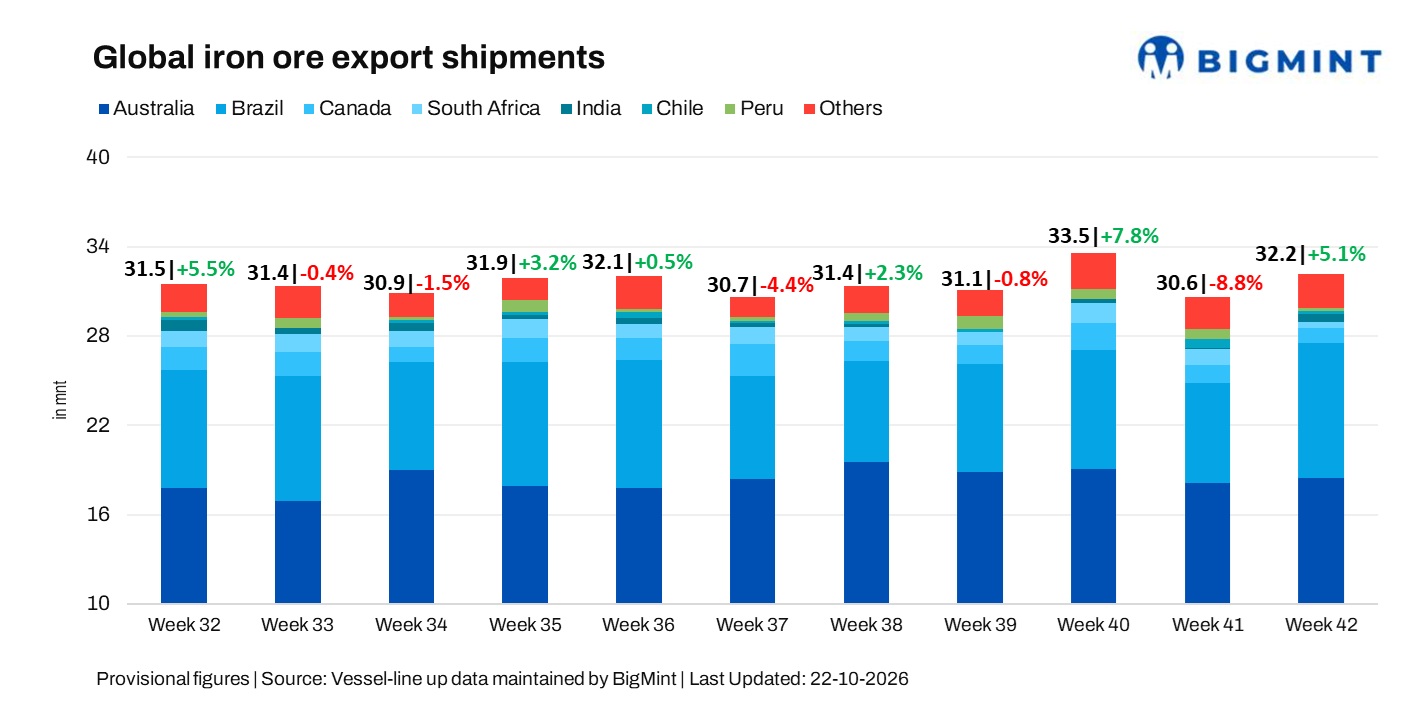
- Brazil records strongest gain of 35% w-o-w; India rebounds from low base
- Lower volumes from South Africa, Canada, Chile, Peru limit overall gains
Global iron ore shipments rose 5.1% w-o-w to 32.2 million tonnes (mnt) in the week ended 16 October, from 30.6 mnt a week earlier. A sharp recovery in Brazilian cargo flows and a rebound in Indian shipments drove the increase, while steady Australian loadings provided additional support. However, lower volumes from South Africa, Canada, Chile and Peru limited the overall gains.
Brazil recorded the strongest increase of 35% among major origins, while India’s shipments recovered from the previous week’s low base. African flows remained mixed, with Liberia and Sierra Leone reporting higher volumes, offset by declines in Guinea and Mauritania. Sweden also resumed seaborne shipments.
Country-wise exports

Port and shipper-wise trends
- Australia: Hedland led at 11.02 mnt, followed by Dampier at 3.60 mnt and Walcott at 3.49 mnt. Rio Tinto topped shippers at 7.09 mnt, followed by BHP at 5.52 mnt and Fortescue Metals at 4.82 mnt. China remained the key destination at 16.14 mnt, followed by South Korea at 1.14 mnt.
- Brazil: Ponta da Madeira led at 3.71 mnt, followed by Tubarao at 2.44 mnt and Itaguai at 1.34 mnt. Vale accounted for 4.28 mnt, while CSN and Vale jointly contributed 3.77 mnt. China was the leading destination at 4.51 mnt.
- Canada: Sept-Iles led at 0.88 mnt. IOC accounted for 0.51 mnt, followed by Guinea and Nimba Mines at 0.37 mnt. The Netherlands received 0.26 mnt, followed by Brazil at 0.18 mnt and India at 0.16 mnt.
- South Africa: Saldanha and Richards Bay each handled 0.20 mnt, with China receiving 0.20 mnt.
- India: Kandla led at 0.19 mnt, followed by Paradip at 0.12 mnt and Dhamra at 0.11 mnt. Rungta Mines accounted for 0.12 mnt, while China received 0.17 mnt.
- Chile: Totoralillo handled 0.20 mnt, with China receiving the entire reported volume.
- Peru: San Nicolas handled 0.17 mnt, with Shougang Hierro accounting for the same volume. China received 0.17 mnt.
- Guinea: Morebaya handled 1.01 mnt, with China receiving 0.46 mnt.
- Liberia: Buchanan handled 0.35 mnt, with Spain receiving 0.06 mnt.
- Sierra Leone: Freetown handled 0.37 mnt, with China receiving 0.18 mnt.
- Mauritania: Nouadhibou handled 0.18 mnt during the week.
- Norway: Mo i Rana handled 0.01 mnt during the week.
- Sweden: Narvik handled 0.36 mnt, with Turkiye receiving 0.17 mnt.
Capesize freights weaken; Supramax remains resilient
Capesize freight sentiment weakened across the Atlantic and Pacific amid subdued demand and limited fresh cargo enquiries. Atlantic rates faced pressure from weaker Brazilian activity and ample vessel availability, while Pacific rates also softened despite support from Australian iron ore cargoes.
In contrast, Supramax freights remained comparatively resilient, highlighting the divergence between vessel segments as subdued demand and limited fresh fixtures weighed more heavily on the Capesize market.
Outlook
Global iron ore shipments may remain uneven, with continued Australian loadings and sustained Brazilian cargo flows likely to support volumes. However, maintenance-related disruptions and cautious Chinese buying could limit further gains. Capesize freight rates may remain under pressure unless fresh cargo enquiries improve and vessel availability tightens, while China’s steel demand and activity across key loading regions will shape the near-term direction of both shipments and freight markets.
Leave a Reply