- Chinese imports rise 6% amid lower domestic production
- Australian production rises 4% in H1, boosting exports by 3%
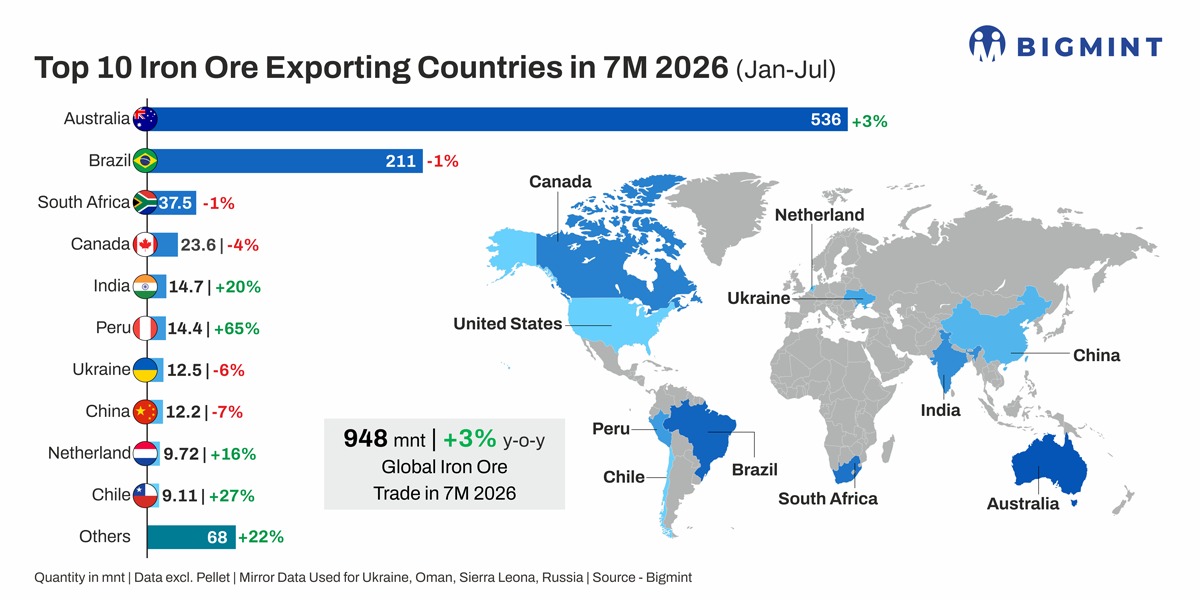
Data Deep Dive: Global iron ore exports rose 3% y-o-y to 948 million tonnes (mnt) in January-July 2026 (7MCY’26), according to BigMint data, despite global crude steel production declining 0.6% y-o-y during the period. The increase reflects continued growth in mine supply and higher Chinese procurement, even as steel output in the world’s largest iron ore-consuming market weakened.
Australia, Peru, and India were the main contributors to the increase. Australian shipments rose 3% y-o-y to 536 mnt, while Peru’s exports jumped 65% to 14 mnt. India’s shipments increased 20% to 15 mnt. However, Brazil, the second-largest exporter, recorded a 1% decline to 211 mnt.
Global iron ore production also remained on a growth trajectory during this period. Output increased 2% y-o-y in H1CY’26, led by a 4% increase each in Australia and Brazil. India recorded the strongest growth among major producers, with output rising 19% to 186 mnt as additional mining capacity came on stream.

Highlights of global iron ore trade in Jan-Jul’26
China’s imports rise despite weaker steel output
China’s iron ore imports increased 5.9% y-o-y in 7MCY’26 despite a 3.1% decline in crude steel production. Lower domestic iron ore concentrate supply, fewer disruptions to Australian shipments during the wet season, and relatively healthy steel margins during the first half supported mill procurement. BigMint data shows Chinese iron ore production fell 7% in H1CY’26.
Geopolitical tensions and concerns over shipping disruptions also encouraged some buyers to secure cargoes earlier. At the same time, negotiations between China Mineral Resources Group (CMRG), the state-backed iron ore buyer, and major miners introduced another layer of uncertainty into procurement.
Notably, China’s portside iron ore inventories reached record highs, hovering within 160-170 mnt during January-July 2026.
Australian exports rise on higher production
Australia remained the largest source of seaborne iron ore supply in 7MCY’26, with exports rising 3% y-o-y to 536 mnt. The increase was supported by a 4% rise in H1CY’26 production to 490 mnt from 470 mnt, according to BigMint data.
Rio Tinto reported its highest first-half Pilbara iron ore production since 2018, supported by its productivity improvement programme. Improved shipment availability during the wet season also allowed Australian miners to maintain strong export flows.
China remained the dominant destination, accounting for around 85% of Australian iron ore exports. The increase in Australian shipments came despite earlier uncertainty over some BHP brands following CMRG’s restrictions. Those restrictions were subsequently lifted after BHP executives visited China and the two sides reached a long-term sales agreement in April.
Australian supply is likely to remain resilient even if iron ore prices weaken. The country’s major producers operate at relatively low costs and benefit from established rail, port, and shipping infrastructure into Asia. This makes Australia less vulnerable than higher-cost producers to a downward move in benchmark prices.
Brazilian exports edge lower despite higher production
Brazilian iron ore exports declined 1% y-o-y to 211 mnt in 7MCY’26, despite production increasing 4% to 215 mnt in H1CY’26.
Logistics disruptions in May weighed on shipments. Exports during the month fell to their lowest level for May since 2022, with maintenance at terminals including Itaguaí and Guaíba affecting cargo flows.
Brazil entered 2026 after recording a strong export performance in CY’25. The increase in production provides scope for higher shipments in the second half if port and terminal operations remain more stable.
Vale continues to increase production through higher output from operations including S11D, Capanema, and VGR1. Notably, the company achieved its strongest second-quarter iron ore production since 2018 in Q2CY’26.

South African exports remain broadly stable
South African iron ore exports were broadly unchanged y-o-y at 38 mnt in 7MCY’26, despite H1CY’26 production declining 9% to 30 mnt.
Rail and logistics constraints continued to restrict the movement of material from mines to export terminals. Intermittent disruptions have limited the country’s ability to increase shipments despite the availability of export demand.
The relatively stable export volume despite lower production indicates that producers have so far been able to support shipments through inventory and available stocks. However, persistent rail constraints remain a structural limitation on South Africa’s export growth.
Anglo American’s Kumba operations also recorded a slight decline in H1 production. Output at Kolomela fell sharply in Q2 following planned plant maintenance carried out alongside scheduled rail maintenance, while rail and port capacity limitations continued to constrain Kumba’s mine evacuation in Q1.
Canadian exports decline as production, logistics remain constrained
Canadian iron ore exports fell 4% y-o-y to 24 mnt in 7MCY’26, while H1CY’26 production declined 6% to 30 mnt.
Lower production availability and operational constraints affected export volumes. Rio Tinto-owned Iron Ore Company of Canada continued to address operational issues, including deferred waste removal and measures to improve long-term pit performance and operational flexibility.
Ukraine exports remain under pressure
Ukraine’s iron ore exports declined 6% y-o-y to 13 mnt in 7MCY’26, broadly in line with the 19% decline in H1CY’26 production to 18 mnt.
Mining and export operations continue to face significant disruption from the Russia-Ukraine war. Damage to infrastructure, interruptions to power supply, security risks, and constraints across rail and port logistics have reduced the reliability of both production and cargo evacuation.
Indian exports recover as production increases
India’s iron ore exports rose 20% y-o-y to 15 mnt in 7MCY’26, reversing part of the weakness seen in CY’25.
The increase was supported by a 19% rise in domestic iron ore production to 186 mnt in H1CY’26 from 156 mnt. Higher availability provided exporters with greater scope to participate in the seaborne market while continuing to meet domestic requirements.
A weaker rupee against the US dollar also improved export realisations, while sustained Chinese demand supported shipments. Demand for single-mine cargoes, particularly from Rungta Mines, and stronger shipments of Karnataka-origin material also contributed to the increase during the first half.
India’s export volumes remain closely linked to international prices because domestic steelmakers compete with exporters for the same raw material. When seaborne prices rise sufficiently, exports become more attractive. Conversely, lower international prices can redirect material towards the domestic market.
This dynamic could become more important as India’s steel capacity expands. Rising steel production will increase domestic iron ore requirements, potentially limiting the amount available for export. At the same time, new steelmaking capacity may require higher-grade feedstock, particularly for DRI-based and more energy-efficient production.
Smaller suppliers add to seaborne availability
Several smaller exporting countries recorded strong growth during the period. Peru’s shipments increased 65% y-o-y to 14 mnt, a sharp recovery in domestic iron ore production. Output reached 7.13 mnt in January-June 2026, up 41.1% y-o-y, according to Peru’s Ministry of Energy and Mines. The increase largely reflected the return to normal operations at Shougang Hierro Perú after its temporary shutdown following a port accident in June 2025.
Meanwhile, Chilean exports rose 27% to 9.1 mnt, supported by higher production at Compañía Minera del Pacífico (CMP), the iron ore subsidiary of Grupo CAP. Additionally, Russia increased exports 26% to 6.7 mnt, while shipments from the Netherlands rose 16% to 9.7 mnt.
These increases provided additional tonnage to the seaborne market and partly offset declines from countries including Canada, Ukraine, and Oman. Omani exports fell 16% y-o-y to 6.5 mnt amid the Middle East conflict between Iran and US and Israel.
Outlook
The next major structural change in global iron ore trade is expected to come from Guinea’s Simandou project. The project exported 6.27 mnt in 7MCY’26, with shipments expected to increase as mining, rail, and port infrastructure are progressively ramped up. In the long term, Simandou has the potential to eventually produce around 120 mnt/year, making it one of the largest new sources of high-grade seaborne iron ore in decades.
The impact on existing suppliers is unlikely to be uniform. Australian miners have a substantial cost advantage and are likely to remain competitive even if benchmark prices decline. Brazil is also relatively well positioned because of its scale and high-quality ore. Vale is continuing to invest in additional production, meaning Simandou will enter a market where other major suppliers are also seeking to maintain or increase output.
Additionally, in China, while the divergence between steel production and iron ore imports can persist for a period, but it becomes harder to sustain if the decline in steel output continues. As such, the main potential offset will be growth in India, Southeast Asia, and the Middle East. Notably, Indian imports increased by 17% y-o-y in 8MCY’26, with monthly volumes crossing 2 mnt in August for the first time in nearly two years.
Expanding crude steel capacity, operational hurdles in iron ore dispatches, high mining costs, steady grade depletion, and sluggish mine operationalisation continue to position India as a potentially high-growth iron ore import market despite rising domestic production.
Dynamics in the Middle East will also be important for global iron ore trade, as Iran, Oman, Bahrain, Qatar, and the UAE have significant DRI-based steelmaking capacity. According to worldsteel, DRI production in the 12 countries responsible for around 85% of global DRI output reached 71.49 mnt in the first seven months of 2026, down 2.6% y-o-y. This decline could reduce demand for premium iron ore feedstock.
Leave a Reply