- Seasonal slowdown in steel market kept mills’ intake limited
- Healthy seaborne supply keeps market sentiment restrained
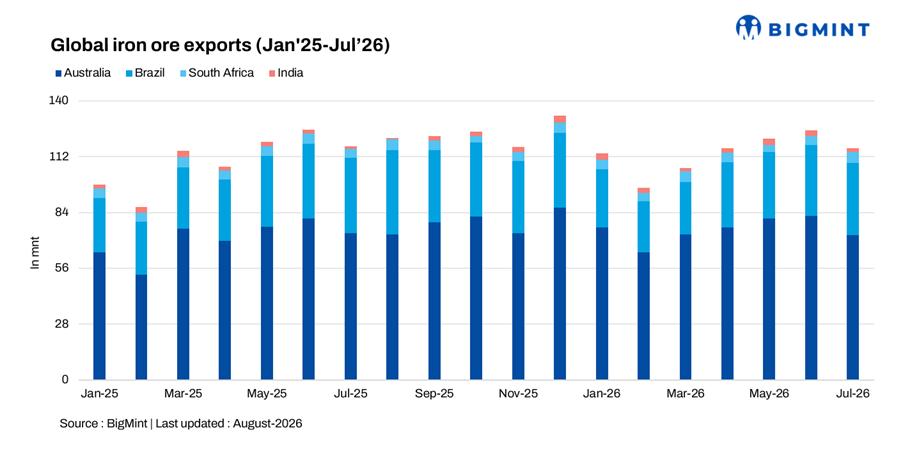
Iron ore (including pellets) exports from key global producers, Australia and India dropped while those from South Africa and Brazil rose m-o-m in July 2026. The sentiment remained largely on softer tone weighed by slower intake from China amid certain product-grade restrictions and lower steel production volumes in early to mid-July.
Australian exports drop 12% m-o-m
Australia’s iron ore and pellet export shipments stood at 72.5 million tonnes (mnt) in July, dropping by 11.8% against 82.2 mnt in June, according to vessel line-up data by BigMint. Meanwhile, shipments edged down by 2% y-o-y against 73.6 mnt in July 2025.
China remained the top importer, receiving 60.4 mnt, followed by Japan at 4.4 mnt and South Korea at 3.6 mnt. Rio Tinto was the leading exporter at 25.9 mnt, trailed by BHP at 25.1 mnt and FMG at 15.9 mnt.
The drop was an outcome of the recent product buying restriction by CMRG which limited volume offtake from Australian ports. Moreover, the buying appetite was naturally less aggressive due to seasonal slowdown in steel industry.
Exports from Brazil steady m-o-m
Brazil’s iron ore exports rose slightly by 1.5% m-o-m to 36.33 mnt in July against 35.79 mnt in June. However, exports declined 6% y-o-y from 35.62 mnt in May 2025.
China remained the largest importer, taking in 25.64 mnt, followed by Japan at 1.1 mnt and Malaysia at 1.01 mnt.
The marginal increase in Brazil’s iron ore exports was supported by improved cargo scheduling and steady shipments from major mining complexes, as producers maintained stable operating rates. In addition, Brazilian medium- and high-grade fines continued to attract healthy demand from Asian buyers, supported by their favourable cost competitiveness, giving them a slight preference over competing origins in a cautious procurement environment.
South African exports surge 25% m-o-m
South Africa’s iron ore exports stood at 5.48 mnt in July, a rise of 25.4% m-o-m against 4.37 mnt in June, as per vessel line-up data. Moreover, export volumes climbed by 23% against 4.46 mnt in July 2025.
China remained the leading importer with 2.63 mnt, followed by The Netherlands at 0.77 mnt.
The sharp decline in iron ore exports in May was mainly driven by weaker vessel loading activity and continued logistical inefficiencies across rail networks, which disrupted the smooth evacuation of material to export terminals. This has however said to be recovered slightly in the latter half of the month.
At the same time, buying interest from China remained subdued amid sufficient availability of Australian and Brazilian cargoes in the seaborne market. Lower arbitrage opportunities, pressure on global iron ore prices, and reduced competitiveness of South African material further weighed on export volumes during the month.
India’s exports drop around 30% m-o-m
India’s iron ore and pellet exports plunge 28% m-o-m to 2.0 mnt in July from 2.78 mnt in June. However, iron ore and pellet exports grew by 46% y-o-y against 1.37 mnt in the same period last year.
China remained the largest importer with 1.17 mnt, followed by UAE with 0.26 mnt.
India’s iron ore and pellet exports rebounded sharply in May, primarily supported by stronger cargo dispatches from east coast ports and improved participation from exporters amid better material availability.
Meanwhile, sustained Chinese buying interest and active pellet enquiries kept overseas demand firm. Slight subduedness in domestic prices and better realisations in the overseas market also kept exports attractive, supporting higher movement of iron ore fines and pellets during the month.
Outlook
In context to Australian exports, as the dispute settlement still remain on a tightrope the export volume figures are expected to slow-down coupled with multiple supply shockers including port-workers strike and operation halting.
Meanwhile for Indian exports, as market remained short on low grade iron ore supply, the exports of fines/lumps will remain thin. While on the other hand, active deals concluded for pellet cargoes will reflect on a stronger tone in August’26.
Cargoes from Brazil are expected to remain firm as short disruption in Australian supply chain lent support to Brazilian products. This, coupled with healthy loading and port operations will keep volumes on firm footing.
Lastly, in South Africa, exports are likley to remain stable m-o-m, weighed down by slower dispatches from miners’ end amid logistics constraints.

Leave a Reply