- Australia, India, Guinea drive stronger Pacific shipments
- Softer Brazil, Peru, Canada flows weigh on exports
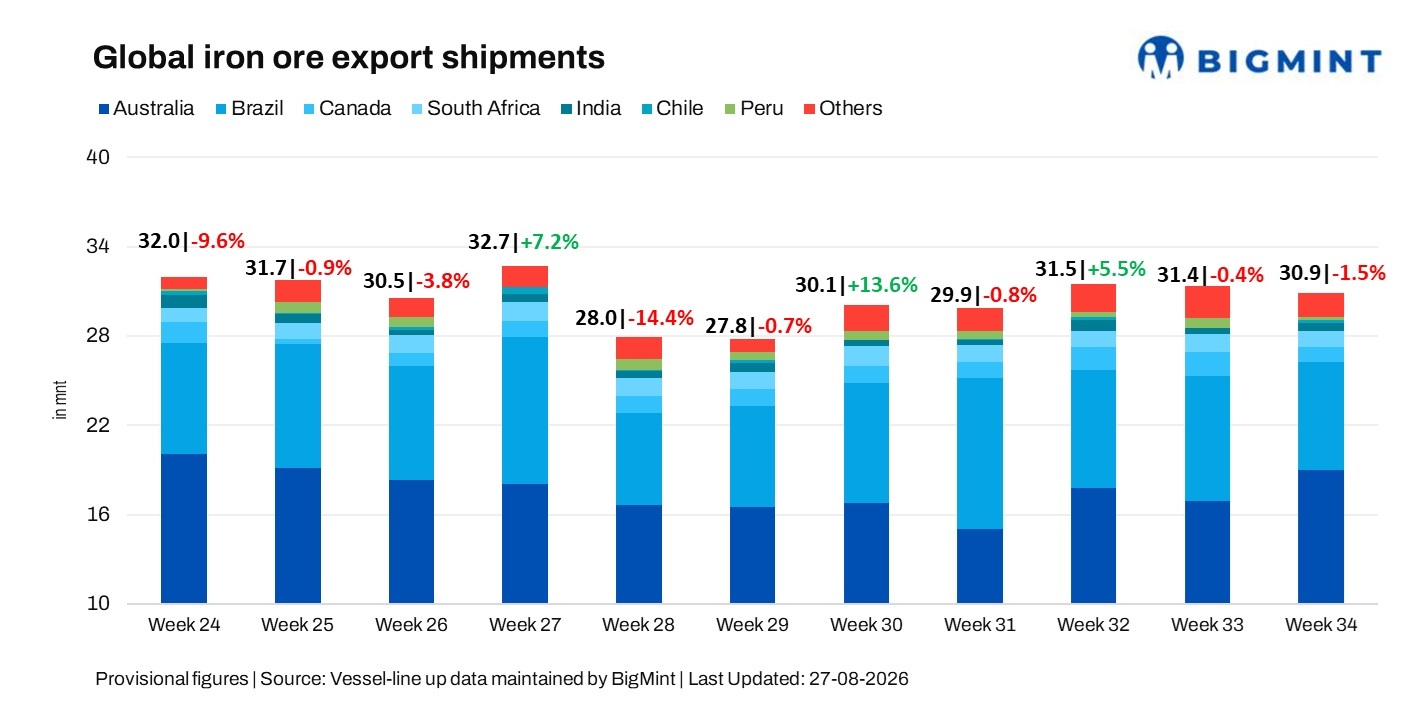
Global seaborne iron ore shipments edged lower w-o-w for the second straight week to 30.9 million tonnes (mnt) in the week ended 21 August, from 31.4 mnt a week earlier. Stronger shipments from Australia, Guinea and India helped cushion softer flows from Brazil, Peru and Canada, keeping global exports broadly stable.
Australia provided the biggest lift, with shipments rebounding following the earlier Port Hedland labour disruption. Guinea also gained on the continued Simandou ramp-up, while Indian shipments recovered from the previous week’s subdued levels. In the Atlantic, Brazil recorded softer weekly loadings, while Peru and Canada saw sharper declines.
Country-wise exports

Port & shipper-wise trends
- Australia: Hedland handled 11.1 mnt, followed by Walcott (4.3 mnt) and Dampier (3.1 mnt). Rio Tinto led shipments at 7.4 mnt, followed by BHP (6.3 mnt) and FMG (3.2 mnt). China remained the largest destination at 15.1 mnt, followed by South Korea (1.2 mnt) and Japan (1.0 mnt).
- Brazil: Ponta da Madeira handled 3.1 mnt, followed by Itaguai and Tubarao at 1.5 mnt each. Vale led shipments at 3.7 mnt, followed by CSN (2.9 mnt). China remained the largest destination at 2.5 mnt, followed by India (0.6 mnt).
- Canada: Sept-Iles handled 0.6 mnt, followed by Milne Inlet (0.4 mnt) and Port Cartier (0.1 mnt). Baffinland and IOC each accounted for 0.4 mnt, followed by Guinea & Nimba Mines at 0.2 mnt. The Netherlands and Egypt received 0.2 mnt each.
- Chile: Huasco handled 0.2 mnt, all destined for China.
- Guinea: Morebaya handled 0.8 mnt, with China receiving 0.4 mnt.
- India: Dhamra handled 0.2 mnt, followed by Paradip, Mangalore, Kandla and Kakinada at 0.1 mnt each. China and the UAE received 0.1 mnt each.
- Liberia: Buchanan handled 0.3 mnt, with Spain and France receiving 0.1 mnt each.
- Mauritania: Nouadhibou handled 0.2 mnt, remaining the country’s sole export terminal.
- Peru: San Nicolas handled 0.2 mnt, with China receiving 0.2 mnt. Shougang Hierro accounted for 0.2 mnt.
- Sierra Leone: Freetown handled 0.2 mnt, with China receiving 0.2 mnt.
- South Africa: Saldanha handled 1.1 mnt, with China and South Korea receiving 0.4 mnt each, followed by Japan at 0.3 mnt.
- Sweden: Narvik handled 0.2 mnt, with Germany receiving 0.2 mnt.
Capesize freight market sees regional divergence
The iron ore freight market remained regionally split during the week. Pacific Capesize rates firmed on steady miner activity and operator demand, while the Atlantic stayed softer amid ample tonnage and subdued fixing interest. The broader Capesize market regained momentum, with the BCI reaching 4,735 points on 25 August, its highest since 11 August. However, softer Chinese steel margins kept sentiment measured.
The regional freight split broadly mirrored trade flows, with Pacific activity finding support while the Atlantic remained under pressure.
Outlook
Global iron ore shipments are likely to remain broadly stable in the near term. Australia should continue to anchor seaborne supply, while Guinea’s Simandou ramp-up could provide additional volumes to global markets. Brazil will remain a key source of Atlantic supply, with export flows likely to vary with loading activity at major terminals.
Overall, the global export outlook remains steady, although shipment momentum is likely to remain uneven across origins amid varying port activity and vessel-loading schedules.
Leave a Reply