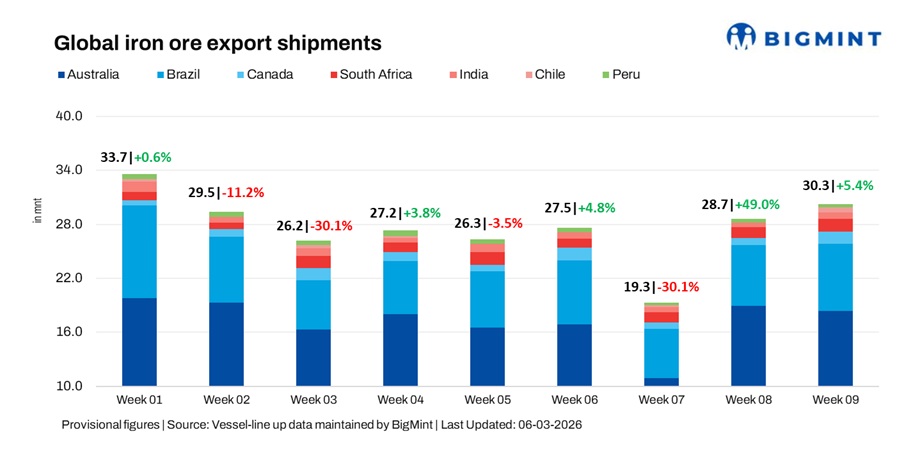
- Brazil, Canada, and India lead gains while Australian exports edge lower
- Freight rates firm across Pacific and Atlantic iron ore routes
Global iron ore export shipments increased 5.4% w-o-w to 30.3 million tonnes (mnt) in the week ended 27 February, compared with 28.7 mnt in the previous week, according to BigMint vessel-line up data. Higher export volumes from Brazil, Canada, and India supported the weekly rise, while shipments from Australia eased marginally after the prior week’s sharp rebound.
Country-wise trends

Port & shipper-wise trends
- Australia: Port Hedland handled 11.6 mnt, Dampier 3.4 mnt, and Cape Lambert (Walcott) 2.8 mnt. BHP exported 6.4 mnt, Rio Tinto 6.2 mnt, and Fortescue Metals 4.1 mnt, with China absorbing 15.1 mnt.
- Brazil: Ponta da Madeira shipped 3.2 mnt, Tubarao 1.8 mnt, and Itaguai 1.0 mnt. Vale exported 3.9 mnt, while CSN & Vale shipped 3.0 mnt. China imported 3.6 mnt.
- Canada: Sept-Iles handled 0.8 mnt, while Port Cartier shipped 0.6 mnt. Guinea & Nimba Mines and ArcelorMittal each exported 0.6 mnt.
- South Africa: Saldanha handled 1.5 mnt, with Romania and the Netherlands receiving 0.3 mnt each.
- India: Paradip and Dhamra each shipped 0.2 mnt, with China importing 0.2 mnt.
- Peru: San Nicolas shipped 0.4 mnt, with Shougang Hierro exporting the entire volume to China.
- Chile: Huasco, Totoralillo, and Caldera each shipped 0.2 mnt, with China importing 0.6 mnt.
Dry bulk iron ore freight improves w-o-w
Dry bulk iron ore freight rates rose w-o-w as improved cargo availability after the Lunar New Year supported fixing activity, while stronger export programmes, higher bunker prices, and geopolitical uncertainties lent cost support. The Pacific saw firmer rates on Chinese restocking and Australia-China enquiries, while the Atlantic remained stronger on steady Brazil-China flows and longer tonne-mile demand.
Outlook
Market participants expect iron ore shipments to remain largely steady in the near term as export programmes from Australia and Brazil continue. However, freight sentiment may stay sensitive to vessel availability, bunker price movements, and ongoing geopolitical developments impacting global shipping markets.
Leave a Reply