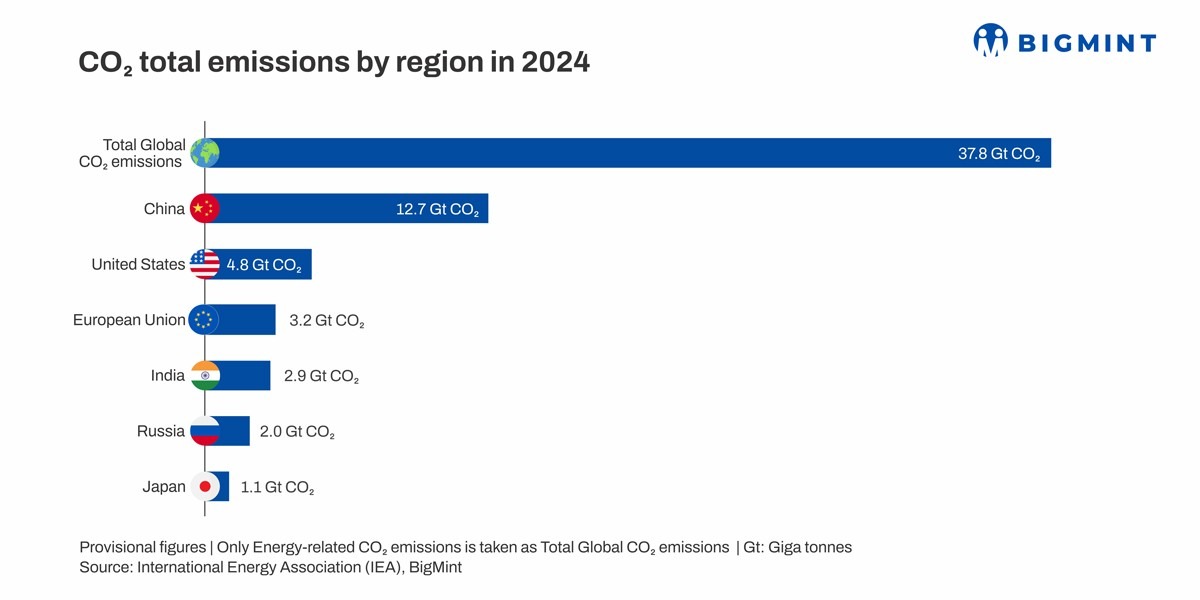
- CO2 emissions from energy rise to 37.8 gigatonnes (Gt)
- India’s emissions up 5.3% y-o-y – highest among major economies
- Worldwide emissions from coal use rise by 135 mnt CO2 in CY’24
Morning Brief: Emissions of carbon dioxide (CO2) globally from energy sources, which account for over three-quarters of anthropogenic emissions, increased to 37.8 gigatonnes (Gt) in 2024, as per latest data from the International Energy Agency (IEA).
C02 emissions increased by 0.8% y-o-y in 2024. Data show that barring the pandemic period emissions have recorded steady growth, although at a moderate pace compared with the global economic rebound witnessed after the lifting of worldwide COVID-related lockdowns and restrictions.
Atmospheric CO2 concentrations of 422.5 ppm (parts per million) in 2024 was around 3 ppm higher than 2023 and 50% higher than pre-industrial levels.
Country-wise CO2 emissions
The latest IEA energy outlook notes that in 2024 “CO2 emissions grew in the emerging market and developing economies and international aviation and marine bunkers, outweighing reductions from advanced economies led by the European Union, Japan and the United States”.

China: China’s energy-related CO2 emissions grew by an estimated 0.4% y-o-y in 2024. Energy demand surged throughout the year, but the expansion of clean energy – particularly in wind and solar PV – helped mitigate emissions growth. Hydropower generation also increased by 11% y-o-y. Industrial process emissions declined by over 5% due to a nearly 10% contraction in cement production caused by weak demand from a struggling real estate market.
India: India’s energy-related CO2 emissions rose by 5.3% in 2024, the highest rate among major economies, driven by rapid economic growth, infrastructure development and surging energy demand.
According to the IEA, “severe and prolonged heatwaves further boosted electricity consumption, which rose by 5%, straining power systems despite record-breaking additions of nearly 35 GW in solar PV and wind capacity. However, the growth in renewables could not keep pace with rising demand, leaving fossil fuels dominant in the electricity mix.”
Advanced economies: In the developed and advanced economies, emissions dropped by 1.1% y-o-y, or 120 million tonnes of CO2 equivalent, in 2024, continued deployment of low-emissions energy sources, with renewables and nuclear power accounting for over 50% of electricity generation, led by strong growth in wind and solar.
The United States’ energy-related CO2 emissions decreased by 0.5% (20 Mt CO2) in 2024, reflecting mixed trends across fuel sources. Emissions from coal dropped by 4.5% as the country registered the lowest coal power generation levels in nearly 60 years, while oil emissions fell by 0.3%, IEA data reveal.
The European Union’s energy-related CO2 emissions decreased by 2.2% (55 mnt CO2) in 2024. Emissions from coal dropped by 11%, while oil emissions declined by 0.3%. Power sector emissions fell by almost 10% y-o-y, driven by a record-low fossil fuel share of 28% in electricity generation.
Energy emissions outlook
Natural gas emissions rose by around 2.5% (180 mnt CO2) in 2024, as per IEA, making it the largest contributor to global carbon emissions growth. This increase was driven by higher consumption in China, the United States, the Middle East, and India.
Global coal emissions rose by 0.9% (135 mnt CO2) in 2024. The increase was primarily fuelled by growing coal consumption in China, India and Southeast Asia.
However, the pace of growth in global emissions shows a decoupling from world GDP growth of 3.2% in 2024, thereby restoring the decades-long trend of decoupling emissions growth from economic growth, which had been disrupted in 2021.
In 2025, while the advanced economies are likely to show a de-growth in emissions, the trajectory is likely to remain flat for China. However, India and the emerging market economies will witness sharper growth in emissions, with GHG-intensive economic activity outpacing the build out of renewable energy infrastructure.
Leave a Reply